

Infantile Spasms Explained: How to Recognize Seizures in Your Baby and What to Do
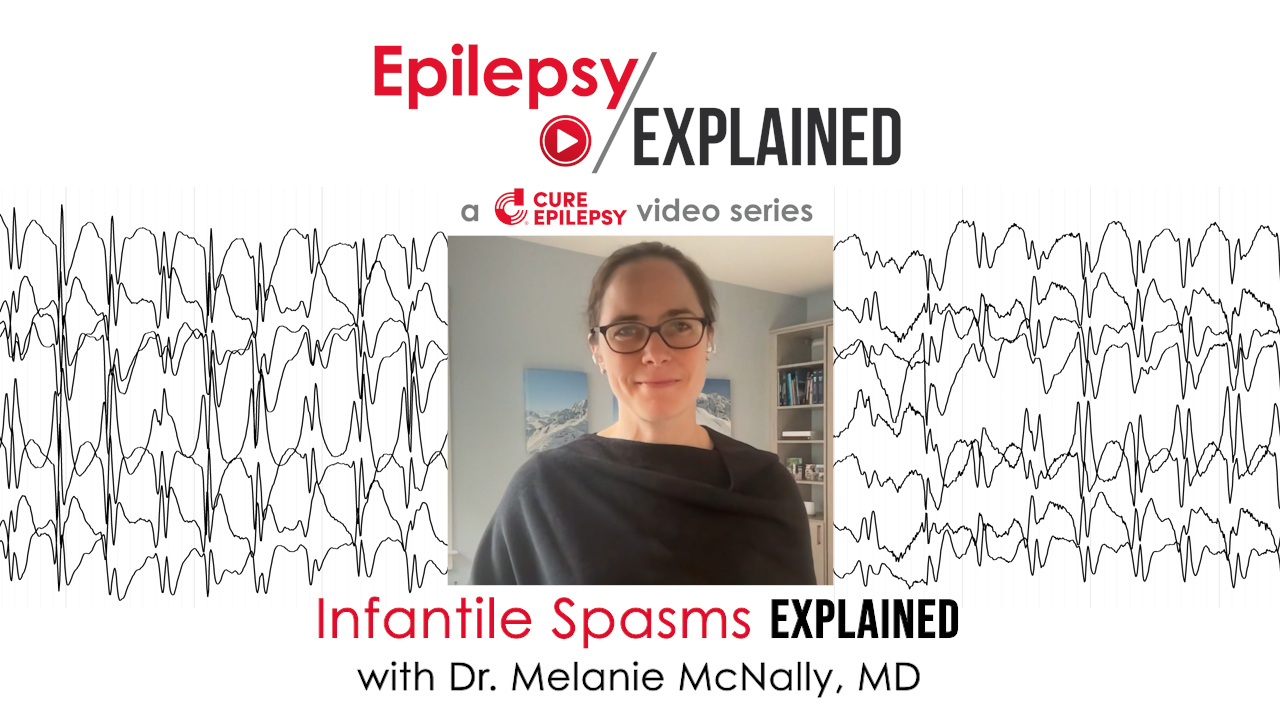
This month’s episode of Epilepsy Explained® focuses on infantile spasms with Dr. Melanie McNally providing important information about recognizing this medical emergency in your baby and taking action as soon as possible.
In “Infantile Spasms Explained,” Dr. McNally, a Neonatal Neurologist and Epileptologist at Massachusetts General Hospital Brigham, answers the following questions.
0:14 What are infantile spasms and what are the symptoms to look for?
2:22 What should I do if I’m concerned that my baby is experiencing infantile spasms?
3:21 How are infantile spasms diagnosed?
5:13 What are the treatments for infantile spasms and how effective are they?
7:33 What is the long-term prognosis for babies with infantile spasms?
9:18 What causes infantile spasms?
Look for new episodes of Epilepsy Explained on the third Wednesday of every month on CURE Epilepsy’s YouTube Channel and here on our website.
If you would like to submit questions for future episodes of Epilepsy Explained, please go to: https://www.cureepilepsy.org/epilepsy-explained/
ABOUT CURE EPILEPSY
CURE Epilepsy is the leading, non-governmental funder of epilepsy research. Since its inception in 1998, CURE Epilepsy has raised more than $100 million to fund epilepsy research and other initiatives that will lead the way to cures for the epilepsies. CURE Epilepsy funds grants for young and established investigators and to–date has awarded more than 300 cutting-edge projects in 18 countries around the world. Our mission is to fund breakthrough research that will transform the lives of people living with epilepsy as we lead the search for a cure.
LEARN MORE ABOUT EPILEPSY
Visit the “Understanding Epilepsy” section of CURE Epilepsy’s website:
https://www.cureepilepsy.org/for-patients/understanding/
STAY CONNECTED WITH CURE EPILEPSY
Sign up for our newsletter for the latest in epilepsy research news: https://www.cureepilepsy.org/subscribe/
Follow us on Facebook: https://www.facebook.com/CUREforEpilepsy/
Follow us on Twitter: https://twitter.com/cureepilepsy/
Follow us on Instagram: https://www.instagram.com/cureepilepsy/
INCREASE YOUR IMPACT
Share your story: https://www.cureepilepsy.org/personal-stories/
Help us find a cure: https://www.cureepilepsy.org/get-involved/donate/
Episode Transcript
What are infantile spasms and what are the symptoms to look for?
Dr. Melanie McNally:
It’s a really important question. So infantile spasms are small seizures in babies that can be associated with really big consequences. And unfortunately, they can be easily missed, and they’re often confused with normal baby behaviors. So I do want to talk about the key symptoms to look for in your child.
So the spasms occur most often between 3 to 8 months of life. And there are these rapid, quick movements that are only one to two seconds long. Often, your baby might have a quick crunch of the abdomen, their arms or their legs might go out quickly. Oftentimes, you’ll see this little, very subtle head drop or an eye opening with an eye roll, so they might look like surprise on their face. It can be very subtle and sometimes only one or two of these features are present. It’s important though that they’re not triggered. So they can sometimes look like what’s called a normal baby startle reflex, but that would occur after a loud noise or a loud clap, and that would occur in isolation. So an important differentiation between a spasm and a startle.
The other thing about spasms is that they often occur in clusters. So you might notice something and be like, “What is that?”
And then you’ll see it repeat every 5 to 10 seconds for about a 5 to 10 minute period, and it’ll look the same every time. These clusters will always happen in wakefulness. They can commonly happen right after a nap. And oftentimes, the infant will be really upset in between the spasms themselves. And sometimes, this can get confused with something called colic, but what differentiates them are these repetitive movements, and there’s actually no belly pain, which is characteristic of colic.
Now, the last symptom I want to talk about is that a lot of infants, not all, but a lot of them will stop developing normally around the time that the spasms appear. So your child may stop rolling or sitting. They may stop babbling or stop being as socially interactive, maybe making less eye contact, just maybe smiling less. So those are important things to look out for as well.
What should I do if I’m concerned that my baby is experiencing infantile spasms?
Dr. Melanie McNally:
Yeah, very important question. And I do want to emphasize that infantile spasms are a medical emergency. So there’s a couple things to do if you are concerned. One of the most helpful things to do is to take a video. So if you notice one of them, since they tend to occur in clusters, try to get your phone out and see if you can capture a few. The next thing you should do is call your pediatrician. If you cannot get in to see them that day or the next day, you should take your child to the emergency room. This is truly an emergency and shouldn’t wait a week or two to get assessed. So in the emergency room or in your pediatrician’s office, they’ll look at the videos and chat with you. And if the pediatricians are concerned, they’re going to emergently consult a pediatric neurologist or brain doctor to help with next steps.
How are infantile spasms diagnosed?
Dr. Melanie McNally:
So when you’re with the physician who is assessing you, the first thing they’re going to do is take a really careful medical history. They’re going to ask you questions about how your baby was born, if there were any complications with the pregnancy or after the birth. They’re also going to ask detailed questions about your child’s development, so do be prepared to answer those questions. They are going to then do a really careful physical and neurologic exam of your child.
The most important test to actually diagnose the spasms themselves is called a brainwave test or an electroencephalogram, which you might hear called an EEG. And that’s a test that puts a bunch of stickers on your baby’s head and measures the electrical activity of the brain. And that’s what’s used to confirm the diagnosis. Now, if we capture the spasm itself while the child is hooked up, we’re going to see a classic seizure pattern on the brainwave test. And critically, in between the seizures, there is also an abnormal brainwave pattern that’s called hypsarrhythmia, and that is diagnostic of infantile spasms. You might hear it described as a high voltage spike in wave pattern on the test. The other thing you might hear is a term called West Syndrome, and that does encompass infantile spasms as well as hypsarrhythmia on the EEG. It’s considered West Syndrome if your child also has developmental delays as well.
The last thing I did want to mention is that if the diagnosis is made, please know that your child is going to need quite a bit more testing to try to understand why they have infantile spasms. Most commonly, they’re going to need a brain scan called an MRI, and they’re probably going to need quite a bit of blood and urine tests as well to try to identify the cause, which we’ll talk about later.
What are the treatments for infantile spasms and how effective are they?
Dr. Melanie McNally:
So we do have quite a few treatments for infantile spasms, but the mainstay, first-line therapy are steroids. And so, depending on which hospital you go to, some hospitals will use a steroid called prednisolone, which is an oral liquid your child will take multiple times a day. And some hospitals use an injection, a shot called ACTH. They both work, and they’re both important as the first and standard treatment for infantile spasms.
Now, unfortunately, only about 40 to 50% of patients do respond to this treatment. So in cases where your child doesn’t respond to the steroid treatment, we go to our second line treatment, and that’s a medication called Vigabatrin. And that’s a medicine that is a powder that gets mixed into solution and given to your child twice a day. If your child does need this second treatment for infantile spasms, the chance of success unfortunately does go down a little bit, and there’s about a 30 to 40% chance that the seizures will be treated.
Now, the one exception to this first and second line order is if your child is diagnosed with a disease called tuberous sclerosis, and that is something the doctors will know about from the brain scan. If that’s the case, your child will get Vigabatrin first, because in that specific disease, it is 60% effective at controlling seizures. The other thing I do want to mention is that there are actively studies being done to see if combining both the steroids and the Vigabatrin could be more effective than giving them sequentially. So you might hear about this in the future, but we still need more data.
Now, if your child doesn’t respond to either of these treatments, your medical team will work closely with a pediatric epilepsy specialist. There are quite a few additional treatments that we can try. There are many different anti-seizure medications. Some patients are candidates for epilepsy surgery, and sometimes we also consider dietary therapies, but those are all after the first two treatments are tried.
What is the long-term prognosis for babies diagnosed with infantile spasms?
Dr. Melanie McNally:
Unfortunately, most of the kids who have infantile spasms do go on to have moderate to severe intellectual disabilities or learning problems later in life, about 70 to 75% of them. And some of these kids do also develop autism. Now, I do want to emphasize that there are 20 to 30% of kids that have normal developmental outcomes and seizure freedom, or only some mild issues. And so, we know that those kids tend to get treated faster and they respond faster, and that’s why it’s so important to get these kids treated as quickly as possible. I also want to mention that if the doctors look for a cause and don’t find one, that’s actually a good thing. Whereas these kids without a cause, 40 to 60% of them can have normal outcomes.
So the next thing I do want to mention in addition to the development, is that about 50 to 60% of kids with infantile spasms do go on to develop different seizures and epilepsy later in life. And if that does occur, it’s often medically very difficult to treat.
So in summary, unfortunately, the majority of kids with infantile spasms do go on to have developmental challenges and epilepsy. However, a significant minority, so up to a third of kids, can do very well and have normal outcomes and seizure freedom. And it’s just so, so important to have the spasms recognized so that you can get fast and effective treatment.
What causes infantile spasms?
Dr. Melanie McNally:
Another good question. So in about two-thirds of babies with infantile spasms or two out of three babies, your medical team is going to be able to identify a cause. And there’s a lot of different types of causes. Most commonly in about 40 to 60% of kids, there’s an actual structural change in the brain that your team will be able to see on the brain MRI scan. Now, this could be from a prior injury, whether your child had an infection in the brain at some point, or there might have been lack of oxygen to the brain, perhaps around the time of birth. The other thing is it can be due to a change or an abnormality in how the brain grew and developed originally. And some terms you might hear are cortical malformations or cortical dysplasias. So again, structural change in the brain is seen in about 40 to 60% of kids. Now, a genetic condition is also possible. There’s many, many different genes that have been associated with infantile spasms, and that’s responsible for about 15 to 30% of cases.
Now, less commonly, we can also see metabolic diseases that affect the way that cells utilize fuel and energy, and these can lead to changes in brain function and also cause spasms in about 2 to 6% of cases. Now, importantly, in about 30 to 40% of kids, the medical team will not be able to find a cause. We don’t see any apparent injury and all the other testing is normal. And if your child, ultimately, they can’t find an etiology, you might hear your medical team call it cryptogenic or idiopathic spasms. And again, this is 30 to 40% of kids. And while I know it’s frustrating to not have a reason, please remember that the kids with idiopathic or cryptogenic spasms do actually have better long-term outcomes.
The last thing I want to mention is that we currently don’t have any evidence that the baby’s sex or factors like immunizations or other medications are related to infantile spasms.