


Key Takeaways
- Common data elements (CDEs) are standardized ways of describing and collecting data, ensuring that every laboratory uses terms and definitions that will allow for more effective collaboration and interpretation of data.
- CURE Epilepsy has been a leader in the creation, review, and dissemination of CDEs for epilepsy, most recently for preclinical Sudden Unexpected Death in Epilepsy (SUDEP) research.
- Without continued CDE use, the actual clinical improvements promised by exciting advancements in artificial intelligence (AI) and big data will be limited.
Keeping the Beat of Research Going
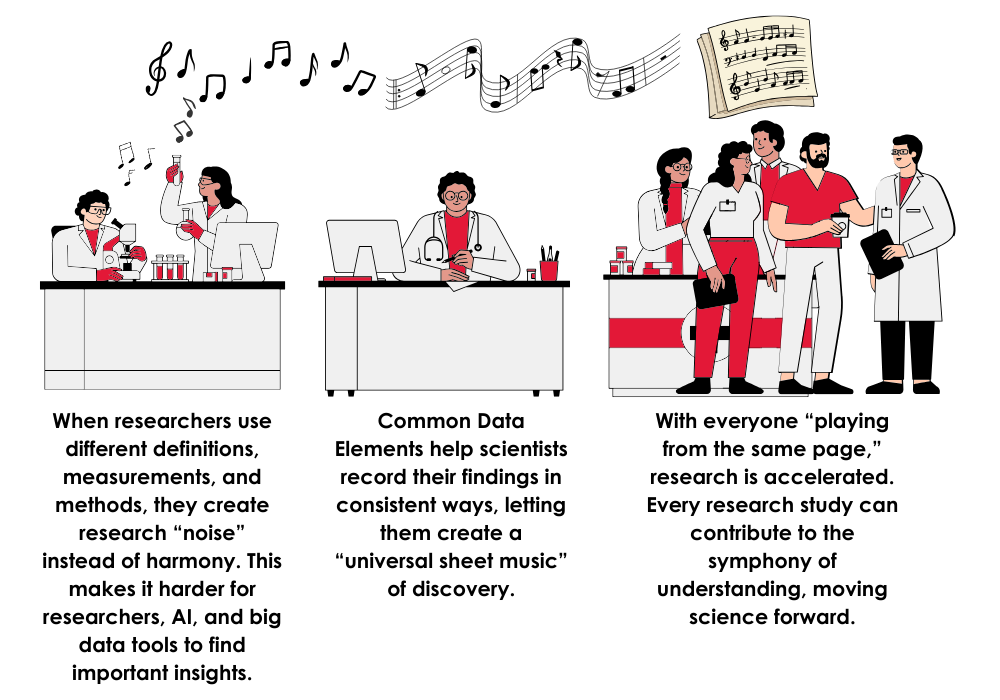
Imagine musicians across the world trying to perform the same song, but each with slightly different sheet music. The result would be noise, not music.
This is what epilepsy research can look like without Common Data Elements (CDEs): brilliant scientists working tirelessly, but creating noise by using slightly different definitions, methods, and measurements in their research studies. Even when studies address the same question, the results may not be reliably compared or combined.
CDEs provide universal “sheet music” for epilepsy research. They provide a standardized way of describing and collecting data, ensuring that researchers are “playing from the same page.” These behind-the-scenes elements have a direct impact on people living with epilepsy; harmonized research accelerates scientific discoveries, increases trust in findings, and ensures that each piece of data contributes to a bigger, meaningful picture.
What Are Common Data Elements?
CDEs are standard definitions, questions, measurements, vocabularies, and formats that researchers agree to use when collecting data. For instance:
- How exactly is a seizure defined?
- What information should be recorded about an animal model?
- How should heart rate or breathing changes be described?
In epilepsy, the first disease-specific CDEs were released around 2010, covering content areas such as anti-seizure drugs, comorbidities, electrophysiology, imaging, seizures and syndromes, and quality of life (PMC12514369). CURE Epilepsy has sponsored subsequent efforts spearheaded by the International League Against Epilepsy (ILAE) and American Epilepsy Society (AES) across preclinical epilepsy research, as well as created Post-Traumatic Epilepsy (PTE)-specific CDEs and case report forms as part of our PTE Initiative.
Why CDEs Matter to Families
While preclinical CDE development and use happen far from the doctor’s office, the effect reaches directly to patients and families through faster progress towards clinical trials, increased confidence in diagnostic and treatment findings, and greater certainty about risk factors associated with epilepsy.
In combination with clinical CDEs, which standardize the way doctors collect patient data, like medication changes or quality of life reports, preclinical CDEs support the ability to ask the fundamental research questions that will eventually go on to inform better care.
Words can't describe our utter devastation over the sudden loss of our beautiful 4-year-old boy, Henry, to SUDEP. Being part of efforts to advance research and understanding into this poorly understood phenomenon has given me hope that one day other people living with epilepsy might not have to live in fear of dying unexpectedly from a seizure or suffering the same fate. CURE Epilepsy's effort around data standardization is essential, especially for understanding less-common occurrences, because it ultimately improves how data can be shared and accelerates efforts towards the development of more effective prevention strategies.
Parent of a Child Lost to SUDEP

Deep Dive: Preclinical CDEs for SUDEP
Along with stakeholders at the 2020 SUDEP Coalition Summit, CURE Epilepsy recognized that the lack of harmonization of research data slowed our ability to compare the results of basic or preclinical SUDEP research studies. With support from the BAND Foundation, CURE Epilepsy initiated the SUDEP Data Standardization Project in 2022 by convening a steering committee and working groups of multidisciplinary epilepsy research experts who understood both preclinical and clinical research. The goal: create a unified set of scientific terms focused on preclinical SUDEP research that any lab could adopt.
To ensure transparency and inclusiveness, draft CDEs were released for public comment, allowing researchers, lab staff, and patient advocates to provide input. Feedback from the community shaped the final set of over 100 CDEs, ensuring they were practical, relevant, and widely adoptable.
Published in a set of papers last year, the final preclinical SUDEP CDEs cover:
- Core elements like physiological recordings of heart rate and breathing
- Supplemental elements like neuroimaging reporting
- Experimental metadata like environmental conditions
By harmonizing data collection, CURE Epilepsy has now enabled labs to compare findings reliably, combine datasets for larger analyses, and replicate studies across institutions.
Our experience leading CDE development efforts in SUDEP and PTE gives us hands-on expertise in the creation and distribution of this type of scientific language. This experience can also translate to emerging fields like focused ultrasound for epilepsy as researchers strive to define key methods and tools before embarking on a roadmap towards translation
CURE Epilepsy, Chief Scientific Officer

Looking Ahead: Toward a Harmonized Future
CURE Epilepsy encourages researchers to adopt the use of CDEs in their work and envisions an epilepsy research landscape where every preclinical and clinical study uses shared CDEs. With everyone “playing from the same sheet music,” the field can move faster, more reliably, and more collaboratively. AI and machine learning are revolutionizing medical research, but the field must have common terms and language for big data systems to be able to translate insights to the clinic. Together, we can turn fragmented studies into a symphony of knowledge — leading to better treatments, deeper understanding, and ultimately, cures.
More CURE Epilepsy Discoveries