


Episode #156 - Epilepsy for Dummies: Your New Handbook for Better Understanding Epilepsy featuring Lauren Aguirre and Dr. Elizabeth Thiele
Epilepsy for Dummies: Your New Handbook for Better Understanding Epilepsy
Episode Overview
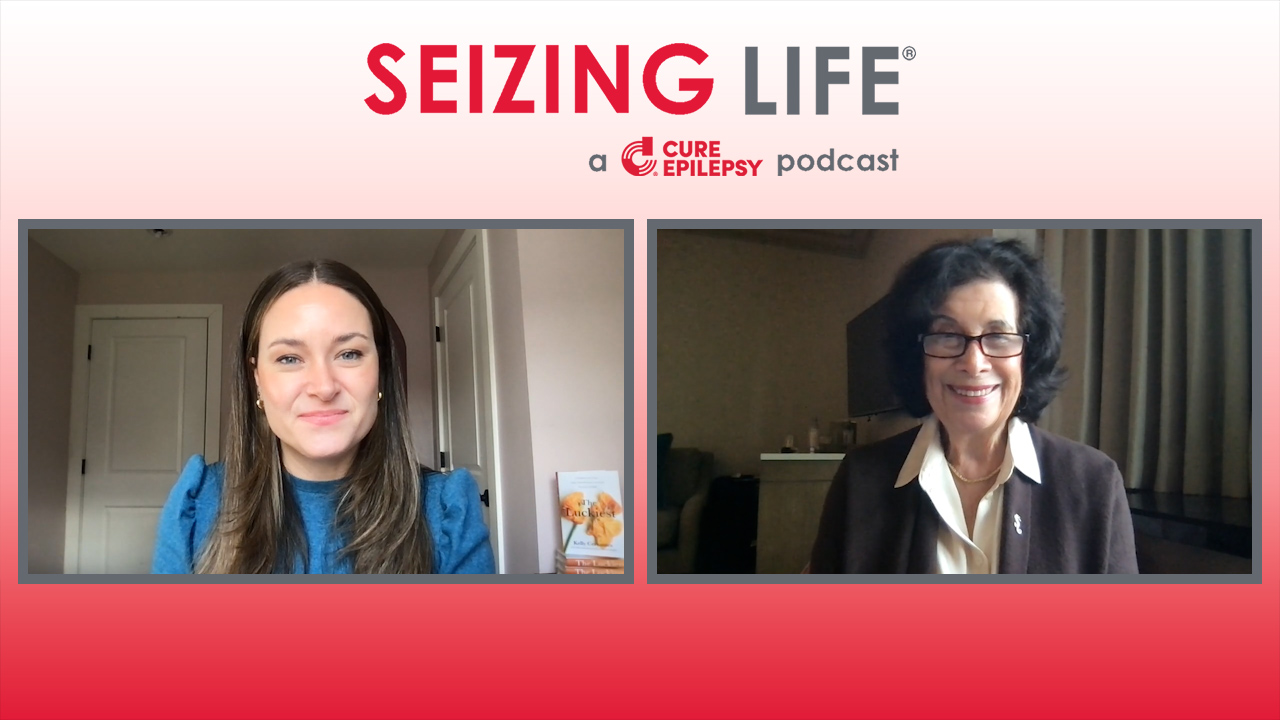
This month on Seizing Life® we talk with Lauren Aguirre and Dr. Elizabeth Thiele, the authors of the recently published “Epilepsy for Dummies.” This new entry in the popular “For Dummies” book series is sure to be a go-to resource for both the newly diagnosed and those who have been on their epilepsy journey for years.
Lauren Aguirre, a science journalist and author who lives with epilepsy and has 3 children also living with epilepsy, and Dr. Elizabeth Thiele, a pediatric epileptologist at Massachusetts General Hospital, explain why “Epilepsy for Dummies” is long overdue and especially vital in this time of Google dives and artificial intelligence. Lauren and Dr. Thiele discuss their collaboration, outline how they collected and organized the information in the book, and explain why their perspectives as epilepsy patient/parent and provider were essential in creating a reliable resource for epilepsy information. The book provides a thorough and well-structured exploration of epilepsy with sections focusing on explaining, diagnosing, treating, learning, and living with epilepsy. In the words of Seizing Life® host Kelly Cervantes, “I don’t know how many times I’ve spoken to other patients or caregivers and been like, ‘If only there was a guidebook…. And now, there is.’” Whatever your relationship to epilepsy, we think you’ll find this book to be a constant and invaluable resource in educating yourself, collaborating on treatment decisions with a provider, advocating for yourself or a loved one, and navigating your epilepsy journey.
Episode Transcript
Kelly Cervantes:
Hi, I’m Kelly Cervantes, and this is Seizing Life, a monthly podcast produced by CURE Epilepsy. Today, I’m happy to welcome two guests to the podcast. Dr. Elizabeth Thiele, who is a Pediatric Epileptologist and the Director of Pediatric Epilepsy at Massachusetts General Hospital, and Lauren Aguirre, a science journalist and author, who lives with epilepsy and has three children, who have also been diagnosed with epilepsy. Dr. Thiele and Lauren have collaborated on a great new book in the popular For Dummies series. As you may have guessed, the book is Epilepsy for Dummies, and the authors are here to tell us about it. Dr. Thiele, Lauren, thank you so much for joining us today. To start things off, why don’t you each give us a little bit of information about your background as it relates to your book?
Dr. Elizabeth Thiele:
Lauren, go ahead.
Lauren Aguirre:
Okay. My background is both personal and professional in terms of how it relates to the book. Personally, I have epilepsy, as do three of my four children, and we were all diagnosed at different ages with slightly different presentations. And then, professionally, I’m a science journalist. I worked for the Nova PBS Science Series for many, many years. But as various people in our family were being diagnosed, I became more and more interested in neuroscience and medicine. I left to write a book about memory, that had to do with a cluster of people who lost their memories following overdosing on fentanyl. And then, I wrote a novel about a young woman with epilepsy set in the early 1900s, which I now have to revise. And then, I worked with Dr. Thiele on Epilepsy for Dummies.
Kelly Cervantes:
I love it. Thank you. And Dr. Thiele, why don’t you give us a little bit of your background?
Dr. Elizabeth Thiele:
Sure. I’m a pediatric epileptologist, and I’ve been taking care of mainly kids, but also adolescents and adults with epilepsy for close to 30 years. My kind of approach to treating epilepsy is always, you have to take care of the person, not just treat the seizures, and I think that’s one of the things that got me so interested in working on this book with Lauren. Because when she asked me about doing this, for me, it was like a dream, because my whole career I thought something like this has been needed. I think I used to walk through bookstores looking at all the books for different medical disorders, autism, ADHD, diabetes, and there was always a paucity of books about epilepsy, so for me, to work on this book and able to have this book come out is a life/career dream.
Kelly Cervantes:
I love that so much. I have to admit that when I heard that the book was coming out, I was a little surprised that it didn’t already exist, because I know that these sorts of books do exist for so many other conditions. I’m thrilled that you put it together. I don’t know how many times I’ve spoken to other patients or caregivers and been like, “If only there was a guidebook. Ha ha ha.” And now, there is. I do wonder though, in the age of the internet and AI, how you feel like this book fits into the changing landscape of how people are receiving information?
Dr. Elizabeth Thiele:
Yeah, thinking about this, I think this book is needed now more than ever, because on the internet and with AI, I think it’s so easy to get misinformation or incomplete information. I think the epilepsy journey is really frightening for people with epilepsy, their family members, their caregivers. And so, I think having a book that addresses things with factual data and real data and the whole picture of epilepsy, not just the seizures, but the treatments, the causes, the impact on learning, et cetera, I think it will be a really useful resource for many people and a trusted resource hopefully. Lots of times, if you go to the internet and type in anything, the sky can fall and the sky does sometimes fall in the journey of epilepsy, but not always. I think knowledge is power, and I think helping people understand the different aspects of epilepsy can hopefully ease that journey for many people.
Lauren Aguirre:
Yeah. If I could add to that, I would say that when you’re first diagnosed or someone you care for is diagnosed, you don’t know what you don’t know. You might go digging for what caused my child’s epilepsy, but you’re not thinking about, “Oh, maybe I should consider education or how do I tell other people in my neighborhood,” or all the different aspects of epilepsy and how they can affect you. I think, again, having this guidebook that this is the world of information that you need to grapple with, it’s going to be really helpful.
Kelly Cervantes:
That is what immediately struck me as I’m just scanning through the table of contents. If I am someone who is first entering the world of epilepsy, I’m not thinking about all of these different ways that it’s going to affect my life or affect my child’s life and all of the different things that I need to be on the lookout for or that I should be aware of. It completely takes you present SUDEP and in the first half of the book. All of these are, like you said, you don’t know what you don’t know, but here is a guide that will act as your reference throughout that journey, so that you can take all of that information in. I wonder how, because you do, you go through the diagnosis and treatment and education and all of the different aspects, how did you choose what to include in the book?
Lauren Aguirre:
I think it was sort of obvious to us, right, Elizabeth?
Dr. Elizabeth Thiele:
Yeah.
Lauren Aguirre:
We just sat down a couple of times and it just, “This is what it needs to be about.”
Dr. Elizabeth Thiele:
But it really helped that we had different perspectives. As a healthcare provider and then a person living with epilepsy and a caregiver to children with epilepsy, I think it helped us get the whole picture of what people need to know from the two different perspectives, which I think really was important.
Kelly Cervantes:
I think that that is absolutely remarkable and incredible and really gives it a well-rounded point of view. Who else did you rely on for information?
Dr. Elizabeth Thiele:
Information and support. Luckily, I have an incredible team of people that work with me that I’ve worked with for a long time, including our nurses, our social worker, our neuropsychologists, our neurosurgeon. We talked frequently with the various experts, educational psychologists. We talked frequently to get people’s perspective, people’s experiences, and then, taking care of and do take care of a lot of patients and families. And so, I think that we talked with many people as we were working on this project, especially when it was tough and we were working hard and I wasn’t sure I could even do this. People also not only supported us with content and what we should include, but also supported us that they thought that this was an important thing to do and worth doing.
Kelly Cervantes:
Yeah. Lauren, I wonder, how did you guys split up the writing of it? I’m always fascinated when people co-author books and what that process looks like.
Lauren Aguirre:
Well, that was also pretty obvious, because obviously, Elizabeth should be writing about how you diagnose and the treatments. As a caregiver and a person with epilepsy, it made more sense for me to write about things like stigma or how epilepsy can affect learning or how to keep safe with epilepsy and the importance of support. It really divided up pretty naturally. But of course, we went back and forth with each other’s drafts quite a bit as well, yeah.
Kelly Cervantes:
Yeah. Who do you envision? Obviously, patients and caregivers, but who else do you see as being an audience for this book?
Dr. Elizabeth Thiele:
I think everyone could be. Everyone should be. If you think 10% of people will have a single seizure during their life, and epilepsy is common, so most of us are going to encounter people with epilepsy in one aspect, one relationship or another. I think teachers, coaches, everyone, I think there’s a … epilepsy is really frightening, and there’s a stigma associated with it, and it’s very complicated and it’s many different things, and so, I think having this information in a readable digestible way is going to be helpful to a lot of people, hopefully.
Kelly Cervantes:
Was there any section in particular that either of you found particularly challenging to write?
Lauren Aguirre:
I found the learning section challenging to write just because it doesn’t draw on my expertise as a science journalist, it’s more of a softer science, and I’ve really benefited a lot from the help of people on Dr. Thiele’s team, a neuropsychologist, an education specialist, and other people in the field to really wrap my brain around it. I think that was the section that I had to do the most research on.
Kelly Cervantes:
You’re talking about how epilepsy or seizures can affect a student’s ability to learn.
Lauren Aguirre:
Yes.
Kelly Cervantes:
And then, how to support them.
Lauren Aguirre:
Yeah, Absolutely.
Kelly Cervantes:
Dr. Thiele, was there a section that was harder for you than another?
Dr. Elizabeth Thiele:
Yeah. For me, it was actually the causes, which was interesting, going through seizure types, treatments, et cetera, but the causes of epilepsy, because epilepsy is not just one thing, it’s thousands of things. And so, not only covering them, making sure that we were accurate about them, but presenting them in a way that were understandable, that was a challenge. For instance, genetics is playing more and more role in epilepsy, and this was a thing Lauren and I were joking about. When we started writing this, I think there were 843 genes that had been associated with epilepsy. Now, it’s a thousand, and that’s in a matter of months. I think it was kind of trying to keep updating this and making sure that it was comprehensive and complete and understandable.
Kelly Cervantes:
Yeah. It’s a little bit bananas actually, when you think about how quickly some of this is progressing and moving forward. On the flip side of that question, was there a chapter that was either of your favorite?
Lauren Aguirre:
I’m going to say chapter 22, Ten People who Made a Difference, just because I think the personal stories are so interesting and they were inspiring to me as well. And to think about all the different types of people from different walks of life or different backgrounds who can make such a huge difference from the social worker who started a hotline decades ago, to the Kenyan activist whose little sister was diagnosed with epilepsy and whose family was sort of cast out of the village, to an amazing epileptologist in France, who decided to study pediatric epilepsy because people thought babies didn’t have seizures, and he thought that was crazy. Just so many wonderful people, who were willing to share their stories, and in some case, patients or patient’s caregivers who shared stories that were heartbreaking in some cases, but also really heartwarming in terms of how they overcame really difficult situations and made meaningful lives, so that was really inspiring.
Kelly Cervantes:
Yeah. I think that you both did a wonderful job of presenting this variety of stories. As we talked about earlier, there’s so many different kinds of epilepsy or the different ways that epilepsy might affect someone’s life, and really just showing that variety in how it does affect people’s lives. It was so beautiful and lovely to read about these different people’s stories, so many of which I hadn’t heard of them before, and so I loved being introduced to them and I appreciate that.
Tasia:
Hi, this is Tasia from CURE Epilepsy. Since 1998, CURE Epilepsy has raised over $100 million and funded more than 300 epilepsy research grants in 19 countries. Learn what you can do to support epilepsy research by going to cureepilepsy.org. Now, back to Seizing Life.
Kelly Cervantes:
What misconceptions about epilepsy do you hope that the book eases, I suppose is the right word?
Lauren Aguirre:
Well, the obvious one is that all seizures look like someone convulsing on the ground. Another is that you can’t have a normal life if you have epilepsy, that you can’t be smart, you can’t be musical, you can’t be this or that, and that you should be quiet about it and not talk about it because the opposite is true. And really, the more you talk about it and take agency, the better for yourself and for everyone really.
Kelly Cervantes:
Yeah. Is there anything, Dr. Thiele, that you have come up against scientifically that you or within the medical community where you see misinformation or misconceptions that you hope are relieved with this book?
Dr. Elizabeth Thiele:
I think there’s a lot of misconceptions about epilepsy and a lot of stigma about epilepsy. A lot of my patients are still bullied in the school setting. Kids will imitate their seizures in front of them, and I think that that is really not only unkind and unfair, but I think it shows, again, a lack of awareness and education about what seizures are and what seizures aren’t. I think that it’s important to realize how common seizures are and that there is a spectrum. Just like many things in life, many people with epilepsy have well-controlled seizures or living their lives doing like Lauren for her kids. And then, there are other people with epilepsy, who have significant impact of the epilepsy and the cause of the epilepsy and their overall life. And so, I think that just understanding the spectrum of epilepsy is really important, and I think both for the medical community and the general population, learning about what it is and what it isn’t is really important.
Kelly Cervantes:
Absolutely. I wonder, if someone is listening or they’ve just been diagnosed and they pick up this book, where do they begin? Do they just start at the beginning and read all the way through? How do you envision the book being used as a tool for someone who’s newly diagnosed?
Lauren Aguirre:
Well, chapter one, it’s kind of an obvious answer, but it gives you the lay of the land, because of course, everyone’s different. It’s going to have different questions, but that will at least show you the world that you should consider. And then, I think practically speaking, chapter 17 about seizure first aid I think is really important. These books are designed, you don’t have to read it from start to finish. Not everything is going to be relevant to every person, and that’s the beauty of the Dummies books and the way they’re structured.
Kelly Cervantes:
Is there something, Dr. Thiele, that advice that you wish that people with epilepsy and their families would take to heart early in the diagnosis process when you’re speaking to them?
Dr. Elizabeth Thiele:
Yeah. I think just the concept of hope and having hope. I think getting the diagnosis of epilepsy is terrifying, and I think that oftentimes, people think of what they see in movies and on TV, et cetera, about what seizures are. And so, I think just learning the spectrum, learning the causes, learning the types of seizures, again, saying that knowledge is really power. And I think also, the other phrase I really like is understanding brings hope, and so, I think just recognizing that. The other part I really like about the book, if I was just being diagnosed or my child is just being diagnosed, is what to do, what information, what about the first visit with the neurologist? Because I think that’s also very empowering. Again, it’s a scary time to get that diagnosis and to have as much confidence and knowledge and understanding about it I think can be very, very impactful.
Kelly Cervantes:
Yeah. I like how you mentioned that knowledge is power and because at some point, or maybe it has always been this way, I’m not sure, but we’ve really just looked to doctors to be the full source of information. But going back to you don’t know what you don’t know, you have to have a base level of knowledge walking into these appointments, so that you can be asking the right questions. But in order to ask the right questions, you have to know what questions to ask. And so, I did really love that section of the as well, where this is how you prepare for these appointments, because it is not just walk-in and expect it all to be taken care of for you. I wonder, someone gets a diagnosis of epilepsy and it is more than taking a pill or starting a diet or doing the tests and the treatments. There are also lifestyle adjustments that can be made, that can greatly improve outcomes. Which of those lifestyle adjustments have you found make the biggest impact?
Lauren Aguirre:
I guess, I would say it’s going to depend on the person or the caregiver. If I would say one thing, I would say take care of yourself, take care of your health in all the different ways that you can do that, whether it’s your mental health or your physical health, and making sure you get enough sleep and trying to avoid stress and being organized enough to take your medication, which is going to be true of any chronic disease, like taking care of your health is going to make the outcome better.
Kelly Cervantes:
Yeah. Dr. Thiele, is there anything that you would add?
Dr. Elizabeth Thiele:
No, I agree with Lauren. I think, overall, taking care of yourself is very important, and especially the mental health aspect as well in addition to physical health.
Kelly Cervantes:
Yeah. I think that piece is so often overlooked how connected and comorbid depression and anxiety are with epilepsy, which when you think about it, it makes perfect sense. It’s more than just taking care of that physical health, the sleep, the stress levels. It really is about checking in emotionally and mentally and making sure that whole body, you’re considering your whole body. What role do you think that patient advocacy and self-education should play in epilepsy management? We sort of touched on this a little bit before, but I wonder if you could kind of expand on that. Lauren, if you want to start.
Lauren Aguirre:
Well, in terms of advocacy, I would also say bigger picture, it’s really important that people advocate for support for people with epilepsy and for awareness, that made such a huge difference in cancer, where people used to be embarrassed and think you couldn’t talk about it and that nothing could be further from the truth now. It would be great to see that with epilepsy. But in terms of an individual person just advocating for yourself just by taking that step, you’re taking control, and that’s how you need to approach your whole life with epilepsy, whether it’s for you or your child. You have to take control of the things that you can take control of.
Kelly Cervantes:
Dr. Thiele, is there anything that you would add on?
Dr. Elizabeth Thiele:
No, I agree with what Lauren said. And I also think, with regard to advocacy, I think that various advocacy groups are incredibly important, especially with all these different genetic etiologies of epilepsy being identified, and they’re more and more patient advocacy groups all the time with these rare epilepsies. And I think that those serve an incredibly important role in the journey for many people. I think it can be life-transforming to meet other people who know what your journey’s like or share aspects of it, so I think advocacy is really important.
Kelly Cervantes:
I will add on to that. We are social creatures, so finding that community is so important, which is something that you talk about in the book as well. Having that community, realizing that you’re not alone in this, all of that, and that impacts the mental health piece, which ideally helps improve seizure outcomes. It’s all really intertwined. Is there anything that you learned while writing the book that surprised you?
Lauren Aguirre:
I learned how much I didn’t know. I knew I didn’t know a lot, but I didn’t know how big the universe of epilepsy was really, and all the different causes, and all the different types. I learned so much, and I’m really grateful, because it also helps me understand some things with my kids that I didn’t understand before.
Kelly Cervantes:
Oh, that’s interesting. Dr. Thiele, was there anything that surprised you?
Dr. Elizabeth Thiele:
Yeah. I learned why there had never been an Epilepsy for Dummies book before. They had sent us a couple of examples of Epilepsy For Dummies books. And then, when we started working on this, it’s like, “I get it now. I know why this has never been done, because it was a big task.” Epilepsy is not just one thing, it’s many things. There’s many causes, many types of seizures, many treatments, many impacts on learning behavior, et cetera. It’s a lot. And I guess, even though I’ve been doing this for decades, to take a step back and say, “Wow! This is what people living with epilepsy, this is what it’s like,” was meaningful and sobering.
Kelly Cervantes:
Yeah. Epilepsy is such an expansive diagnosis. Because you have all of these seizure disorders and epilepsy is the umbrella, but it feels so … once you get into the weeds of epilepsy, that word just feels so broad in reality. Dr. Thiele, I wonder, what has been your colleagues’ response to the book?
Dr. Elizabeth Thiele:
Very positive, because I think, again, there is so much to try and help someone with epilepsy know and understand to help them on their journey. With medical care, we don’t have a whole lot of time. We don’t have time to sit here and go through everything in this book when you’re diagnosing a person with epilepsy. We have a half an hour usually for a follow-up patients to talk about seizures, to talk about this. If we have time to talk about how is school, how is life, et cetera, that’s great. But there’s not time to talk about, “Gee, these are the treatments.” Well, can talk about the treatments, but not the level that people need to really understand, again, that knowledge is power. And also, talk about the things on the horizon with treatments to give, again, hope. I think that my colleagues, I think have been pretty excited about this, because I think that I’m not the only person. Lauren wasn’t the only person who thought there has been a need for this kind of information for people for quite a long time.
Kelly Cervantes:
Lauren, I wonder how your kids responded to it, several of them having epilepsy themselves, if they’ve taken a look through it, how they responded to you?
Lauren Aguirre:
Well, one of them gave it to his girlfriend, which I thought was great.
Kelly Cervantes:
Wow. I love that. We didn’t talk about that earlier, but it’s not just patients and caregivers, it’s anyone who loves someone with epilepsy just to sort of give them a greater understanding. Absolutely, it should be given to significant others. I feel like that is a very, very high mark, Mom. Well done. Can you tell us about some of the emerging therapies and technologies that you learned about while you were writing the book?
Dr. Elizabeth Thiele:
Well, I think that there continues to be more anti-seizure medications that are being developed, and in the past several years, the trend has gone from rather than treating seizure types like focal seizures or generalized epilepsy to treating these specific etiologies. I think that’s a change that’s been very exciting, particularly for the rare epilepsy network that now we’re looking at specific treatments for specific disorders. I think the other thing that there’s a lot of excitement about is that we’re now entering the age of precision medicine, especially with these genetic epilepsies that genetic therapies are being developed. That’s wicked exciting, I think, for the entire epilepsy community, not just people living with these specific disorders thinking about that’s where we are now, treating the underlying etiology, not just epilepsy, which is a symptom for many of them. And then, neuromodulation. I think the advances in neurosurgery and with our neuromodulatory devices.
The other thing I think is very important are the development of the seizure detection systems. Parents have oftentimes worry about their kids possibly having a seizure night that they might miss. The fact that we have, and we’re going to have more wearables and other devices to detect seizures and notify people, I think the future is really bright for the treatment of epilepsy and people living with epilepsy, which is very exciting.
Kelly Cervantes:
Yeah. I am right there with you, equally excited about we seem to be on the cusp of some really remarkable discoveries in treatments and options. I do. I fully believe that the landscape of epilepsy is going to look different 10 years from now. Lauren, as someone with epilepsy and as a parent to children with epilepsy, what piece of advice would you give to a parent or a patient who is newly diagnosed?
Lauren Aguirre:
Well, if I can maybe give two pieces of advice.
Kelly Cervantes:
That’s fair. We’ll allow it.
Lauren Aguirre:
One is what we’ve been talking about all along, which is educate yourself. Don’t look the other way, because not knowing is actually scarier than knowing. Even if what you learn is like, “Oh, that’s kind of scary,” just wrapping yourself around it, your brain around it, is really empowering. And then, the other thing is to learn how to live with unpredictability, which is something that I definitely struggled with. You have to prepare and try to do everything you can to manage things. But sometimes, the seizure is going to happen anyway, or you think your kid’s never going to have seizures again, and they come back or they come back differently. You just have to be prepared for that. And then, if I can give myself one more thing, it would be like, don’t think you can do it yourself. It’s too big.
Kelly Cervantes:
It is. It is, ask for help, and I’m going to tack one more thing on there. Get the book, Epilepsy for Dummies. It really is a wonderful resource. I think that the two of you did such a wonderful job, and I appreciate both of you taking time to chat with us today. Thank you so, so much.
Lauren Aguirre:
Thank you.
Dr. Elizabeth Thiele:
Yeah, thank you very much, Kelly.
Kelly Cervantes:
Thank you, Lauren and Dr. Thiele for all the work that went into this incredibly thorough book. I think it’s going to be an amazing resource for those in the epilepsy community and hopefully for those outside of it, to learn more about this complicated and often misunderstood condition. For more than 25 years, CURE Epilepsy has been focused on raising awareness and support for epilepsy research in our mission to find a cure for epilepsy. Since 1998, CURE Epilepsy has raised more than $100 million to fund epilepsy research and other initiatives that will lead the way to a cure. If you would like to support our mission, please visit cureepilepsy.org/donate. Thank you.
Legal Disclaimer:
The opinions expressed in this podcast do not necessarily reflect the views of CURE Epilepsy. The information contained herein is provided for information only and does not offer medical advice or recommendations. Individuals should not rely on this information as a substitute for consultations with qualified healthcare professionals who are familiar with individual medical conditions and needs. CURE Epilepsy strongly recommends that care and treatment decisions related to epilepsy and any other medical conditions be made in consultation with a patient’s physician or other qualified healthcare professionals who are familiar with the individual’s specific health situation.