

Episode #158 - Stanzi Potenza: Pursuing Dreams, Creating Content, and Advocating for Epilepsy featuring Stanzi Potenza
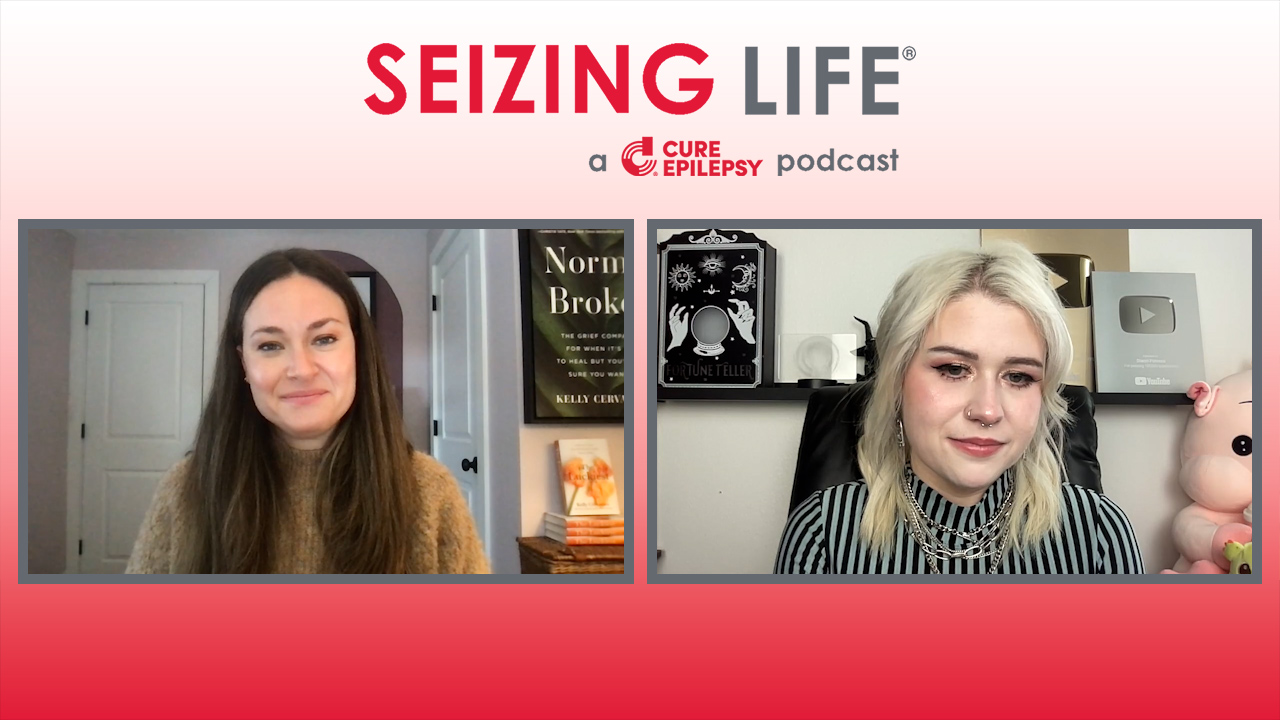
Stanzi Potenza: Pursuing Dreams, Creating Content, and Advocating for Epilepsy
Episode Overview
This month on Seizing Life®, comedian, actress, and podcaster Stanzi Potenza shares her experiences growing up and living with epilepsy.
Stanzi Potenza first gained attention through TikTok videos and has gone on to create several successful online sketch comedy series including Civil War Love Saga and Heaven and Hell. She also hosts the podcast What Fresh Hell Is This? and performs stand-up comedy across the country. Stanzi has accomplished all this while living with epilepsy and has openly shared her experiences in videos and podcasts providing a positive, encouraging and irreverent voice for those impacted with epilepsy. On this episode of Seizing Life®, Stanzi shares her earliest experiences with seizures, which eventually led her to be diagnosed with a “seizure disorder” at the age of 15. However, it was five years and two neurologists later before Stanzi received a proper diagnosis of right temporal lobe epilepsy, resulting in more effective treatment that would provide her with significant periods of seizure freedom. Stanzi discusses her college years and shares her journey to finding the right neurologist. She explains how a stay in the epilepsy monitoring unit was the inciting incident for her first online video posts, and discusses how digital content creation has helped her to manage epilepsy amid the demands of a career in entertainment. She shares her personal experiences of breakthrough seizures and provides a particularly interesting description of the post-ictal or “recovery” phase. Stanzi concludes the episode by sharing some supportive and encouraging words of advice for other young people living with epilepsy.
Episode Transcript
Kelly Cervantes:
Hi, I’m Kelly Cervantes and this is Seizing Life, a monthly podcast produced by CURE Epilepsy. This month, I’m excited to welcome Stanzi Potenza to the podcast. Stanzi is a comedian and actress who has created several successful sketch video series on YouTube and TikTok, and is the host of the podcast, What Fresh Hell Is This? Stanzi has also lived with epilepsy for half her life, having been diagnosed in her teen years. She’s been very open and public in discussing her experience living with epilepsy, and she’s here today to do just that with us. Stanzi, thank you so much for joining us here today. I know that you have shared your epilepsy story with your followers and with your community in the past, but for anyone who isn’t familiar with who you are and your story, I’d love for you to share it with us today.
Stanzi Potenza:
Awesome. Yeah, thank you so much for having me. I started having seizures 15 years ago, which is crazy to think about because I’m 30 now, so it’s been half my life. I was a freshman in high school and it was spirit week and I was getting ready for school one day. And I had woken up earlier that day than I had probably in previous weeks because I wanted to make sure that I was getting ready for spirit week and I had everything put together and stuff. And I just remember putting on… I was putting on clothes. I was putting on pants and then I think maybe I just felt a little lightheaded or something. So I went to go sit down and that was the last thing that I remember was going to sit down in this chair. And then when I woke up, my sisters and my mom were all sitting around me and they looked really scared.
Their eyes were just like, they had these really concerned looks on their faces. And my mom, I was kind of like, “What?” And she was like, “We called an ambulance.” And I was like, “Why would you do that?” And they were like, “You were slumped over on the chair. You were foaming at the mouth. You weren’t being responsive.” And I was like, “I’m fine. I’m just tired.” And my mom was like, “We’ve had this conversation three times already.” And I was like, “What?” And I was really overwhelmed. And then in come the paramedics, so they walk in, they start asking me questions. The typical questions that they’ll ask you when you’re having seizures, so what day of the week is it? When’s your birthday? What’s the date? And I had gotten all of those questions wrong that I thought I was answering correctly, except for one where they asked me who the president was and very aggressively I had said Barack Obama. And they were like, “Oh, okay.” She got that one. She was not going to forget that.
So I got that question right. I got all of the rest of them wrong. And then they got me in the ambulance and that’s when they realized that I was not in fact okay because my blood pressure and my heart rate were through the roof and they were like, “Oh, this is not normal.” So I went to the hospital and then they told me that I had a seizure. We still, at that time, we weren’t really sure what was going on, but we knew that I had a seizure. So that was kind of how all of this started.
Kelly Cervantes:
So you go to the hospital and they tell you that you had a seizure. Did they tell you anything else after that initial seizure?
Stanzi Potenza:
Not really after the first one. They knew that I had a seizure, but they were like, “We don’t really know why this happened.” It’s also hard to… Once you have the seizure, it’s over. So it’s kind of hard to even get information from that specific seizure because I was fine after that. I was in the hospital, I was tired. And so they were like, “Well, this is not normal obviously, so now we have to do all these tests.” So for the rest of that year, it was a lot of me and my mom waking up. Also, my mom was so amazing during this time. She took off so much work and was just there for that entire journey and always has been. So it was just me and my mom getting up pretty early in the morning and stuff and her taking off work and me taking off days of school so we could go to the hospital and do all these tests that I needed to get done.
And they had kind of explained there was probably two major things to check for, which was epilepsy, but also brain tumors. So I had to get MRIs and then EEGs. So just a lot of these different tests that I would have to go and get done, different blood work stuff, just a bunch of different tests that I would have to do. The MRI, obviously, that came back fine, but then the EEGs came back abnormal, which is pretty much as much information as I got from that. We had finally seen a neurologist who kind of came back and was like, “Yeah, you have abnormal brainwaves. You probably have some sort of seizure disorder.” But that was kind of it. We didn’t really get a whole lot of information after that.
Kelly Cervantes:
And during that time period, you didn’t have another seizure, which also sort of bizarrely complicated matters as well. While you’re certainly hoping you don’t have another seizure, that also means that there isn’t any more data to look at. So how long after that initial seizure was it until you had your next seizure?
Stanzi Potenza:
It was probably, it was like a year and a half. So it was a good chunk of time where nothing was happening, so much so that I even remember my mom sitting me down being like, she was like, “You don’t have epilepsy.” Because I had said to someone that I had epilepsy, I was like, “Well, I mean, they told me that I had these abnormal brainwaves and that I probably had a seizure disorder.” I didn’t get official diagnosis or anything, but I think I already knew. I was like, “Yeah. But we’ll see.” And then we did a year and a half later. And it was another thing where it was a late night thing that I was at. And then I just woke up one morning. And for this one, I actually started to get the aura a little bit right at the beginning, so I kind of felt it coming on. And yeah, I woke up, went to the hospital again, and that was kind of when we were like, “Oh yeah, it wasn’t a one-time thing.” Yeah.
Kelly Cervantes:
Right. And it wasn’t just going to go away either. So you start having seizures, and I understand that they start happening more frequently too. Now it’s not a year and a half in between them. How frequently were they happening?
Stanzi Potenza:
It started to happen every six months throughout the rest of high school.
Kelly Cervantes:
And at this point, what are the doctors telling you? It’s still just a seizure disorder?
Stanzi Potenza:
Yeah. We started seeing a different neurologist who also wasn’t a good fit. He looked like the Six Flags bow tie character and all those commercials. He was kind of a character. Once I started to now have them more frequently, we were back at more testing. We were back doing more testing and stuff. So I think I even got another MRI at some point because they wanted to do an MRI with contrast, but I had started… Yeah, I got more EEGs, more blood work.
Kelly Cervantes:
And had they started you on medication at this point?
Stanzi Potenza:
Yeah. So he put me on Lamictal. And so I was taking Lamictal for a bit while he was my neurologist. And then I had a really bad seizure when I was taking Lamictal. So he went to the ER and then I remember talking to a nurse that was like, “Oh yeah, my daughter was on Lamictal. It made her seizures worse.” And I was like, “Oh, it’s not what you want to hear.” And obviously, it was not working for me. So we talked to that neurologist and he was like, “Well, we should just stick it out and see if it changes or something.” And we were like, “I don’t want to do that.” Yeah.
Kelly Cervantes:
I can imagine how frustrated you must have felt, you and your mother must have felt going through this because I am sitting here frustrated for you where you don’t have information and the medicine isn’t working and there’s no clear answers. And now you’re in college, you’ve gone through high school, you’re having seizures every six months, you’re on this medicine that’s not working, you’re on your second neurologist and you still don’t have these answers. And now you’re going to college, which it’s really common for adolescents to have an uptick in their seizures when they go to school because of sleep deprivation, because of alcohol, because of stress, because of all of these things. What was your college experience like?
Stanzi Potenza:
At this point, I didn’t even have a neurologist anymore and I wasn’t on any medication because after the experience that I had with the last neurologist, he had also put me on Keppra too because I was like, “I don’t want to be on this anymore.” He was not happy with me making that choice, but I was like, “I don’t feel good on this and it’s clearly not working.” I looked at my mom one day and I was like, “I actually want to die, I don’t want to be on this anymore.” And she was like, “Yeah, no, okay, we’re done. We are going to stop taking that.” Because I was also dealing with, I had a lot of mental health issues that I was also concerned about. And I was like, “I don’t want to be on a medication that also makes that worse.”
Kelly Cervantes:
Negatively impacting your mental health, which is another comorbidity of epilepsy, unfortunately.
Stanzi Potenza:
Yeah.
Kelly Cervantes:
You’re having all of these signs and all of these symptoms and none of the answers.
Stanzi Potenza:
Exactly. So I was like, “If I’m having them every six months, I feel like I can deal with that. I feel like I’ll know about the time.” It was usually April, May, and then January, February is when I was like, “I’m probably going to have one soon.” So I was like, “I feel like I can take control over this a little bit on my own. I can’t deal with feeling like a guinea pig and just being thrown on these different medications when I know that mentally I’m not in a place where I have the capacity to do that.” But that means that when I got to college, I was unmedicated. I didn’t have a neurologist and it was my freshman year of college. So another really stressful time in my life where I’m starting a new school again and it’s this whole life changing, a new chapter of my life.
And then I made the very poor decision of taking all morning classes. I was taking a morning class every day and I figured, I was like, “It shouldn’t be too bad.” I’m coming from high school where I was also taking morning classes and it was just not the same experience. Part of the reason why I did that is because I wanted to be able to work in the morning and then go to school. And then I was a theater major, so I needed my evenings free so that I could do rehearsals and stuff. So I wanted to get everything out of the way in the morning, which was a terrible idea because sleep deprivation is my biggest trigger. So that first year of college, I had a seizure every month.
Kelly Cervantes:
My mama heart is like so… Because I’m like, knowing that you don’t have a doctor, knowing that you’re not on medication, I’m like, the SUDEP risk is so high, and it just makes me so nervous for you. And it makes me so angry that you weren’t getting the care that you needed and I’m like, that’s a really, really scary place to end up and to feel like that was your best option. What did it take for you to get that diagnosis and to find that right doctor?
Stanzi Potenza:
Yeah, it was really rough. And luckily I was still living at home at the time because I went to a commuter school in Boston. So I would just commute with my mom in the morning to go to school. So she was there for pretty much all of that and she felt awful. It was definitely very traumatizing for her because every time I would wake up in the morning, she would know… It was usually between the first 30 minutes of me waking up is when she would… That would be kind of the period, it’s like I’m either going to have it or I’m not. And so, she was always on alert every time she would hear me wake up and she says it all the time. She’s like, “Every time I would hear your alarm go off, I was just so nervous.” And if I yelled out to her or something, even if it was just something normal, she would fly out of the room and be like, “What?” And it was just awful. It was an awful experience for both of us.
And especially because I have the tonic-clonic grand mal seizures, it would take… As soon as I would recover from one, I would have the other one. And so it was just constant. I was never able to fully heal from the last one.
Kelly Cervantes:
No, and the bruises, and the sore muscles, and [inaudible 00:15:06].
Stanzi Potenza:
Biting down on my tongue. Yeah. I would have these gashes basically on my tongue and my mouth and they would start to heal and the swelling would go down and then it would just be like I would be hit with another one. And so I was never able to heal. And then there was one day after I had one early in the morning of getting ready for school. I woke up on my bathroom floor and my mom was there right next to me. And I remember looking at her and I was kind of like, “I can’t do this anymore.” I was like, “I’m not capable of handling this on my own without any help.” And that was when we made the decision to start going and finding a new neurologist.
Tasia:
Hi, this is Tasia from CURE Epilepsy. Since 1998, CURE Epilepsy has raised over $100 million and funded more than 300 epilepsy research grants in 19 countries. Learn what you can do to support epilepsy research by going to cureepilepsy.org. Now back to Seizing Life.
Stanzi Potenza:
Luckily, we started going to Mass General Hospital, which is one of the best hospitals. And I’ve had so many amazing experiences there with different doctors. So we started going there. We met a neurologist there who, she was a pediatric neurologist. Her name was Catherine Chu, but I hadn’t aged out yet. So I was still fine to go see a pediatric neurologist. And she was just an amazing person. She changed my life. I’m almost overwhelmed talking about it because she had such a huge… I mean, she probably saved my life. You could tell she really threw herself into trying to figure out exactly what was going on with me. So we started doing all those tests again. And then based on her findings, she was like, “Well, you have epilepsy, you heard it here.” And we were like, “Oh, finally. Someone finally told us exactly what was going on.”
And then we started going from there going and trying to find treatments and going into depth with my diagnosis, what type of epilepsy, what’s the best medication. And she was great because there were medications that she put me on that I did not like. She put me on one called clobazam and I hated it. It was really like, I don’t know what, it gave me these really bad migraines and as soon as I told her about it, she was like, “Okay, well, we’re done. We’re going to move on to the next one.” And I was like-
Kelly Cervantes:
Yes.
Stanzi Potenza:
… “I love that I don’t have to argue with you about this.”
Kelly Cervantes:
I’ve spoken to so many people with epilepsy and listening to their journey to get their diagnosis. And it is so frustrating to hear that even in the 2000s, 2010s, we’re still struggling to get these accurate diagnoses. Five years of seizures before you get an answer and you find a doctor who’s willing to work with you to find the right medications. And so kudos to you for going back and keeping trying. And to your mama for being there as a support for you. What eventually did… Dr. Chu, right? What did she eventually tell you? What kind of epilepsy do you have and what does that mean?
Stanzi Potenza:
I did two stays at the EMU, epilepsy monitoring unit, and then the first time they didn’t really find anything. The EMU was also crazy. They couldn’t leave my bed because they are trying to sleep deprive you so that you’ll have one. I didn’t end up having a seizure.
Kelly Cervantes:
Of course, you never have one when you’re in there.
Stanzi Potenza:
Yeah. I was like, “I know it’s not going to happen.” And it didn’t. So the first time I stayed, I was like, “This is not great.” But she had put me on a medication called Trileptal, which was working for a while to some degree. I was still having auras, so technically I wasn’t seizure-free while I was taking it, but I wasn’t having convulsions while I was taking it. So I was like, “Okay, well, it seems like this is working.” And it was somewhere between two to four years or something, maybe three years, I was not having them. So I was like, “Okay, maybe this will work.” And then in 2019, I had one. And so it was back to the EMU. It was right before the pandemic. It was right before lockdown. So we did another EMU stay and every other doctor was convinced that I had general epilepsy. It was just everywhere. She was convinced that it was local.
And so we did the test and she was right. So I got diagnosed with right temporal lobe epilepsy. The good thing about that was that it meant that I had some options. So I did meet a surgeon because surgery was now on the table, so that was a potential option. But while I was in there… I did have a seizure while I was in there, which was good. They actually weren’t able to capture on camera because the one seizure that I had while I was in there was in the bathroom. I was like, great. So we didn’t get to capture on camera, but they had the scans, obviously, and there was a nurse there that was able to give them information about what she saw. And based on everything that they found, she put me on a new medication called Aptiom, which is the medication that I’m on to this day.
Kelly Cervantes:
But something else started while you were in the EMU. You started recording TikToks, is that right?
Stanzi Potenza:
Yeah.
Kelly Cervantes:
And that’s kind of how your current career got started. Talk to us about what inspired you to do that.
Stanzi Potenza:
Yeah. I had just downloaded TikTok. I was kind of posting some videos here and there, but then I was in the hospital and I was like, “Maybe I’ll record my journey through going through the epilepsy monitoring unit and just my time in the hospital.” And also it was just a way for me to distract myself from how miserable that experience is because you are just stuck there for 10 days. And so, I was like, “I need to find different ways to entertain myself while I’m in here the second time.” So I came prepared. And so I was having some fun doing little videos and recording my experience while I was in there. And one of my videos got a lot of views. I think it got 300,000 views and I was like, “Oh, that’s kind of cool.” Now I know that I’m capable of having a little viral moment, having my videos kind of do well. So yeah, I had started posting while I was in there and then eventually I started to do the sketches. But yeah, that is when I really started posting.
Kelly Cervantes:
First of all, I want to say how wonderful and amazing it is that you talk so openly about your seizures and epilepsy and this whole journey because me as a mom and a caregiver, it’s one thing for me to talk about my daughter’s experience, her epilepsy and her seizures were so disabling. She was never going to lead a typical life. And so for me to talk about her, it wasn’t risking stigma. There was no real risk to her. But when someone who is otherwise leading a typical life whose seizures are a part of their life, but is not all of their life, when someone like you is able and willing to get out there and talk about it, I think that’s when we really start to make waves and create that awareness. And so I’m just thank you for being so open and willing to talk about your experience.
I watched one of your videos and you’re talking about what your seizures look like and the auras that happened before and your postictal period. And what struck me is your postictal period is much different than a lot of other people’s seizures. And postictal means that time after, immediately after the seizure, for listeners who may not know. So if you can share with our listeners what your seizure experience looks like, because I think it is a testament to the fact that everyone’s seizures are different, everyone’s epilepsy is different. And it’s not just the causes, but even if you were to talk to another person who had the exact same right frontal lobe epilepsy, temporal lobe epilepsy, their seizures might not look like yours do. And so I think it’s important for people to understand just how varied and different these seizures look like. So please share with us.
Stanzi Potenza:
Yeah. First of all, thank you. It doesn’t feel like a burden to me at all to talk about my experience with these things. It’s very much a huge part of who I am. And I know that me talking about this has had an impact on other people who are either dealing with this themselves or they’re parents to someone who’s dealing with that. It’s important for me to be able to talk about my experiences, but I know it’s also important for other people to feel like they have someone to relate to that has those experience because it can be a very isolating experience. I will have the aura and my aura is also kind of crazy. I’ll have a lot of confusion and racing thoughts. Sometimes it’ll affect my vision. So sometimes I’ll see rainbow out of one of my eyes. It’s usually my right eye where I’m seeing just rainbow and I’ll have the convulsions.
And then when I wake up during postictal, I kind of have described it before as like the seizures, it’s like your brain having some sort of virus, like a computer virus or something. And the postictal is like the brain rebooting. And while the computer is rebooting, sometimes it takes a minute for it to download all of the information that was on it before. So when I wake up, it’s a lot of confusion, like really intense confusion. So I don’t know who I am. I don’t know who anyone around me is. I don’t recognize any of my loved ones. I don’t know how to speak yet. So anything that’s coming out of my mouth is just complete gibberish, nothing’s making sense. And also anything that anyone is saying to me is also not being registered as like, I don’t know what they’re saying.
And it’s also combined with really intense paranoia. I sort of have described it before as like you’re going through psychosis and dementia at the same time, because I don’t know what’s going on or who anyone is around me, but I’m also incredibly paranoid. So it’s like a very primal state to be in where I’m just assuming that everything around me is a threat. Even when no one is there, because I’ve also had them alone, but even when I’m alone, I still feel like there’s someone in the house with me. And so, it’s really scary and every time I’ve had one, it’s been that. And I’ve done things like my sister, for example, my younger sister who’s seen most of the seizures that I’ve had, I think it was the third one that I had ever, I thought she was trying to kill me.
So I was running away from her and I ran into a wall and hit my head and obviously mild concussion probably. And so I do that. And then because I thought she was trying to kill me, I tried to jump off the second-store balcony of our house at the time because I was like, I have to get away from her somehow. So I had a whole leg over the ledge and she had to come over and pull me off and she walked me into her bedroom and basically put me to bed. And I passed out until my mom got home and then we went to the hospital.
Kelly Cervantes:
It’s terrifying.
Stanzi Potenza:
Yeah. It’s really-
Kelly Cervantes:
For everybody involved.
Stanzi Potenza:
Yeah. So I’ve had to give them instructions basically on what to do if I have a seizure around them because I’ve also, I’m a danger to myself, but also them because I’ve tried to swing at my mom before after waking up and she had to be like, “Whoa,” because I thought she was trying to kill me. So I had to be like, “Don’t make direct eye contact with me because it feels very threatening. Just keep telling me I had a seizure over and over again until eventually my brain understands what it is that you’re saying.” Because as soon as I understand what’s happening, it immediately I come out of it and I’m like, “Oh, okay, got it.” And so, everything else stops because usually I’m hyperventilating crying, I’m screaming, crying and then-
Kelly Cervantes:
The computer has fully rebooted and you’re like you again.
Stanzi Potenza:
And I’m like, “Oh, okay.” And I’m like, “Oh, got it. I had a seizure. Okay.”
Kelly Cervantes:
It’s like this whole other layer on top of the danger of the seizure, on top of whatever is going on in your brain that makes that happen in the first place. Now, thankfully you have had some significant episodes of seizure freedom. You sort of spoke about a couple of them, but you had a good chunk of time, and then unfortunately had another seizure last year. Talk to us about that.
Stanzi Potenza:
Yeah, I definitely was lucky going through some pretty big periods of time not having them. I had had a seizure, I think it had just turned 2023 because it was right before I moved to Los Angeles from New York. And I was very stressed because I was moving across the country. I had a lot going on. It was just a very stressful time in my life. And it was also kind of a weird one that happened because I had been out with… I had gotten coffee with a friend at night, which I would never have them at night pretty much. And I came back home, ordered Wendy’s, I’m sitting on my bed, I’m eating. And then I felt it coming on. And usually I have at least 30 seconds to kind of be like, “Oh, I’m about to have one,” and get myself situated. And I did not get that this time.
When I came to, I was sitting against my bed on the floor crying, sobbing. And I was already on the phone with my mom and she was just like, “I know, I know.” Trying to sort of soothe me. And then I’m looking around and that’s when I’m realizing I’d finally, brain rebooted, downloaded all information. I’m like, “Oh, okay. I had a seizure.” I’m looking around. I’m trying to put the pieces together what happened because I was on the floor and I wasn’t… And I look and I see that my nightstand was all the way against the wall. So I was like, “Okay.” So I had rolled off the bed, hit my head off my nightstand, and then fell on the floor, which is obviously really dangerous because that’s another aspect of seizures where it’s like you could really injure yourself if you don’t get yourself into a safe position.
So yeah, I hit my head, which is not great. And then I went two years without one. And then May of 2025, I was moving again, very stressful time in my life. I was just going through a lot and my sleep was just atrocious. I was going days without actually going to sleep at all. And I was really wired and part of that was definitely because of how stressed I was about moving and getting everything ready. And it was one of those days where I did not sleep. And so it was 7:00 in the morning and I was like, “Well, I’ll just stay awake and I’ll do house chores and I’ll just get the house sorted and I’ll just kind of get the day started early.” And then I felt it coming on. And I was also thinking about the last one that I had had where I did injure myself and it could have been a lot worse than it was.
And so in my head, I was like, “Oh, should I try to get someone’s attention or something?” But it’s 7:00 in the morning, it’s Memorial Day weekend. So I’m like, no one is around. And I was standing in my apartment and I was near the front door, but I was in my apartment. And then when I woke up, I was not in my apartment anymore. I was in the garage of my apartment building and I was in an elevator, and I was all the way backed up into the corner like this. I was hiding from someone. So I kind of immediately was like, “Okay, what’s going on?” And so I’m like, I looked down, I’m only wearing a long T-shirt. I have no shoes on, didn’t have the key to my apartment. Luckily, a cleaning lady walks in five minutes later and I go up to her and I was like, “Hi, can you let me back into my apartment?” And she was just like, “Yep.” She didn’t ask any questions. So she was just like [inaudible 00:34:27].
Kelly Cervantes:
Thank goodness for wonderful cleaning ladies.
Stanzi Potenza:
Yeah, because honestly, based on how I looked, it probably looked like I had just wandered into the building and I wasn’t supposed to be there. I definitely, I think I had the convulsions in the actual garage because I kind of remember going down. And I was looking at my elbows and I looked at my right elbow and my right knee and saw that they were scraped and stuff and bruised. So I was like, “Okay, so I must have fallen down on this side in the garage, had convulsions, went back to the elevator.” I’m sure I was probably trying to get back to my apartment, but because I didn’t have my key, I couldn’t get access. So I was just hiding in this elevator and it was just, I’ve never done anything like that before. And that was concerning because I was like, “I need to make sure that if I have something like this again, I’m not wandering.”
Kelly Cervantes:
That you’re safe. Yeah. You have to figure all of those pieces out, but you figured so much out and now you’re incredibly successful both online and then with your standup comedy and you learned how to find the neurologist that works for you. You’ve learned so much. What would you want other young people to know about epilepsy, whether they’ve just been diagnosed or they’ve been living with this for years?
Stanzi Potenza:
Yeah. One of the things that came out of this for me was obviously how important it is to find healthcare providers that are going to fight for you and have a genuine interest in your health and getting you to a place where you can live a normal life and function. And I went through two neurologists that were not right for me. And then I met someone that really fought for me. She had a genuine interest in figuring out exactly what would work for me and stuff. So meeting her was incredible for me and not everyone is lucky enough to find doctors that are putting in the work to help them. And I think some people don’t even realize that they have the option to go and try to find someone else, which can be very difficult. It’s not easy, but you have to advocate for yourself.
You know your body, you know what is working for you and what’s not. So advocate for yourself, especially when you’re a woman or a minority, that’s like an additional thing that you have to really think about. So yeah, you have to advocate for yourself because I don’t know where I would’ve been if I didn’t find someone that really worked with me and had a genuine interest in my health and getting me better. Outside of that, you have to do other things to help yourself, like managing your stress, and your sleep, and all these other aspects of your life. But you can do it, because there was obviously a period of time where I didn’t think I was going to be able to do any of the things that I’m doing now, but you can. And even right now, I’m not currently… I mean, there are aspects of traditional entertainment that I do stand up and stuff, but there are a lot of things that are more in my control.
If you are someone that genuinely thinks, “Man, I don’t think I’ll be able to ever do film, or television, or something.” You can do the internet thing and you can have something, but it’s something that might be a little bit more within your control. That’s a good place to start. There are other avenues to get to where you want to be. It’s not impossible. And so yeah, I think don’t give up on yourself.
Kelly Cervantes:
Stanzi, your advice is incredible and you are incredible and every day you are helping so many people see themselves and know that anything is possible. And so thank you for being willing to share your story. Thank you for chatting with me.
Stanzi Potenza:
And thank you too, because moms like you make the world a better place and everything that you’re doing now and talking about this and bringing awareness to all of this, it’s so important. I really respect it. And I see so much of my mom in you too. And you guys are just warriors and-
Kelly Cervantes:
Thank you.
Stanzi Potenza:
… I really appreciate it. Thank you so much for having me on.
Kelly Cervantes:
Thank you, Stanzi, for sharing your experiences and insights. And thank you for providing such an open and public voice for those living with epilepsy. Since 1998, CURE Epilepsy has been fostering community for those living with epilepsy, their family and loved ones. Founded by a group of parents who were unsatisfied with the status quo in epilepsy care, CURE Epilepsy has raised over $100 million to advance epilepsy research and improve treatment while leading the search for a cure. If you would like to support our efforts to end epilepsy, please visit cureepilepsy.org/donate. Thank you.
Legal Disclaimer:
The opinions expressed in this podcast do not necessarily reflect the views of CURE Epilepsy. The information contained herein is provided for general information only and does not offer medical advice or recommendations. Individuals should not rely on this information as a substitute for consultations with qualified healthcare professionals who are familiar with individual medical conditions and needs. CURE Epilepsy strongly recommends that care and treatment decisions related to epilepsy and any other medical conditions be made in consultation with a patient’s physician or other qualified healthcare professionals who are familiar with the individual’s specific health situation.