

Subtle Seizures, Big Impact: A Young Woman’s Personal Epilepsy Journey
Episode Overview
In this episode of Seizing Life®, Skylar Swatt shares her epilepsy journey. From a stroke that caused seizures at birth to the onset of “mini-seizures” when she was a child which eventually resulted in a tonic clonic seizure and an epilepsy diagnosis in her teens, Skylar details her journey and the mental health impacts of her diagnosis and treatment.
Skylar Swatt’s story begins at birth, when she suffered a stroke that caused 15 seizures in her first few hours of life. Though doctors were able to get the seizures under control, after several years of seizure freedom they returned but were mistakenly identified as muscle spasms in her jaw. Skylar recounts how these jaw twitches went undiagnosed throughout childhood, until she experienced her first grand mal (or tonic clonic) seizure at age 14. She and her family began to push for answers—initially facing dismissal and frustration within the healthcare system. Through persistence, Skylar eventually found a neurologist who listened, explained her condition clearly, and helped her make sense of what her brain and body had been experiencing all along.
Beyond seizure control, Skylar opens up about the emotional side effects of anti-seizure medications, including anxiety and depression, and how epilepsy affected her education, social life, and major life transitions such as starting college and navigating adulthood. She also discusses the importance of self-advocacy, mental health support, routine, and finding compassionate care.
This conversation highlights the many ways seizures can present, the often long road to diagnosis for many people with epilepsy, and why being believed—and truly heard—can make all the difference.
Episode Transcript
Kelly Cervantes:
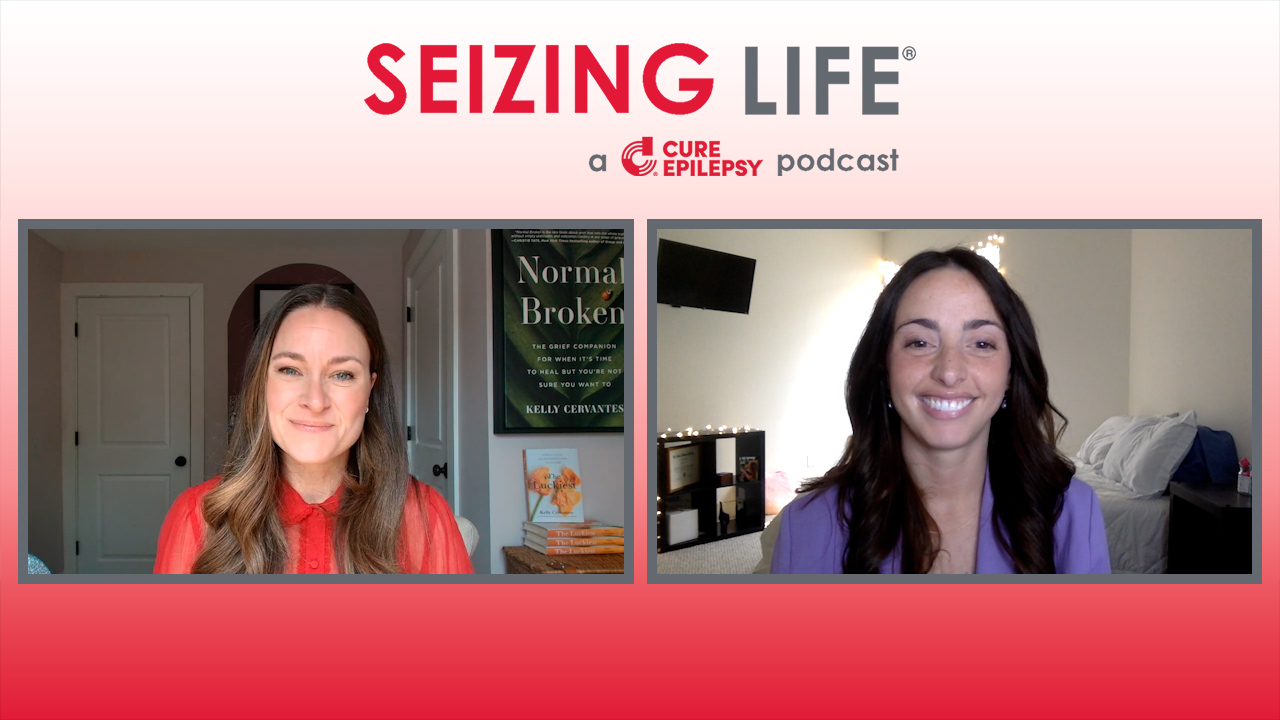
Hi, I’m Kelly Cervantes and this is Seizing Life, a monthly podcast produced by CURE Epilepsy. This month, I’m happy to welcome Skylar Swatt to the podcast. Skylar has lived with epilepsy since birth, when a stroke caused her to have seizures. Medications have helped Skylar achieve seizure control, but they have also had emotional impacts in the form of anxiety and depression. She’s here today to share her epilepsy journey and talk about managing those emotional side effects. Skylar, thank you so much for joining us today. Before we get into your epilepsy journey, I want you to tell us a little bit about yourself. Who is Skylar Swatt?
Skylar Swatt:
So Skylar is from Chicago, Illinois. I was born there. Moved to Upstate New York when I was around three years old. Grew up in a super small town called Johnstown. Super close family. Grew up playing sports, running around in the backyard, all those things, just growing up. Small town life, going to school, playing sports my whole life. And yeah, that was basically me growing up. I went to college in Rochester, New York. Did some floating around with some jobs, and now I’m here in Rensselaer, New York.
Kelly Cervantes:
I love it. Now, your epilepsy journey begins at birth. Why don’t you tell us about that?
Skylar Swatt:
Yeah, so just a few hours, I was sitting in the bassinet after my mom gave birth to me. She looked over at me and she said I started to turn blue and then I started to turn gray. So she hit the panic button, “Nurse, come in, come in, come in.” They took me away. We’re doing a bunch of tests. They came back in and told my mom and my dad that I had a stroke and they were both like, “How did this happen? Why? She had a healthy delivery, everything.” And so they actually said, my mom was like, “Why? What happened?” And they said, “Drug and alcohol abuse from the mother.” And my mom was like, “That is not what happened here. So what happened to my child?” So they were like, “Let me do a bunch of other tests, see what happened.” And to this day, they really don’t know why I ended up having a stroke at birth.
Kelly Cervantes:
Wow. Okay. So you have the stroke at birth, which I’m sure was just utterly terrifying for your parents. And then how did that turn into seizures?
Skylar Swatt:
So I had 13 seizures the day I was born, but after spending five days and nights in the hospital, they determined that the seizures had calmed down, they weren’t going to come back again. So I lived my life from one day old to one day in sixth grade, I had a twitch in my jaw, a feeling in my jaw when I was at lunch with my friends. A few years later, after I had a grand mal seizure, it was told to me that those were mini seizures. So from sixth grade until 10th grade, I was having these mini seizures, where I would be eating and my jaw would snap and move to the side. I was conscious for it, but I couldn’t control it.
When this first happened, I went to the nurse and I said, “This is what happened during the episode.” And she said it sounded like a muscle spasm. And to me, it made sense because that’s what a muscle spasm would feel like to me. After that first episode, that just kept happening. And it was just, I guess I have muscle spasms when I eat sometimes. They would only come up when they wanted to. I couldn’t control them until one did happen when I was in the 10th grade, and it turned into a grand mal seizure.
Kelly Cervantes:
I’m so happy that you’re sharing your story. Thank you for doing that because I don’t think that people fully understand all of the different ways that seizures can present themselves. And so a muscle spasm in your jaw turns out to be mini seizures that you have been, or not mini, I don’t even want to use that word, just seizures that you have been having for years before all of that buildup in your brain becomes a grand mal seizure. And so I hope that people listening are aware that seizures can look and present in numerous different ways and are not just what is fictionalized in TV or on movies. Talk to us about the day that you had the grand mal. You’re 14 years old. Set the scene.
Skylar Swatt:
Yeah. So it was actually one of my friend’s birthdays. We were going to a concert and her dad was going to drive us. So we all got in the car to go to the concert. We stopped at Wendy’s to just grab something before we headed over to the concert. And right down the street from the Wendy’s was a gas station, so her dad pulled in to just pump some gas and get us ready to go before the concert. And we were all just sitting there, eating our Wendy’s and all of a sudden I started to have the jaw twitch. So I was like, okay, I’ll just wait this out. Everything will be fine. I’ll just continue eating after and it would be okay. So this one wasn’t going away. And then I remember starting to go backwards and I was like, I’m supposed to be sitting up, but I could see my friend, who’s behind me. I was like, something’s weird, something’s wrong. And it just felt like my whole body was just vibrating.
I heard my friend who was sitting next to me, she said, “Help. She’s having a seizure.” And then I immediately, I say I went to sleep, so I blacked out. And then a few times during the seizure, I woke up, people were trying to get me to come to, say, “You’re having a seizure, you’re okay, you’re okay.” And then I woke up and I was in an ambulance and I saw my mom getting in the ambulance. So then they took me to the hospital and ran all the tests and then it was known that I had had a grand mal seizure.
Kelly Cervantes:
So you’re in the hospital, they’re doing these tests. Did they diagnose you with epilepsy at that point? What information are you given after having this seizure and before you’re sent home?
Skylar Swatt:
So actually, I was not diagnosed at the time. The doctor that I had, he wasn’t very nice. He wasn’t very nice to my parents, so he was downplaying what had happened because I think that he thought that I maybe had done something crazy or that kids shouldn’t be doing, but that wasn’t the case at all. They said, “This is her brain. This is how she grew up. She’s been fine ever since. So what is different? What happened?” So they didn’t really give me any information at the hospital at that time, but it was known right off the bat, she needs a neurologist to figure out which triggered this one to be a full grand mal seizure.
Kelly Cervantes:
Okay. So first frustrating experience with the American healthcare system, not being taken seriously. I have a funny feeling that that is not the last time that that happened for you. Talk to us about your journey in finding a neurologist.
Skylar Swatt:
So I went to, I believe it was about two or three before I found my saving grace, my neurologist that I love dearly to this day. At one neurologist, one of the neurologists that I visited with my parents, we all got frustrated and I just felt defeated because she was like laughing and she was like, “Well, don’t eat chicken nuggets.” And it was like, this is a huge problem that just happened to my body. I’ve never been through this. We’re trying to figure out what is going on and you’re taking it as a joke. It was like, this is not the time and place to think of funny things to say. I don’t know if she was trying to make me feel better, but it did not. And it was just not a good experience until I found the one that I have now.
Kelly Cervantes:
And was that the doctor that figured out that the muscle spasms were seizures?
Skylar Swatt:
The doctor I have now, the one that I found that I truly love.
Kelly Cervantes:
Yeah. So he or she puts all of this together that you had been having seizures for years and, I’m assuming, diagnoses you with epilepsy. What is your understanding at that point? And are you still 14 at this point? How old are you?
Skylar Swatt:
Yeah, I was still 14. It was awesome because he was talking to me like I was a 14-year-old. He took a piece of paper and he said, “These are what your brainwaves are supposed to do. When you were having the mini seizures, your brain waves were,” and he just drew a higher line than general. And then he said that when I had a grand mal seizure, my brain waves were just out of control. So it just made sense to me. I was like, okay, this is what my body’s doing when nothing is going on. When I’m having these mini things, these little brainwaves are doing the electricity thing that we are told. And then when I was having the grand mal seizure, the brain waves go crazy. That’s how it came off to me while I was sitting there and he was able to communicate that with me as a 14-year-old.
Kelly Cervantes:
I’m curious, do they believe that these seizures that you’re experiencing sixth grade through eighth grade, freshman year, is this a result of the stroke? Did you have a brain MRI?
Skylar Swatt:
Yes, absolutely. I got all the tests done. I’ve done EEGs, MRIs since. It is from the stroke. So when I was born and all these tests were done, they said, “She may have seizures one day,” but from date of birth to sixth grade, I was completely fine. So we thought, okay, she’s good. So after the stroke, I have a completely compromised right side of my body, but I’m able to do everything that everybody else can. It’s just a little bit weaker and slower. So we thought that that was going to be the only side effect, but then come sixth grade, these seizures started out of nowhere.
Kelly Cervantes:
Hi, it’s me again. Can I ask you to do me a favor to help the podcast out? It would mean so much to me and my colleagues at CURE Epilepsy, if you could rate us five stars on Apple or Spotify and leave a review. Ratings and reviews help Seizing Life reach more people in the epilepsy community who are looking for answers, connection and hope. Every rating, review, and download really does make a difference. Thank you so much for listening and now back to Seizing Life.
So Skylar, you finally find a neurologist who listens to you and who can speak to you in a way that you understand. You have this diagnosis, you have so much more knowledge and information, which I feel like in and of itself is a comfort, but what is a bigger comfort is being able to control said seizures. So did your neurologist start you on medication and were you able to gain control of, certainly of the grand mal, but also of those smaller jaw seizures?
Skylar Swatt:
So yes and no. I was prescribed Vimpat right off the bat and I’m still on that today. I’ve been on it since the seizures started. And when I first got the medication, I was like, “Yes, anti-seizure medication. I will never have a seizure again. We’re good to go. I’m going to be normal, live a normal, healthy life.”
Kelly Cervantes:
If only it were that easy. I thought that too. I totally thought, I was like, “We’re just going to take a pill and my daughter will be fine. This has to be curable.” But it’s not that simple, is it?
Skylar Swatt:
No. So I started that medication and I was good for a little while, but my parents and my sister, because she’s a year older than me, so we were the only ones in the house, noticed my depression. Depression was so, it was very severe. There were certain things that I was saying that my parents were like, “You’re not like this. What is going on?” So I went back to my neurologist. I said, “This is happening. I’m saying these things. I’m doing these things. My parents can tell there’s a huge drop in my mood.” So he prescribed me with an antidepressant. That made everything 10 times worse. I got even more depressed. It was just an overwhelming sadness, anger, whatever it was. So we took me right off of that as soon as that started. So it was just getting used to the Vimpat, where my mood started to stabilize a little bit.
And at that time, I didn’t have any more grand mal seizures and my jaw was completely calmed down when I was eating, but it was probably a few months after that, because when I know I’m going to have a seizure or mini seizure, I have a feeling in my jaw and then my jaw starts to twitch. So I was with friends. I was actually at a field hockey carwash and I started to get that feeling and that had never happened before since I started the medication. So I was like, oh my gosh, I’m going to have a seizure. I’m freaking out. I don’t know what to do. I’m terrified because this was the scariest thing that’s ever happened to me. I don’t want to go through it again. But I ended up, my jaw didn’t twitch to the side or anything. I just had that feeling and it completely went away after that. So that was a good few months after I started the medication, but thankfully because I was on the medication, I did not have a full-blown seizure or even the mini seizure that I was having before.
Kelly Cervantes:
Yeah. So I guess you know that the medication was working, but still unnerving and anxiety inducing all the same, which is really what I want to get into next here because you’re at the field hockey carwash. You are in high school, you are a teenager. How does this impact you socially and emotionally, as you’re navigating high school as a teenager with epilepsy?
Skylar Swatt:
Huge. So my anxiety was high when I was a kid. I’ve always had that. So when-
Kelly Cervantes:
[inaudible 00:15:37].
Skylar Swatt:
Yeah. So when this all started and this all was happening, it just riled way up. So even though I knew that things were being controlled through the medication, I still, anytime I would eat and I would feel funny, freak out, run to the bathroom, call my mom, call my dad, call whoever could calm me down. It was terrifying, even though I knew that I was going to be okay, especially before the medicine, the anxiety was incredible because it was so scary. The unknown was the worst part because it was like, is this going to stop? Is this going to turn into a big one? Is this not going to? The anxiety was always there. Thankfully, I had sports. That’s my outlet. So towards the end of the day, I was able to calm down more, but during the day, during school, when things are going crazy, busy, it is hard to be able to center yourself and say, “I’m going to be okay,” because with this, you don’t know.
Kelly Cervantes:
And were you impacted academically at all?
Skylar Swatt:
I had an IEP because we knew my brain was different. I can do things always, but I just need to be a little bit more secluded and it takes me a little bit longer to do things. And with that extra added epilepsy diagnosis, it was just an added pressure. Can I do this? Can I finish this? Can I, can I, can I? So it was hard academically because it was just hard enough for me to focus when the slightest thing felt a little bit different or a little bit off.
Kelly Cervantes:
And did you tell your friends in high school about your epilepsy? I mean, I guess some of them were there when you had that first grand mal or tonic-clonic. What was your friend’s response, your teammate’s response to your epilepsy?
Skylar Swatt:
They were great. Everybody was very, very supportive of me. If I ever needed anything, they were there for me. In any situation, they knew. I wasn’t embarrassed to talk about it, but when something would happen, I would be embarrassed about it happening. I’d be like, I just want to be in this moment, normal like everybody else is. So when things would happen, I would try to hide it, but everybody knew about it. So it wasn’t hard to talk about, but it was still a little embarrassing to deal with.
Kelly Cervantes:
Of course. And so you have this strong support system growing up, it sounds like incredibly supportive family, supportive friends, and then you leave to go to college and that is a tough transition for anybody, but I imagine that it is a little extra challenging when you’re dealing with epilepsy. How did you handle that transition to college? Did you tell roommates? Were you continuing to have seizures at that point?
Skylar Swatt:
So seizures had stopped. I had no seizures in college, which I am so grateful for. The transition was very hard. I, like you said, have a very good support system, and I went to college three hours away. So I couldn’t just say, “Hey, I’m coming over. I’m scared. I don’t feel good,” anything like that. I didn’t really tell anybody in college until it came up in conversation or anything like that. And I’m also a very structured, scheduled person. That makes me feel good because I like to know what’s going on. And in college, it was brand new, so I didn’t know what to expect. So I was very scared. I was very nervous and that just caused my anxiety to go insane. So I ended up starting talk therapy at college.
I walked in there. Actually, my first time I went in, I just started sobbing and they were like, “Okay, come with us.” And they just took me into a room and started talking to me. And I actually was on a small dose of antianxiety medication. And so my therapist at school had called my neurologist and said, “Hey, this is how she’s feeling. This is what’s going on. What do you think about increasing her dosage to mellow her out while she goes through all these changes?” So that happened. So I freaked out at the beginning. I was just nervous all the time, but once I got in a routine of making sure I’m taking my medication, making sure I’m talking to my doctors, making sure I’m going to therapy, make sure I’m working out, I was able to create another routine for myself. So it was hard, but I got through it.
Kelly Cervantes:
Yeah. So often mental health issues, anxiety, depression, whether it is because they are side effects from the medication or just that anxiousness and nervousness of not knowing when or if another seizure is going to happen, all of those things are such common comorbidities. And another thing that we just don’t talk about enough or prepare young people for enough, especially as they are going through these major transitions in life, you go into college and then you leave college, you graduate and it’s a whole other transition. Now you have a job and you’re dating and you’re living this young adult life. Talk to us about this next major transition in your life and how your diagnosis impacted that.
Skylar Swatt:
The hardest thing for me dealing with my epilepsy was the insurance. That is my biggest thing that I want everybody with epilepsy to know as a young adult.
Kelly Cervantes:
Yeah. It’s something that I don’t think a lot of young adults think about, unless they have a medical condition like epilepsy or some other chronic condition. And you turn 26 and you’re off your parents’ insurance and now you have to find a job that is going to supply you with that insurance, but that’s not enough because there’s all of the other contingencies. If your doctor takes it, if they’re going to fill your prescription. What were some of the challenges that you faced in learning how to navigate health insurance?
Skylar Swatt:
Yeah. So my biggest challenge was when I decided to move to Arizona by myself. That was the coolest thing I’ve ever done for myself, but it was very challenging, especially with the health insurance because I had always had this support system behind me and then I was like, “Whoa, I really need to do this all by myself.” So I order my medicine at my new pharmacy and I show up and they’re like, “You know that this is like $2,000, right?” I was like, “What?” I was like, “No, no.” So I’m on the phone with my mom, I’m crying to my mom. I’m like, “I don’t know what to do. I’m out in a couple days and I need this. I need this.”
Thankfully, this pharmacy was helpful enough that night to break one of their bottles open and give me a couple so it could hold me over until I could get my insurance, pharmacy and doctor all on the same page. So I got, I think it was two days worth of medicine. That was $76. So after that day, I was at work, I was trying to work, but all I was doing was calling the pharmacy, the insurance company and my doctor to just try to get them all on the same page to be able to get everything that I needed for the upcoming prescriptions and all that.
So that was the first time that I ever really knew how much it was going to be a struggle to have a job and make sure all of these are on the same page. And then you never know something could happen. You go to a different job, you move, something happens with the company, the company changes insurances, you have to do it all over again. So it doesn’t really get easier, but you just have to keep doing it and fighting for yourself so you can do what you need to do to help yourself survive.
Kelly Cervantes:
Yeah. The learning how to self-advocate is a huge lesson and one that I think a lot of people don’t learn until later in their life. But when you are dealing with a chronic illness like epilepsy, it’s one that you have to learn really, really early on. And you had another layer on top of all of this, complicating it. You have a condition called SIBO, small intestine bacterial overgrowth. Talk to us about that and how that impacted your epilepsy.
Skylar Swatt:
Yes. So I was living in Virginia at the time. I was living with my friend and no matter what I was eating, my stomach would just … I would have such bad stomach pain and my stomach would grow really, really big. I would get super bloated. I was having bathroom issues, all these different things where my stomach was just not right, 24/7, all the time. So I was like, “Okay, I will take out the things that I know are not great for you to have a lot of.” So I cut out like the dairy, cheese, bread, all those things. And I was like, “I’m just going to do a protein and a vegetable for dinner.”
Usually during the day, I actually wasn’t even really thinking. I was just trying to get by. So I wasn’t really paying attention to what I was eating during the day, but then when I would get home and have this meal, protein and vegetables, I was still so sick. I was like, “What is going on?” So I went to a gastrologist and I finally did a, it was a breath test, so I just breathed into these little tubes and they sent it away and they came back and told me that I had SIBO.
So I was talking to my doctor and I said, “I’m just trying to have a protein and a vegetable. I don’t know why it’s still happening.” And she said,” What vegetable are you eating?” I said, “Broccoli.” She’s like, “That’s one of the worst things you can eat with this condition.” So once I figured out that that is what I had, they put me on an antibiotic, which helped, but when I was still trying to figure out this process of why I was so sick, I had an epilepsy episode where I was at lunch with my friends and my right leg started to feel weird, which usually never happens when I’m feeling, having epilepsy triggers. I was super anxious and my leg felt weird and I just had this weird vision of reality. Nothing was really connecting or making sense in my brain.
I said, “I think I need to go to the hospital. I don’t know what’s going on. Something feels off.” I get to the hospital, I tell them what’s going on and I was like, “I think I had some kind of seizure episode because I was exhausted.” My body was just completely … Immobile, I was so exhausted. They did a bunch of testing, I did a bunch of blood work, stayed overnight, and then the doctor came back in the morning and after all the testing and everything, they said that it looked like, with the stomach condition that I had, my medicine wasn’t getting metabolized correctly, so that started to trigger the epilepsy symptoms. So then I had to just get on the SIBO diet where I was eating all the right things for SIBO, but it’s just something that I, an add-on that I have to balance with epilepsy and this SIBO condition.
Kelly Cervantes:
It’s such an important reminder about how all of the different things that can change the ways that our body metabolizes the medicine, that you need to stay healthy. And because your body wasn’t metabolizing the medicine, you have this breakthrough seizure. I also would love to talk to the doctors and go on a wild tangent about brain-gut health and that wild connection as well, but we won’t go into that here. That is just my curiosity flaring up and wondering how these two things could be interconnected with inflammation and all of these things. So what is the current state of your seizures, Skylar? How are you doing? You talk about how you’re on the SIBO diet to help that. You’re still taking the Vimpat. Is it working? How are you feeling? Do you have routine? How are you doing today?
Skylar Swatt:
Yeah. So after that SIBO episode, I actually was put on Briviact to just enforce the seizure medication getting into my system, getting to my brain. So I’m on Vimpat and Briviact, and I’m also still on antianxiety medication. I’m making sure I take my medicine at the right time every day. My outlet and one of the main things that I do is exercise. It’s so good for my body. It makes my mental health, anxiety, depression, all the things so much lighter for me. So medicine, staying consistent with that, staying in routine with exercise and also talk therapy. I have an incredible therapist. She just lets me come in and talk about whatever I need to. But those are the main things that I’ve been doing lately to be able to take care of myself and manage my epilepsy.
Kelly Cervantes:
And that’s a great tip for people as well in terms of trying to find a good therapist. Your local epilepsy organization can sometimes point you in those directions. I know that you have also started to dip your toe into advocacy. Talk to us about that. It’s one thing for me or another parent to get out there and be an advocate in terms of our children, but I think it is so much more powerful when someone with epilepsy is out there advocating and sharing their story. I think that first person narrative is just so important in allowing people to understand the impact. So A, thank you for dipping your toe in, but also talk to us about what inspired you to do that and what you’re up to.
Skylar Swatt:
I actually started just thinking about things that people didn’t know. And I started seeing things on Facebook, just certain pages. And I was like, that is very important that people don’t know that. And I want to spread that information. So I started a TikTok page where I’m starting to tell my story and also just telling my day to day, how I’m feeling and how I’m dealing with those things. So hopefully that can help others. And I have actually gotten people I don’t know and people I do know coming to me and saying, “Thank you for telling your story. Thank you for sharing these things. I know someone or my son or my daughter has it or has a friend or something.” So it’s been really cool to even just get that small feedback because I haven’t been doing it long.
And I actually had the opportunity to go to Memphis and share my story in a speech with an organization called BEATS Awareness down in Memphis, Tennessee. So I was able to go and there were a bunch of organizations there, representing organizations for individuals with invisible disabilities. So being there and being able to tell my story has been awesome. I’ve gained some followers from that and just gaining more information as well about other people and their treatment plans and what they’re doing to manage their epilepsy as well.
Kelly Cervantes:
Well, thank you for doing all of that. And I can guarantee you that it does make a difference. In closing, Skylar, what advice would you give to other people who are living with epilepsy?
Skylar Swatt:
I would have a few things. My first is don’t give up on yourself. There are so many times where I was just so sad, so defeated. This medicine isn’t working. I’m just so overwhelmed, but I had to keep going because I just wanted to fight for myself and I wanted to feel good. So don’t give up on yourself. I definitely would also say to have an outlet. Anything that can take your mind completely away from your condition, your work, your anything, just because with people with epilepsy, it’s just like an added stressor. So just to have something to be able to take your mind completely away, whether it’s reading, art, exercise, something like that, just have an outlet that can just be you and this thing.
And then my last thing I would say to somebody would be use your resources. There have been so many times where I just thought I was in this pickle. I didn’t know what to do. How do I get my medication on this date? How do I get my medication? How can I afford this? How can I afford that? There are so many organizations and resources out there that I didn’t know about until I was desperate to help you with this. So do your research and find places near you to help yourself, lessen the anxiety, lessen your triggers, and not stress you out.
Kelly Cervantes:
Skylar, that is all incredible advice. Thank you again so much for chatting with us today for sharing your story. It means more than I think you realize. Thanks so much.
Skylar Swatt:
Thank you so much.
Kelly Cervantes:
Thank you, Skylar, for sharing your epilepsy journey with us. For more than 25 years, CURE Epilepsy has been funding breakthrough research that aims to transform the lives of people with epilepsy while leading the search for a cure. If you would like to support our mission, please visit cureepilepsy.org/donate. Thank you.
Legal Disclaimer:
The opinions expressed in this podcast do not necessarily reflect the views of CURE Epilepsy. The information contained herein is provided for general information only and does not offer medical advice or recommendations. Individuals should not rely on this information as a substitute for consultations with qualified healthcare professionals who are familiar with individual medical conditions and needs. CURE Epilepsy strongly recommends that care and treatment decisions related to epilepsy and any other medical conditions be made in consultation with a patient’s physician or other qualified healthcare professionals who are familiar with the individual’s specific health situation.