


Understanding Epilepsy Main Menu
Table of Contents:
- What is a febrile seizure?
- Who is at risk for a febrile seizure?
- What to do if your child is having a febrile seizure
- Febrile seizure diagnosis and treatment
- Febrile seizure prevention: Is it possible?
- Frequently asked questions
Febrile Seizures
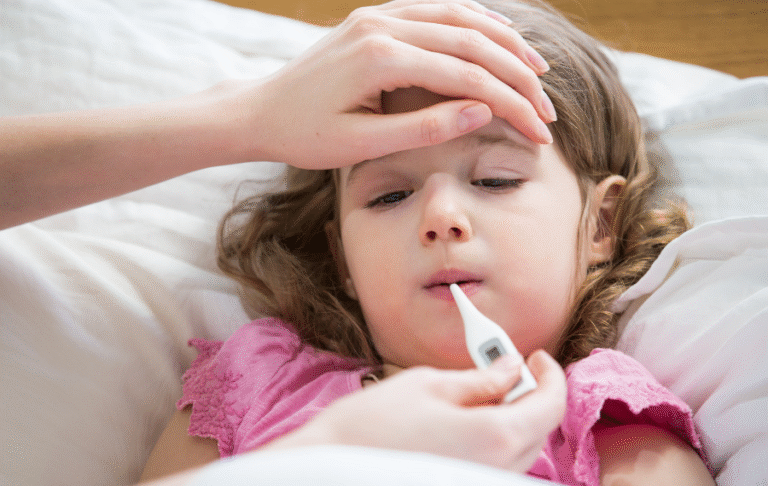
A febrile seizure (pronounced FEB-rile) is a type of seizure caused by a fever. This kind of seizure can happen in otherwise healthy children. Febrile seizures typically happen between six months and five years old. Febrile seizures can occur in up to 5% of all children when they have a fever.
The seizure happens within 24 hours of getting sick with common illnesses such as:
- colds
- flu
- ear infection
- chickenpox
- COVID-19
- RSV (Respiratory Syncytial Virus)
Typically, febrile seizures in a child are not life-threatening. They also do not usually indicate a more serious health condition, such as epilepsy. Even so, febrile seizure can be scary and difficult to understand for caregivers and kids. Knowing about potential causes, symptoms, and what to do can help.
What is a febrile seizure?
Most febrile seizures are convulsive, but not always. In some cases, the seizures are not convulsive, without obvious shaking and jerking.
Febrile Seizure Symptoms: What to Look For
When having a febrile seizure, a child may experience any of the following:
- Uncontrollable shaking or jerking of his/her body, including arms and legs
- Stiffening in his/her arms or legs
- Loss of consciousness
- Loss of control over bodily functions, such as drooling, vomiting, urinating, etc.
Febrile seizures are not harmful and do not have lasting impact on a child. They do not cause brain damage. The most common type does not increase the risk of developing epilepsy. [1]
Simple vs Complex
There are two types of febrile seizures – simple and complex:
- Simple febrile seizures are most common (65-90% of all febrile seizures [2]). A simple febrile seizure is generalized. That means it affects both sides of the brain. Both sides of the body may exhibit signs of the seizure such as shaking or jerking. The child will typically lose consciousness as well. Simple febrile seizures last from a few seconds up to 15 minutes, and only happen once in a 24-hour period.
- Complex febrile seizures last longer than 15 minutes and/or occur multiple times within a 24-hour period. These seizures can be focal, meaning that they only occur on one side of the brain and body. They can also be generalized and affect both sides of the body.
What causes febrile seizures?
Febrile seizures are triggered by a rapid rise in temperature causing a fever, typically at or above 100.4 F (38.0C). Two common causes of fever that may lead to febrile seizures are:
- A viral infection: typically colds, flu, ear infection, roseola, chickenpox, COVID-19, and RSV.
- A low-grade fever post vaccines: some vaccines can cause a temporary fever as part of the normal immune response. Very rarely does a fever trigger a febrile seizure. When it does, it is the fever, not the vaccine, that causes the febrile seizure. Vaccines, including those for diphtheria, tetanus, pertussis, and measles-mumps-rubella (MMR), actually prevent many illnesses that can cause febrile seizures. [3, 4]
Who is at risk for febrile seizures?
There are several factors that can increase the risk of having febrile seizure. These include:
- Young age: Febrile seizures occur in up to 5% of all children when they have a fever. Children aged six months to five years are most likely to have febrile seizures.
- Family history: The most common risk factor is a family history of febrile seizures. In some cases, these children may be more likely to experience more than one seizure. There may be a genetic link to susceptibility to febrile seizures. Researchers have identified several genes that can influence risk. [5]
- Sex: People assigned male at birth are at slightly higher risk than people assigned female at birth.
It is important to note that if a child experiences a febrile seizure, it does not mean he or she has epilepsy. However, complex febrile seizures slightly increase the risk of developing epilepsy. This is especially true if a child is younger than 5 months old and has multiple prolonged events. [6]
What to do if your child is having a febrile seizure
Febrile seizures may only last a few seconds to a few minutes. Still, it is vital that parents and caregivers keep a close eye on their child and try to stay as calm as possible.
During a febrile seizure, while monitoring their child, caregivers should:
- Help prevent injuries or falls
- If the child is sitting or standing, place them on a safe surface like the floor. Also put them on their side or stomach to avoid choking
- Remove nearby hard and sharp objects
- Loosen tight clothing
- Do not restrain or hold the child down during a seizure
- Do not put anything in the child’s mouth
- Time the seizure. Call 911 or take the child directly to a hospital emergency room, IF:
- The febrile seizure lasts longer than five minutes.
- The seizure is less than five minutes, but the child is not recovering quickly or has a stiff neck, breathing issues, vomiting, or severe sleepiness.
Febrile seizure diagnosis and treatment
Often times, children who experience febrile seizures are not hospitalized. Children are more likely to be hospitalized if they are younger than six months of age, the seizure has persisted for a long time, or the seizure occurs alongside a serious infection.
Talk through what happened with a healthcare provider after a febrile seizure. Through a comprehensive review of the child’s medical history and a physical check-up, providers can help identify the cause of the fever and related next steps in the care plan.
Parents and caregivers can also help the care team by providing:
- Detailed notes about the child’s experience with the seizure, including the signs and symptoms before and during. A video of the seizure can also be very helpful.
- A list of treatments (i.e., prescription, over-the-counter, vitamins, etc.) their child takes.
Make a list of questions for the provider. Some good questions may be:
- “What tests does my child need?”
- “What should I do next time my child has a fever?”
- “Is there anything I should do differently if my child has a febrile seizure again?”
Febrile seizure prevention: Is it possible?
These seizures are triggered by a fever. Giving a child or infant over-the-counter fever-reducing medications, including acetaminophen (e.g., Tylenol) or ibuprofen (e.g., Advil) may help. However, it is important to note that reducing the fever will not prevent a febrile seizure.
In very rare instances, a child’s physician may recommend antiseizure medication to treat febrile seizures.
Frequently Asked Questions
-
What is a febrile seizure?
Febrile seizures are triggered by fever. They can cause temporary convulsions lasting a few seconds to several minutes. Febrile seizures can also be non-convulsive. They can affect young infants and children who are otherwise healthy.
-
What causes a child to have a febrile seizure?
The underlying trigger of febrile seizures in children is a fever, typically at or above 100.4 F (38.0C). Two common causes of fever that may lead to febrile seizures are:
- A viral infection: typically colds, flu, ear infection, roseola, chickenpox, COVID-19, and RSV.
- A low-grade fever post vaccines: some vaccines can cause a temporary fever as part of the normal immune response. Very rarely does a fever trigger a febrile seizure. When it does, it is the fever, not the vaccine, that causes the febrile seizure. Vaccines, including those for diphtheria, tetanus, pertussis, and measles-mumps-rubella (MMR), actually prevent many illnesses that can cause febrile seizures.
-
What steps should I take if my child is having a febrile seizure?
During a febrile seizure, it is important to keep a close eye on your child and stay as calm as possible. While monitoring your child, make note of the following tips:
- Time the seizure. Call 911 or take the child directly to a hospital emergency room, IF:
- The febrile seizure lasts longer than five minutes.
- The seizure lasts less than five minutes, but the child is not recovering quickly or experiencing a stiff neck, breathing issues, vomiting or severe sleepiness.
- Help prevent injuries or falls by placing the child on a safe surface like the floor. Also place them on their side or stomach to avoid choking.
- Loosen tight clothing.
- Do not restrain or hold the child down during a seizure.
- Time the seizure. Call 911 or take the child directly to a hospital emergency room, IF:
-
Can febrile seizures be prevented?
Febrile seizures cannot be prevented. Parents should have seizure-specific first aid training to learn how to respond to febrile seizures.
-
Are there treatments available for febrile seizures?
For very rare instances of severe cases, providers may recommend antiseizure medications. Fortunately, for most patients, febrile seizures don’t require treatment. They are usually short, not life-threatening, and don’t indicate a more serious condition, like epilepsy.
-
After a febrile seizure, what are some key questions we need to discuss with my child's provider?
Caregivers should work with a provider on any next steps in their treatment plan.
These questions can help guide your discussion with your child’s provider:
- What caused my child’s seizure?
- Are there any specific medical tests or procedures we need to consider?
- Will my child potentially experience another febrile seizure?
- What should I do to best protect my child if he or she does experience another seizure? Should I do anything different than what was done during this experience?
- The next time my child has a fever, what should I do?
On your end, share all relevant details of your child’s health history and seizure experience. Make sure to share the following details with your child’s provider:
- Any recent changes in your child’s health history.
- If your child experienced an illness or fever before the seizure.
- If there is a family history of seizures of any kind.
- Details about the febrile seizure, including length of seizure, signs and symptoms, etc.
-
Where can I learn more about febrile seizures and how to help my child during a seizure?

Keep Learning
Subscribe to our emails for more content like this.
More about types of seizures



References:
- Mewasingh, L.D., Chin, R.F.M. and Scott, R.C. (2020), Current understanding of febrile seizures and their long-term outcomes. Dev Med Child Neurol, 62: 1245-1249. https://doi.org/10.1111/dmcn.14642
- Waruiru C, Appleton R. Febrile seizures: an update. Arch Dis Child. 2004;89(8):751-756.
- https://www.vaccinesafety.edu/do-vaccines-cause-seizures/
- Nienke E. Verbeek, Floor E. Jansen, Patricia E. Vermeer-de Bondt, Carolien G. de Kovel, Marjan J.A. van Kempen, Dick Lindhout, Nine V.A.M. Knoers, Nicoline A.T. van der Maas, Eva H. Brilstra; Etiologies for Seizures Around the Time of Vaccination. Pediatrics October 2014; 134 (4): 658–666. 10.1542/peds.2014-0690
- Skotte L, Fadista J, Bybjerg-Grauholm J, Appadurai V, Hildebrand MS, Hansen TF, Banasik K, Grove J, Albiñana C, Geller F, Bjurström CF, Vilhjálmsson BJ, Coleman M, Damiano JA, Burgess R, Scheffer IE, Pedersen OBV, Erikstrup C, Westergaard D, Nielsen KR, Sørensen E, Bruun MT, Liu X, Hjalgrim H, Pers TH, Mortensen PB, Mors O, Nordentoft M, Dreier JW, Børglum AD, Christensen J, Hougaard DM, Buil A, Hviid A, Melbye M, Ullum H, Berkovic SF, Werge T, Feenstra B. Genome-wide association study of febrile seizures implicates fever response and neuronal excitability genes. Brain. 2022 Apr 18;145(2):555-568. doi: 10.1093/brain/awab260. PMID: 35022648; PMCID: PMC9128543.
- Mewasingh, L.D., Chin, R.F.M. and Scott, R.C. (2020), Current understanding of febrile seizures and their long-term outcomes. Dev Med Child Neurol, 62: 1245-1249. https://doi.org/10.1111/dmcn.14642