

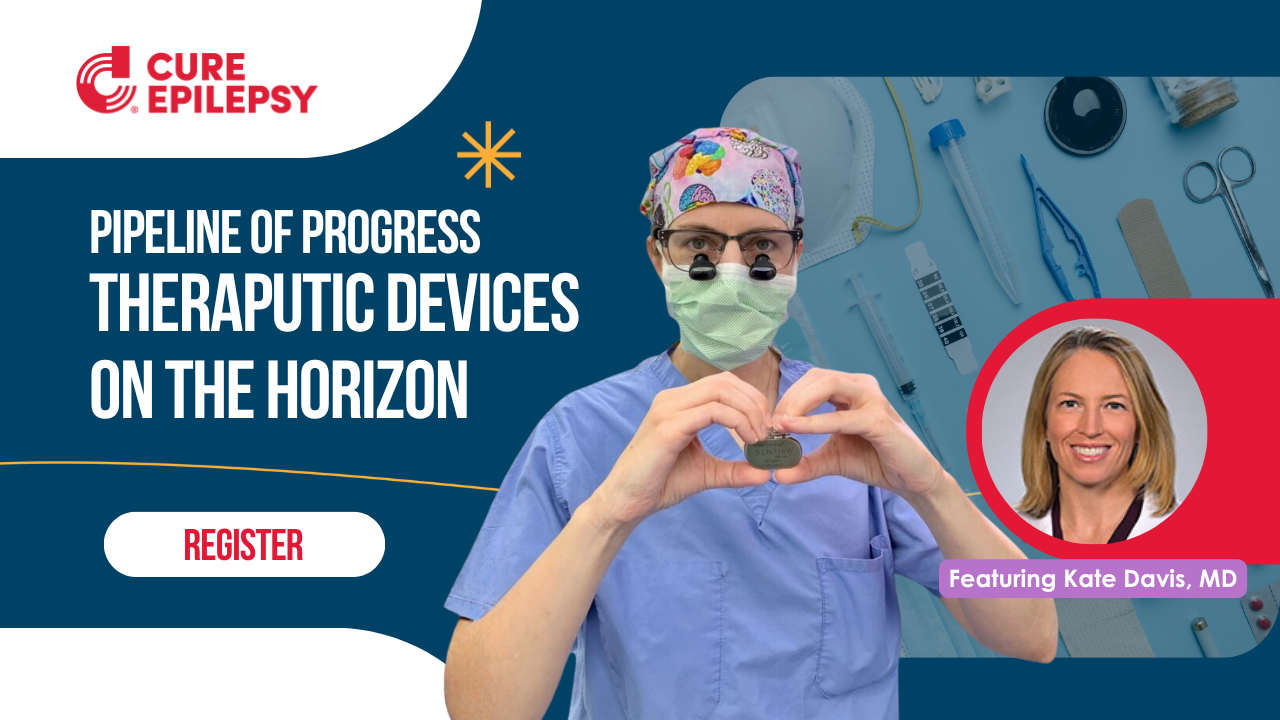
This webinar is the second in our Pipeline of Progress series, created especially for people living with epilepsy and the loved ones who support them.
This webinar explores what new therapeutic devices are on the horizon and what researchers are working on right now, including devices involving transcranial electrical stimulation, transcranial magnetic stimulation, and focused ultrasound.
Our speaker is Kate Davis, MD, a Professor of Neurology and Division Chief, Epilepsy at the University of Pennsylvania. She has deep expertise in presurgical evaluation of epilepsy patients, with a research focus on improving localization of epileptic networks in refractory epilepsy.
The Pipeline of Progress series is generously supported by independent educational grants from Lundbeck, Stoke Therapeutics, uniQure, and Xenon Pharmaceuticals and produced by CURE Epilepsy. CURE Epilepsy is solely responsible for the selection of the presenters and moderators. The opinions and recommendations expressed are those of the presenters and do not necessarily reflect the opinions, recommendations, or endorsements of CURE Epilepsy.
Download Transcript | Download Slides
Q&A Transcript
What is the success rates for VNS, RNS, and DBS? What is even considered success?
I ask my patients what success means to them as an individual before starting a treatment, to make sure that our expectations are set correctly. For example, most of these devices are intended to reduce seizure frequency. So, if a patient has two seizures a year, but they’re very severe, reducing that by 50%, meaning to one seizure a year, that might be very clinically meaningful to one patient and not very meaningful to another patient. Having reasonable expectations going into any kind of procedure is important.
Every one of our patients is unique. They have different types of seizures, different seizure frequencies. They impact their quality of life in different ways. That needs to be a really clear and detailed discussion with your clinician when you’re making these decisions.
The devices that are approved right now – the other part of this question is how well do they work? They have never been compared head to head. We cannot say this device is better than that device, but we can go through the available clinical trial data and discuss your specific type of epilepsy to determine what might be the most effective device. For some patients, they really prioritize a less invasive device like VNS over some other variables. So again, really important to drill down on the data and how it applies to that individual when making these decisions.
Are the approaches you discussed also useful for generalized seizures, or are they only for focal seizures?
There are some studies (one of which is wrapping up) using the RNS device for idiopathic generalized epilepsy where the initial data results have been released. The RNS device has also been studies in a smaller patient cohort or group with Lennox-Gastaut syndrome. To me, it’s very exciting to have some neuromodulation options with data behind them that can help the generalized epilepsy population.
There’s also work on using both VNS and DBS in the generalized epilepsy. That’s the invasive side. The non-invasive work, as was astutely pointed out, has been focused on focal epilepsy. I think some of the work that’s been being done targeting the thalamus for focal epilepsy can hopefully translate to the generalized epilepsy population, but to date there’s not been a lot of investigation.
Can neuromodulation actually detect seizures that the patient doesn’t experience themselves? And how is AI going to change what we do with devices?
For the first question, currently, the only device that can detect seizures with a high degree of certainty is the RNS device, because that device is constantly recording brain activity. We put those electrodes in the areas of the brain that are individualized to the patient where the clinicians believe the seizures are coming from.
I use that device frequently in my patients, and almost all of the patients have seizures they’re not recognizing. Patients don’t know – they lose consciousness or awareness often during these events. So how will they know how often they’re having those events? And then there are events where there’s no clear clinical outward signs, but there’s still seizures going on. RNS can really help us understand how to manage someone’s epilepsy. We can understand how well a new drug is working, for instance, much more quickly than we would if we didn’t have those recordings. It can help us really push forward their management and give us that data to do so.
The second question is AI. The work that I’m most familiar with is with also the RNS or NeuroPace device. And that is because it is recording all of that data. That data is a kind of goldmine of information of how our patients with epilepsy’s brains are working, not only when they’re in the hospital just getting monitored for a day or a week, but all of the time, 24/7. You can look at that data and understand what’s happening when they’re asleep, when they’re awake, if there’s different cycling to their seizures that potentially we can adjust medications based upon that cycling.
There is ongoing work now being brought to the bedside using AI to cluster or identify patients that might respond better to certain device settings than other patients. So we can take a new patient and see, does their brain look like this other group of patients that we already know did well with these settings? And then go more quickly to those settings to hopefully get that patient more quickly to improvement.
Can something like transcranial electrical stimulation or focused ultrasound be used in somebody with a VNS or an RNS?
It’s going to differ between the therapies, and likely it will need to be studied and proved that it’s safe. We may not have significant safety worries, but in order to get approval to do those together clinically, we’ll need studies proving safety in many cases. I honestly will have to do some homework on that because I can’t answer for each specific device at this time, but it’s a really good question.
What’s the difference between LIFU and TMS?
This is an engineering question. The methods use very different ways to deliver electrical energy to the brain. But they’re doing it using different types of technologies. Ultrasound is a very different technology than the magnetic stimulation that’s used in TMS.
What are the risks of TMS?
TMS has been approved and used for multiple disorders to date, so it is considered a very low risk intervention. I would expect if it does go forward into the approval process for epilepsy, that this is a case where you have other indications. The safety data is really strong because of all of the experience in other diseases for TMS. It’s the efficacy data and how long it will work – that’s the durability data – is less clear. The pediatric data in that small trial [I referred to in my presentation] was more promising, but overall there’s not a lot of data to date supporting us being very confident that this is going to be a successful therapy moving forward.
Which of the therapies might be useful in reducing seizures in an adult with a Dravet? Having focal seizures, which then generalize?
There can be a lot of variability from one Dravet patient to another. It’s hard to generalize, and what individuals can potentially tolerate in terms of testing could also differ substantially. Can they tolerate an inpatient video EEG monitoring? Can they tolerate intracranial EEG monitoring? Because some of that testing can be really critical to helping us determine what the best device may be for a Dravet patient.
A vagal nerve stimulator, I would say, is almost always an appropriate option for a Dravet patient, whether they have all focal seizures, a combination of focal and generalized seizures, or all generalized type seizures. The other two currently available devices, DBS and RNS, it requires more testing to allow us to really determine what area of the brain might be best stimulated to result in the best seizure reduction. That is going to be very individualized and based upon what testing that patient is able to do and what information we get from that testing.
Are any of these new treatments closer to FDA approval than others?
I think the work in HIFU is closer than others. We went through some of that data, and certainly the work with temporal interference is very early stage. Unfortunately, although we have TMS devices available and FDA approved, the data is not really that close yet for epilepsy. So it varies from option to option.
To me, it’s exciting that there’s investment in this space from CURE Epilepsy and others, that there’s ongoing work, and that there are likely going to be non-invasive options in the future. We’re going to have to carefully weigh new therapies against the currently available invasive options. It’s potentially the case that the invasive options work better, but they’re more invasive. So it’s a balance for an individual patient and their clinician to decide how to weigh the pros and cons of each option.
What are your recommendations to find the best hospital for neuromodulation surgeries? How do people find out more? Is there a list somewhere? How do people pursue this?
There is a national structure for epilepsy. The NAEC, or a National Association of Epilepsy Centers, which does have information on what centers in various regions have been determined to be level four centers (which have met criteria where they can offer all of the various epilepsy therapies, including neuromodulation) or level three centers (which often are not able to offer the full array of options).
The first thing is to ensure that you have checked where level four centers are in your region. Most folks aren’t able to travel super far for these types of interventions. And in fact, for the neuromodulation therapies, you do need to return to a center that is able to program the devices. It’s not only important that you have a center that is able to implant the device, but you also need to make sure that you have a center that is able to program the device that you can get to on a regular basis.
Ideally these devices are placed and managed fairly locally, so that you’re able to return as needed. Many centers like my own can implant devices, and partner with other centers that may be closer to where you live that are able to program. These are emerging changes in how we’re delivering care. It’s really important to ask these questions and make sure that you’re going to be able to get there to get the treatment and get your device programmed.
There’s also a move with these devices to doing remote programming where we can. I think in the near future, we’ll be able to program all of the devices remotely, which will enable us to do a lot more for patients that don’t live close to a main epilepsy center.
It’s recognized that clinical trials can take a long time to complete in order to advance these kinds of technologies. How far away are these technologies from coming to use in the general population? Is there anything in the next few years? And how would you coach somebody who might be older in thinking about using these or participating in trials?
Those are hard questions. I think these less invasive devices, if effective, will have a much faster path to approval and use outside of the clinical trial setting.
Surgery risks can increase with age. When considering your options with your clinicians as an older adult, it might be the case that you should not wait for these non-invasive devices to come to market and that a currently available therapy may be effective. The earlier you do those procedures, the lower the surgical risks in general.
We don’t know how well these developing technologies work, it’s unclear how long they will work, and how often they’ll need to happen is still unknown. As a patient, will you want to have a treatment every day or once a week, even if it’s noninvasive? Or would you prefer to have a one-time typically well tolerated surgical implantation that you don’t have to continue to maintain and have that ongoing therapy? These are really personalized decisions.
If somebody wanted to learn more about participating in a clinical trial to support the advancement of these technologies, what would they do?
Trials are registered on ClinicalTrials.gov, where you can look up what trials are enrolling patients. Also, I’d encourage you to always ask your epileptologist or your clinician what studies are available outside of just devices. There are many exciting pharmacological studies and other types of treatment studies that are the focus of other webinars this year from CURE Epilepsy. If you are being seen at a center that’s enrolling, they can tell you potentially what’s practical for you. If there’s not a study being conducted locally, it may not be feasible for you to enroll in a study.
Latest from the Community