

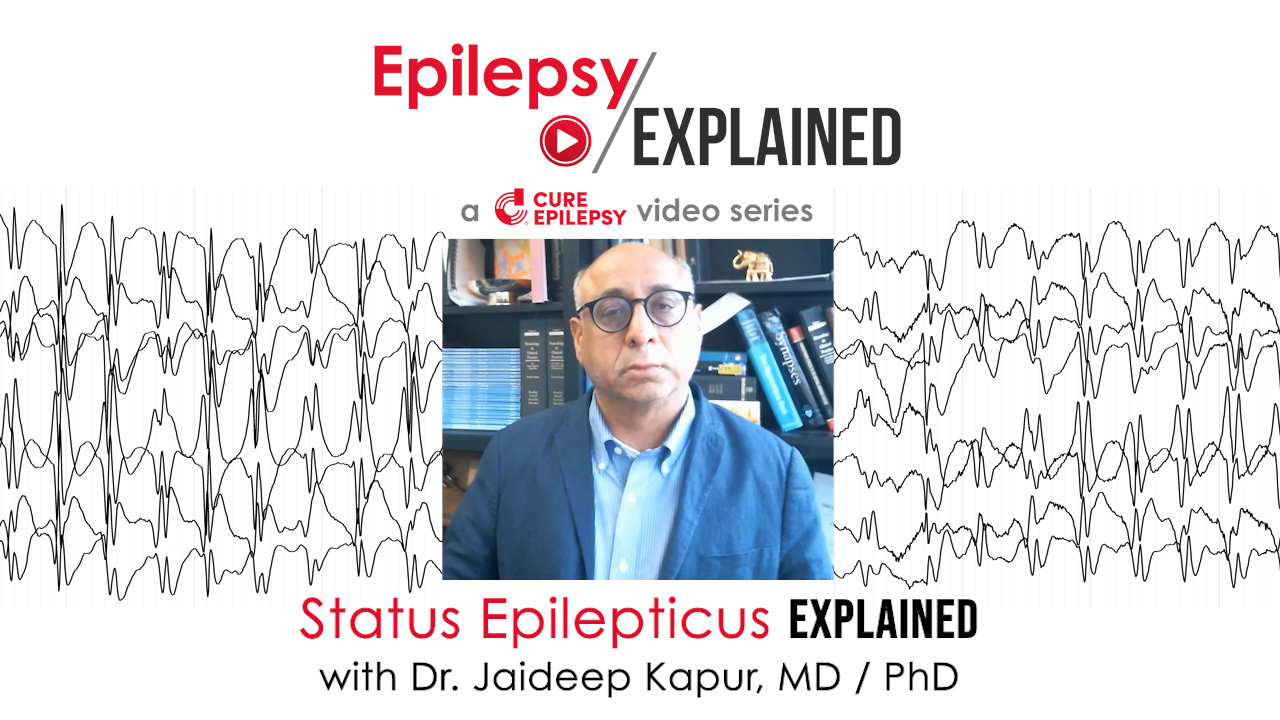
Status Epilepticus Explained: what it is and what to do if it happens
In this episode of Epilepsy Explained, Dr. Jaideep Kapur, MD/PhD, answers your questions about Status Epilepticus, a seizure that lasts more than 5 minutes. Dr. Kapur is a neurologist at University of Virginia’s Children’s Hospital and Eugene Meyer III Professor of Neuroscience and Neurology at the University of Virginia. In Status Epilepticus Explained, Dr. Kapur answers the following questions.
0:15 What is status epilepticus?
0:57 Why is status epilepticus considered a medical emergency?
1:42 How is status epilepticus treated?
2:41 What causes status epilepticus and who is most at risk for it?
4:06 What are NORSE and FIRES?
5:36 What research is being done on status epilepticus and potential treatments for it?
Look for new episodes of Epilepsy Explained on the third Wednesday of every month on CURE Epilepsy’s YouTube Channel and on our website at: https://www.cureepilepsy.org/epilepsy-explained/
If you would like to submit questions for future episodes of Epilepsy Explained, please go to: https://www.cureepilepsy.org/epilepsy-explained/
ABOUT CURE EPILEPSY
CURE Epilepsy is the leading, non-governmental funder of epilepsy research. Since its inception in 1998, CURE Epilepsy has raised more than $100 million to fund epilepsy research and other initiatives that will lead the way to cures for the epilepsies. CURE Epilepsy funds grants for young and established investigators and to–date has awarded more than 300 cutting-edge projects in 18 countries around the world. Our mission is to fund breakthrough research that will transform the lives of people living with epilepsy as we lead the search for a cure.
LEARN MORE ABOUT EPILEPSY
Visit the “Understanding Epilepsy” section of CURE Epilepsy’s website:
https://www.cureepilepsy.org/for-patients/understanding/
STAY CONNECTED WITH CURE EPILEPSY
Sign up for our newsletter for the latest in epilepsy research news: https://www.cureepilepsy.org/subscribe/
Follow us on Facebook: https://www.facebook.com/CUREforEpilepsy/
Follow us on Twitter: https://twitter.com/cureepilepsy/
Follow us on Instagram: https://www.instagram.com/cureepilepsy/
INCREASE YOUR IMPACT
Share your story: https://www.cureepilepsy.org/personal-stories/
Help us find a cure: https://www.cureepilepsy.org/get-involved/donate/
Look for new episodes of Epilepsy Explained every other month on CURE Epilepsy’s YouTube Channel and here on our website.
Episode Transcript
What is status epilepticus?
Dr. Jaideep Kapur:
Status epilepticus is the most extreme form of epilepsy. Most seizures, thankfully, end within five minutes. But some, less than 1%, of seizures will continue on their own and they’re not going to stop without treatment. If seizures have gone on more than five minutes, it’s very important that we treat them. If seizures go on for more than half an hour, they can injure the brain, change brain circuits, and leave long-term impact on the patient.
Why is status epilepticus considered a medical emergency?
Dr. Jaideep Kapur:
Status epilepticus is considered a seizure emergency when seizures have lasted more than five minutes. Seizures lasting more than five minutes can cause brain damage, they can rewire the brain, and if they are convulsive in nature, they can even threaten lives of individuals, because they can stop breathing. If somebody is having very prolonged seizure, we call the rescue squad, and by the time they arrive, it’s usually five to 10 minutes. And if the patient is still having seizures, they need immediate treatment right there at home, and on way to the hospital.
How is status epilepticus treated?
Dr. Jaideep Kapur:
We must treat status epilepticus as soon as it is recognized. And, when a patient is having seizures at home and emergency medical personnel arrived, they must start treating them right there. They can give drugs called diazepam or midazolam by intramuscular route, or they have to start an IV and give lorazepam. These drugs are often available in rescue squads, and are available for treatment. If we give adequate doses of these drugs, then seven out of 10 patients will stop having seizures, even by the time the rescue squad arrives in the emergency department. Our goal is to have a patient’s seizures stop even before they arrive in the hospital, so that there is no brain damage for the patient.
What causes status epilepticus and who is most at risk for it?
Dr. Jaideep Kapur:
Babies as young as six month olds, and older adults as old as 90, can have status epilepticus. Actually, status epilepticus is most common at two extremes of age. In children, in babies six months to six years, the most common cause of status epilepticus is a fever or fever related illness, an infection that leads to a high fever, what we call febrile status epilepticus. There are other causes in children, but that’s the most common one.
In older adults, they’ve suffered from a stroke in the past, or they’ve had a cardiac arrest or bleeding in the brain, or a brain tumor. In between, there are situations like drug use, alcohol withdrawal, that can cause status epilepticus. Very important for our patients with epilepsy to know that low blood levels of anti-seizure medications can cause status epilepticus in individuals with epilepsy. Sometimes our patients lose access to medications due to emergencies. Sometimes they have vomiting or other conditions where they’re not retaining their medications, and that leads to status epilepticus.
What are NORSE and FIRES?
Dr. Jaideep Kapur:
So NORSE and FIRES are rare forms of status epilepticus, but they’re devastating. When a patient has status epilepticus and first and second drugs fail, we place the patients under anesthesia, and wait for a day or so and remove the anesthetic. In some patients when we remove the anesthetic, seizures come back, and we call them having refractory status epilepticus.
And NORSE refers to new onset refractory status epilepticus. These patients can stay in the ICU having seizures for days, weeks, or even months. FIRES is another form of NORSE. It’s more common in children. It refers to fever induced refractory status epilepticus, suggesting that the child had some febrile illness and an infection that preceded this refractory status epilepticus. We believe that this is some form of autoimmune attack on brain cells, and it is important to test for that attack and treat it in these individuals. There is going to be a pretty important clinical trial testing out immune therapies to stop NORSE FIRES.
What research is being done on status epilepticus and potential treatments for it?
Dr. Jaideep Kapur:
There’s a big NIH-funded clinical trial going on, called ketamine add-on therapy for established status epilepticus. So patients who do not respond to benzodiazepines, the first line treatment, are now given a second line drug, often Keppra, sometimes Depakote or phenytoin, but only half of the patients respond to this second line agent. We are conducting a multi-site clinical trial to test whether adding ketamine to the second line drug, Keppra, would improve the outcome of status epilepticus. There are other trials that are using ketogenic diet for refractory status epilepticus. These are patients who are not responding to anesthetics. They are put on ketogenic diet through the intravenous route, or through their nasogastric tube, to see if the diet can improve the outcome of status epilepticus. Finally, there are newer pharmaceutical companies-sponsored trials that are on the horizon that would look at improving the outcome of status epilepticus.