

Epilepsy and Medical Trauma: Recognizing, Accepting, and Healing
Episode Overview
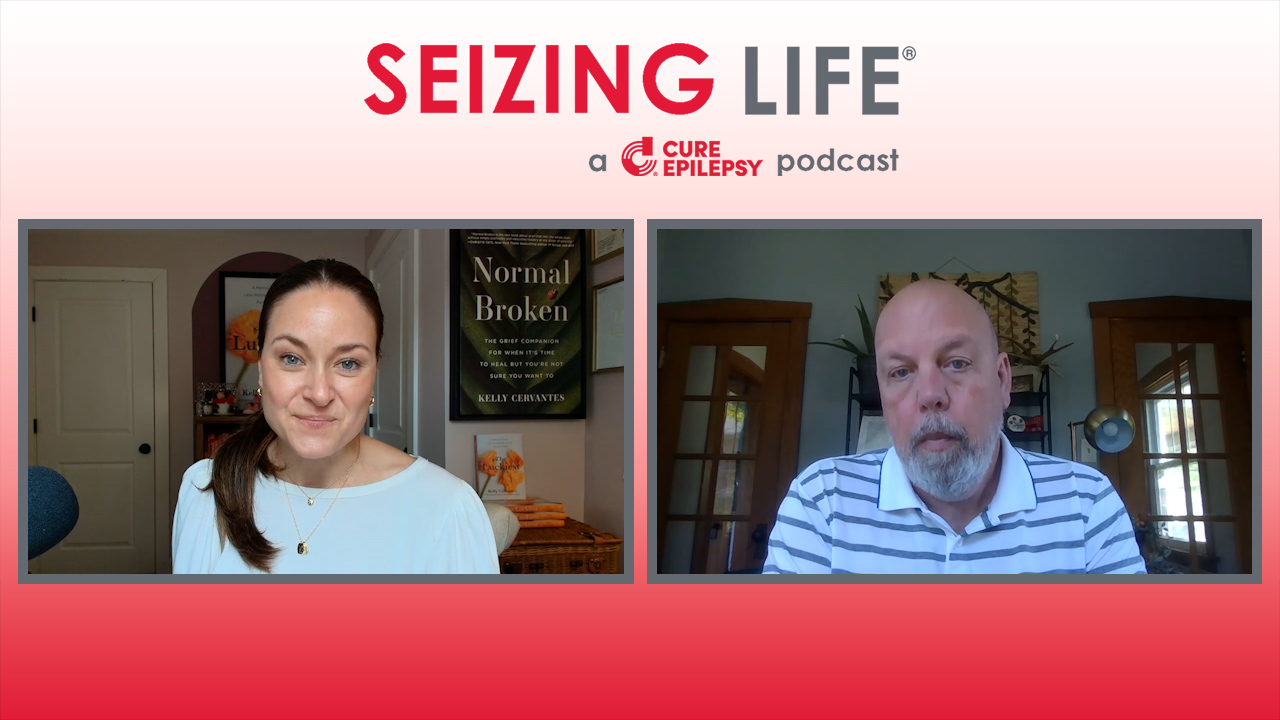
On this month’s episode of Seizing Life®, Kelly Cervantes speaks with neuropsychologist Dr. James Jackson about medical trauma and the often-overlooked emotional toll of living with epilepsy.
Dr. James Jackson, psychologist and neuropsychologist at Vanderbilt University Medical Center, and author of the recently published Reclaiming Your Life from Medical Trauma, discusses this relatively new term and explains how it can present in both patients and their family members. Growing up the son of a father living with epilepsy, Dr. Jackson understands personally the psychological and emotional impacts it can have on those living with the disorder as well as those who love them. He shares how seizures, hospital stays, ongoing uncertainty, and even everyday medical experiences can leave lasting effects on patients, caregivers, and entire families. He explains why epilepsy-related trauma is unique, and how it can show up as anxiety, avoidance, shame, or PTSD-like symptoms, and offers insights on recognizing warning signs and seeking support. Based on his work with patients and caregivers as well as his own personal experiences, Dr. Jackson encourages early mental health support, sharing his approach of Acceptance and Commitment Therapy to help patients begin to heal and move towards building a rich, meaningful life even in the presence of fear and uncertainty.
As those in the epilepsy community know, epilepsy doesn’t just impact the individual living with it, it touches everyone around them. This episode provides insights, encouragement, and support for those struggling with epilepsy’s “hidden” emotional and psychological effects.
Episode Transcript
Kelly Cervantes:
Hi, I’m Kelly Cervantes and this is Seizing Life, a monthly podcast produced by CURE Epilepsy. Today I’m happy to welcome Dr. James Jackson to the podcast. Dr. Jackson is a psychologist, neuropsychologist, and research professor of medicine at Vanderbilt University. He’s just published a book entitled, Reclaiming Your Life From Medical Trauma: Recognize the Symptoms, Find Treatment That Works, and Heal Your Brain and Body. Dr. Jackson is here today to explain medical trauma and discuss how it can impact individuals and families living with epilepsy. Dr. Jackson, thank you so much for joining us today. To kick things off, can you just give us a quick profile about yourself, your professional background, and how it is that you became interested in medical trauma?
Dr. James Jackson:
Yeah, thanks, Kelly. Lovely to be here. I’m a psychologist at Vanderbilt Medical Center where I have been for almost a quarter of a century, which makes me feel really old. I started working at Vanderbilt in 2001 and my work really gravitated toward engaging survivors of critical illness, working with people who had been hugely ill and hearing their stories of survival. Their stories and the stories of chronically ill patients we worked with were complicated. They weren’t strictly speaking completely positive. People had survived but often had brand new challenges. And it led me to realize that one of the themes in the lives of these patients was trauma. Often it was new trauma oriented around the development of a new condition, either acute or chronic. And as I engage patients a bit more fully, trauma was a theme that ran throughout.
And my interest in medical trauma, as it’s called now, led me to write this book, this book, Reclaiming Your Life from Medical Trauma, led me to focus on a group of people there it is, that have been underappreciated, I think, that have been underserved, that had been overlooked. All too often, patients with chronic illness, when they’re given medication, when their symptoms are managed, often the only emotion they’re supposed to experience is gratitude. And I have found that the stories are a lot more complicated than that. People don’t quite know what to do, Kelly, with the complicated feelings that develop in the context of chronic illness.
Kelly Cervantes:
Yeah, 100%. I was so excited when John presented this topic to me because I know as a caregiver, this is something that a lot of medically complex caregivers speak about, but I don’t think that there has been much focus on it. Just so we’re all working on a level play field here, can you give us a simple definition of medical trauma and maybe an example or two?
Dr. James Jackson:
Absolutely. In the very simplest terms, medical trauma refers to the idea that often emotional distress develops after medical experiences or encounters of all kinds. They can be difficult visits to the physician. They can be the development of life altering illnesses like epilepsy. They can be surgeries. They can be things that people might think would be traumatic or might not. But regardless, it’s the idea that someone has a medical experience. It leaves an emotional mark and that emotional mark is significant enough for it to impact the day-to-day lives of people. A medical experience, there are many that leaves an emotional mark severe enough that it impacts your life. That’s medical trauma.
Kelly Cervantes:
So does it only stem from sort of these critical life altering experiences and chronic illnesses, or can it also result from more subtle experiences?
Dr. James Jackson:
It absolutely can result from more subtle experiences. And I love that comment because too often I think people talk about big T and small t traumas and I think those distinctions aren’t necessarily helpful. There have been things in my own life that people would consider small t and the impact has been big T. So equally, I think in the medical arena, there are some things that are quite profound, dramatic ICU hospitalizations, let’s say, that everyone would agree would be traumatic. And there are some things that many would say would be relatively minor and yet it’s the patient, it’s the caregiver that gets to decide whether that’s a trauma.
I think it’s really unhelpful what people do too often, sometimes in the psychology field, which is to say, “Here’s how we define a trauma. What you’re talking about is a little too subtle. It doesn’t really measure up.” I think that’s really invalidating. If people call it a trauma, I want to meet them where they’re at and affirm them. And in my experience, there have been some things that I’ve seen in some patients that, as you noted, are nuanced, they’re subtle, they’re quiet, and yet they leave quite a profound mark.
Kelly Cervantes:
As you’re talking, I’m thinking from my own personal experience, yes, there were these big capital T traumatic moments, but some of the moments that stick with me the most or haunt me the most are some of those more subtle moments, but maybe they were repetitive. They occurred over and over again day after day. And so it’s almost this snowball effect of this small little t trauma, but when it happens over and over and over again, it definitely leaves an impact on our lives. I wonder if you can speak to the experiences of patients living with epilepsy. What do they typically cite as traumatic events aside from obviously the seizures themselves?
Dr. James Jackson:
Yeah, it’s a really good question. And I think you’re right. The phrase that people sometimes use is the death of a thousand cuts. And that’s a real phenomenon. It’s a real phenomenon that is subtle things that may be almost incidental, but they’re so repetitive and they are so enduring that they’re really problematic. When I interact with patients with epilepsy, I think there are a range of things that occur in terms of their own trauma. One of the things that’s very traumatic to them certainly could be a seizure that they had, but equally, I think real trauma relates to the ongoing fear that is percolating in them that they’re going to have another one and another one, another one and that that is going to impact their young child who perhaps didn’t see the profound seizure that they had, but they worry that he or she might see the next one. And the next one and the next one, they’re worried that they might have a seizure and this time it would prevent them from driving. We could come up with all these examples, but in many cases, in many traditional traumas, the trauma is behind you. That is if you’re in combat in Iraq, you were there in Fallujah in 2003, that trauma happened behind you. As you retire, you know you’re not going back to Fallujah, it’s behind you. But if you have a condition like epilepsy and it’s very likely that the traumatic thing, the seizure is going to happen again and again and again, then that trauma is never behind you. That trauma is behind you and in front of you. And when it’s in front of you, Kelly, as you know, that’s a particularly challenging thing when it’s in front of you and when you feel like you carry it around in your body. I think it’s very scary, not only for patients, but equally scary, I think, for family members who often adapt their lives completely for better or worse to try to care for this loved one who again might have another seizure. It’s very much a family problem and the trauma is forward-looking.
Kelly Cervantes:
Yeah. You brought up service members, which makes me think of PTSD. And I wonder, so is medical trauma sort of a form of PTSD? But then you’re talking, I’m like, it isn’t just post, you’re right. It’s that future that the trauma of knowing that this is going to happen again or it could happen again. I’m thinking also of extended stays in an epilepsy monitoring unit for days on end and the stress that the doctors may put on someone’s body to try and induce a seizure. In the sort of clinical landscape, how does medical trauma fit in with PTSD?
Dr. James Jackson:
So it’s a great question. Medical trauma often leads to PTSD. It doesn’t always, but in many cases, it very much leads to PTSD and the boxes you check to get a diagnosis of PTSD in the context of medical trauma are really the same boxes that you check in the context of PTSD due to things like combat. Now, the symptoms are expressed a little bit differently. In the case of combat, the thing that people are worried about would be often loud sounds. You hear Vietnam veterans talk about how they came back from Vietnam and a car backfired and they hit the sidewalk. That’s a common story at the VA that I hear.
Well, people with epilepsy, of course, aren’t worried about a car backfiring, but the thing that is activating them would be subtle changes in their body that they notice that might cause them to think, “Oh my, I’m about to have another seizure.” Or anniversaries perhaps of the day they had a profound seizure that was life changing or similar sorts of things. So the template fits. It’s not always true in every patient, but in many patients with medical trauma, there often is PTSD. In many, there is anxiety and many there’s depression in many there’s OCD, but PTSD is really quite common.
Kelly Cervantes:
Hi, it’s me again. Can I ask you to do me a favor to help the podcast out? It would mean so much to me and my colleagues at CURE Epilepsy if you could rate us five stars on Apple or Spotify and leave a review. Ratings and reviews help Seizing Life reach more people in the epilepsy community who are looking for answers, connection and hope. Every rating, review, and download really does make a difference. Thank you so much for listening and now back to Seizing Life. Now, earlier you had mentioned that epilepsy affects the entire family, not just the patient. I’m wondering in what ways do you see medical trauma show up for partners and caregivers or children?
Dr. James Jackson:
This is a deeply personal conversation to me. I was at my parents’ house just three hours from here over the weekend. They’re in their 80s now and they’re delightful, but my dad has had epilepsy basically his entire adult life and my mom had whatever plan she had and she altered those pretty dramatically in an effort, I think, to make sure that if my dad’s epilepsy continued to be an act of concern, someone would be at home, for instance, to attend to the kids, that someone would be reliable if his illnesses derailed things. So I witnessed her, I really heard later that she had made very particular choices. She’d made choices to give up on a professional career that she wanted to pursue so that she could always be home because she felt like she needed to be home. But I think her story is quite similar.
That is that often people are wrapped up by pretty immersive experiences of fear when a family member develops epilepsy, has seizures and they move into a very protective mode and that’s not wrong. I don’t think that’s right or wrong, but it clearly impacts people. It clearly impacts the choices that people make. And in addition to that, I think if there are young kids involved, often they themselves develop meaningful symptoms of anxiety. I think sometimes they become very parentified. Sometimes they take on way too much responsibility. Sometimes a spouse feels like they have to take inordinate pains to monitor and attend to their own health because if something happens to them, who is going to take care of their partner? So there are a huge array of consequences and even if loving family members embrace them because they love their spouse or they love their son or daughter, even if they embrace them, there’s still consequences. There’s still really meaningful challenges and Kelly, they affect the entire family sometimes dramatically.
Kelly Cervantes:
Dr. Jackson, have you been spying on my family? A parentified child.
Dr. James Jackson:
It’s familiar.
Kelly Cervantes:
Lots of anxiety. There is something bittersweet, pseudo comforting to know that our family with my daughter and my son was only, he’s 13 now, but he was only 7 when his sister died. And so he was young when all this was going on and watching him sort of become this parentified child. There’s something comforting to know that it is a very typical response and also just it makes my heart break for all of the kids out there that that is their reality. They grow up with this kind of medical trauma. I feel like I have such this wonderful opportunity again, fortunately, unfortunately to talk to you about this because you are a child of someone with epilepsy and if you would be willing to share with us how that impacted you.
Dr. James Jackson:
Sure. I’m glad to. And I empathize with these challenges you’re having. You’re so thoughtful in conveying them and I’m sorry. And you mentioned so many things that remind me of the importance of what I’m going to call both andness, both andness. And what I mean by that is these situations are hugely difficult and they can be beautiful, right?
Kelly Cervantes:
Absolutely.
Dr. James Jackson:
I’m looking at the poster behind you, normal, broken, both andness, normal, broken, beautiful, tragic. These things go together often in families with epilepsy. For me, I was not aware of the scale, honestly, of my dad’s struggles. My mom, in the way that people did in the 1970s, built kind of a wall around the magnitude of the difficulties he was having. It was only later that I learned that he had had seizures as commonly as he had. At one point as a young man, I said to my mom, “Do you remember when dad had that electric bike? That was amazing. That was so cool.” And she said, “Do you know why he had that?” And I said, “No, I just thought it was amazing. I remember him riding the work on this bike with a little motor.” And she said, “Well, it was because we didn’t want him to drive.” And I thought, “Oh my gosh, I didn’t know that.”
So there are a lot of seizures that my father had had that I don’t recall, but there were quite a few that he did have that I remember and that translated in our family into anxiety in my mom, which I think in turn translated into anxiety in my life and that anxiety in my life has turned into ongoing anxiety in my life. And when well-meaning people say to other people, “It’s just anxiety.” I think, “Really, just anxiety? If you ever had anxiety, don’t put the word just in front of anxiety.” So I think in our family, part of what happened was my mom took whatever resources she had to try to support my dad and that meant there weren’t resources for her to do other things that she wanted to do that she probably needed to do. And I think that zero-sum dynamic is a common one. That is, you have a limited store of resources. And if you are devoting them all in this direction by definition, you’re only going to have so many left to attend to other things. I think that’s a common phenomenon. It’s easy to empathize with. And for me, I think that the development, one of the dynamics was anxiety. I think for me, one of the lovely developments was an interest in medical trauma that if I was really honest, probably began somewhere around 1975 or 1976 or 1977, even though I didn’t know it. I remember occasionally my dad would have his medications changed and he’s doing very well and has for many years, thank God. But every time he would change his medications, there was this tremendous anxiety around, “Oh my, what’s going to happen now?” And at one point, I think the doctors had suggested that he stopped taking medication. He perhaps didn’t need it anymore. It had clear side effects. And I remember in my family and my parents, there was tremendous concern about that. I have this complicated relationship with medication. I don’t like to take it. If I’m taking it, I don’t want to change it. And I really think it has origins perhaps in witnessing this with my dad, that when it was working, it was scary to change it. Maybe he didn’t need it, but he didn’t want to leave it. I think these sorts of things, Kelly, they cast a long shadow in the lives of families where epilepsy is unfolding.
Kelly Cervantes:
Dr. Jackson, I cannot say enough how validating this conversation has been for me. And I know it’s going to be for so many others. I wonder next if you can help us, what are the signs that someone is affected by medical trauma? And I guess if we see it in someone else, how can we help them? Or if we see it in ourselves, what are the steps we should take that are going to be meaningful?
Dr. James Jackson:
Sure. It’s a great question. One of the things our medical trauma patients need more than anything is support. They need support. All support is not created equal and often people don’t know when they need to get support to answer your your question. And one key bedrock that often is evidence of medical trauma, I mean, it’s important for a provider to diagnose it, not me across the airwaves, but one key feature often that tells me somebody has been traumatized by a difficult medical experience is really profound avoidance. And that often takes the form of things like withdrawing from the life that someone had before, could take the form on the heels of epilepsy of real depression. It could take the form of pretty intense shame. It could take the form of a lot of blame. It could take the form of ruminating on for people in particular who developed epilepsy relatively later, it could take the form of ruminating on life before versus life after.
This is often assigned to me that issues have to be addressed when people spend inordinate amounts of time thinking about the old me versus the new me. Before I had that first seizure and it caused me to lose my driver’s license and it caused me to feel different than everybody else, my life was perfect and now my life has been derailed. That framing often is indicative in my mind of the idea that someone has experienced some degree of medical trauma and the cure, there’s not a single cure, but the cure to that, of course, is let’s find a way to integrate both parts of you. Let’s recognize that there really isn’t a pre-epilepsy you and a post-epilepsy you. There’s a you. There’s a lovely you, but often that’s what happens a lot of fragmentation.
I reference shame and often there is literal symptomology of PTSD and that could take the form of nightmares about the events that surrounded this seizure, nightmares related to being in the hospital if indeed someone was in the hospital. It could relate to marked avoidance. “Hey, I’m not going back to the neurologist even though I need to because it’s too scary. I’m not taking the medication even though I should, because if I do, it validates that I have a problem, I don’t want to deal with it.” All of these symptoms often are reflective of some degree of medical trauma.
Kelly Cervantes:
Something that you bring up in the book that I think is so important is that we have these traumatic events in our life or we go through something particularly challenging, say a seizure and it feels like of course we’re going to be affected by it. Our response, this idea that it has negatively impacted us is, well, of course it is. And this feels like a typical response. But what I love that you’re pointing out is like, yes, just because we are responding to trauma in a typical fashion doesn’t mean that we have to let it dictate our lives, that we can address it ideally in some sort of therapeutic or clinical setting. Can you talk to us about acceptance and commitment therapy and what that is?
Dr. James Jackson:
Yeah, I love it that you’re mentioning acceptance and commitment therapy. And I wish the concepts in ACT, as it’s called, were broadly available years ago in the way they are now because I think for your listeners who are interested in connecting with a mental health professional, they’re not sure what to do. Seeking someone out with expertise in ACT is probably one of the best things that they can do. ACT is predicated acceptance and commitment therapy. Is predicated on the idea that you don’t necessarily have to change your symptoms. I mean, we would like you to, of course, we’d like that to be your story, but even if your symptoms don’t change, you can change your relationship with your symptoms, you can change your relationship with them. And I think that’s important because many people, whether it is lupus or whether it’s multiple sclerosis, whether it’s long COVID, whether it’s epilepsy, whether it’s chronic pain, often the narrative is until this condition goes away, I’m not going to be okay.
Until I get a lockdown 100% handle on it, things are not going to be okay. And often if that’s the stance that you take while I understand it, you’re going to be pretty unhappy because often you’re waiting for something that might not happen. So the challenge is even if this isn’t fixed, how can I find a way to be okay? And one way to do that is to make space for, this is a core ACT concept, to make space for uncertainty and to make space for the possibility that some really unpleasant things are going to happen. But the key has to do with uncertainty. And I think with epilepsy in particular, often people decide to build their lives around control and certainty because the idea is if I dot my I’s and cross my T’s enough, maybe I’ll never have another seizure. Well, the truth is often even if you do everything right, you cannot positively rule out the possibility that you’re going to have another seizure. It could happen. It could happen even though you’re being the very best patient as people try to be. So the truth is this search for certainty, while understandable, is a little bit of a fool’s errand and a wiser approach I think is to say, “Yes, I’m going to make good choices. I’m going to follow my doctor’s advice, whatever, but I’m not going to wait for this to be fixed to live a meaningful life. I’m going to try to find a way to live a meaningful life right now.” And that’s the heart of acceptance and commitment therapy.
Kelly Cervantes:
What are some of the activities or actions that someone can do to try and accept their reality to make a commitment to their health? What are simple strategies or tasks that someone might try?
Dr. James Jackson:
Sure. I love the question and I’ll start with a story. I’ll be quick. As a 50-year-old, more or less, I developed OCD. I developed OCD as an adult in my early 50s and it came quite out of the blue. It wasn’t epilepsy that I developed, but the process was similar. One day I was fine and the next day, here’s something that I didn’t ask for and I didn’t want. And I went to see a psychologist and I said some version of, “I don’t have time for this. This isn’t supposed to happen to me. I don’t really like this. It isn’t fun.” Let’s get rid of it. Let’s just grab it like a weed. How do I uproot it? I don’t want to have it. And she said kindly but firmly, “I don’t know that that’s how this works. I think you’ve got it now. I don’t think you can unring the bell now.” And Kelly, for about two years I just resisted, just fought that message that I needed to accept it. And there was a certain narcissism I think in that, that is I’d been pretty successful and I viewed myself as a problem solver and I kind of thought other people can accept it, not me. And my wife would gently nudge me to try to accept it. I would push back. And one day we lived on a house on a big hill at the time and I remember sitting in my car thinking, “I’ve made no progress over two years with this. Maybe I need to try to accept it.” And when I did, it was like the lights came on, music playing. It was dramatic and things started changing a lot and I started improving. And one practical thing that happened was I stopped overidentifying with it. That had been a big thing, stopped overidentifying with it and I began recognizing that I could make space for this thing that was really unpleasant. I could make some space for it and I could learn to treat it, this isn’t my phrase, but I could learn to treat it like an unwanted house guest, meaning, somebody came to visit. I’m not very happy they’re here and I think I can probably find a way to tolerate the fact that they’re here over time, unwanted house guests.
And there are practicalities and we can break them down with regard to things like accepting epilepsy, but it starts with an openness to the idea that in some ways the more I fight against this internally, the more I’m going to keep it activated and the more I can make space for it, the more freedom I’m going to get. And in that sense, Kelly, I know I’m a good bit older than you, but in that sense it reminds me a lot of the thing that maybe you remember. I remember used to be at county fairs and they were called finger traps. Do you remember these things?
Kelly Cervantes:
Yes. Yes.
Dr. James Jackson:
And you stick your fingers in? Do you remember they were made kind of out of a bamboo?
Kelly Cervantes:
Yep.
Dr. James Jackson:
And the harder you would pull, the more they would kind of clash your fingers. And if you push instead of pulled, if you stop fighting, you could just sort of get some freedom. You take your hands out, you’d be free. And it’s a similar dynamic with so many chronic illnesses. I have found that if people are even open to the idea that maybe I can find a way to live a rich life with this, then things start to change. But the more they are pushing a beach ball underwater to try to get rid of it, the more it invariably pops up in their face. So the key I think is to begin there, begin with the idea that I don’t want this. I don’t like it. I didn’t ask for it. It’s not fair, whatever. And I’m going to begin considering the possibility that I can live a rich life with it.
Kelly Cervantes:
Yes. So we’ve spoken about patients and their families and how medical trauma impacts them. What about medical professionals, doctors, nurses? What should they be aware of when it comes to medical trauma?
Dr. James Jackson:
It’s a great question. And I work every day, of course, with thoughtful physicians at Vanderbilt and elsewhere and have such affinity and affection for physicians. And yet I think there’s a common phenomenon which is you go to the neurologist for a follow-up in the context of epilepsy, you haven’t had many symptoms or your seizures are well-managed or whatever. And not infrequently, I think things stop right there. The physician says, “Really happy you haven’t had another seizure. It seems like the medication’s working. Follow up with me again in six months or whatever.” And too often there isn’t that conversation which is, “Oh, by the way, how are you doing emotionally because I’m guessing this is a struggle for you?” Or, “You told me the last time we met that you were worried about losing your job. What has happened about that? Or I know you were this pretty high-flying guy now and you love cars and you can’t drive now. What is it like to have your wife drive you around?”
Those are simple questions and it would take, I think 30 seconds to ask them, but I think they would reflect genuine care and I think they would begin to invite people, patients to talk about the sorts of things that they need to not bottle up. So that would be my desire with the medical profession writ large, which would be don’t equate a good medical outcome with a good overall outcome. Somebody’s epilepsy could be well managed if the only metric we’re using is they haven’t had a seizure in the last year. And if they now have PTSD or their life is so contracted that they’re hardly leaving the house, is that really a great outcome? Not necessarily the outcome that would matter to the patients.
And I think we just need to be a little more curious, maybe a lot about that because when we ask those questions, often patients will join us, tell us how they’re feeling and in identifying those problems, “Ah, you’re anxious, you’re depressed, you have PTSD.” We can then connect patients with resources. And what I would tell you is when people with medical trauma due to epilepsy get the mental health care they need, their marriage gets better. Their children do better, their life gets better, but often they need an invitation to pursue something because sometimes they don’t really have the words to describe what is going wrong.
Kelly Cervantes:
So where can someone turn to for help with medical trauma? Can they see any therapist or psychologist or are there people who are specifically trained in medical trauma?
Dr. James Jackson:
There are some experts in medical trauma. There aren’t many. There’s not a phone book, not that those exist anymore, but-
Kelly Cervantes:
Although there is this book, which I have to recommend to any and everyone, your book that just came out last month.
Dr. James Jackson:
No, thanks for that. And really one of the reasons for that book was to try to shine a light on a problem that many people sort of inherently know about. They don’t know how to describe it. So there are some medical trauma experts, but I think there are some medical trauma experts. I think that if someone goes to a capable therapist, I have a preference for a psychologist. Often they have a little more sophisticated mental health training, but a therapist would be fine. A competent master’s level therapist very often would be fine. If someone can go to a capable therapist, often that is the place where healing can really begin. There are some nuances related to the treatment of medical trauma, but if someone is thoughtful and adept at treating trauma, I think they often can figure out how to support this. I think if someone knows how to manage depression or anxiety, even if it isn’t due to medical trauma, often that professional will be adequate.
I think the key is taking the first step. I’ll share a really quick anecdote if I may, and I think it underscores this. Years ago, my wife and I lived in California and we moved to Nashville. We had one car, didn’t have any kids. It was a little Mazda and I drove it and I drove it and I drove it. And one day the check engine light, Kelly, came on and I had some note cards in my car and I took a note card and I can’t believe I did this, but I did. I put it over the check engine light and I just kept driving. I didn’t want to deal with it. I was in a hurry. I just kept driving. And actually I remember thinking, “That’s amazing. There’s no check engine light on.” I kept driving. And then four or five months later, one night the car started shaking, it started smoking.
It broke down by the side of the road and the next day I sold it to a scrapyard for $50. That’s the story. And the lesson I think is when you’re witnessing these blinking lights in your life, whether it’s the car or whether it is in the context of epilepsy, I’m withdrawing from my life. I’m feeling deep shame. I’m getting angry with my kids over things that didn’t bother me before. I’m engaging my wife or husband in ways that are a little bit harsher. I’m not so motivated. I’m having nightmares. These are blinking yellow lights, right?
They’re blinking lights. And if you can attend to these things while they’re blinking yellow, it’s much easier to transform those problems than it is now that the car is sitting by the side of the road smoking. So the invitation would be if you feel like you’re struggling with mental health problems due to the fallout of epilepsy, start with your PCP, talk to your pastor, talk to a trusted friend and don’t wait. Go seek some help. It will be relatively easier to address it if you don’t wait three or four years until you absolutely have to. I think that’s the message.
Kelly Cervantes:
Yes. Dr. Jackson, thank you so much for writing this book. Thank you for chatting with us today, Reclaiming Your Life From Medical Trauma. I really think this episode is going to help so many people and I’m just so grateful for you for shining a light on this very prevalent and serious issue.
Dr. James Jackson:
What a pleasure to be with you and I’m personally really grateful for the work you’re doing. So thank you. Thank you.
Kelly Cervantes:
Thank you, Dr. Jackson, for sharing your insights and advice on medical trauma and how it can impact those living with epilepsy and their families. The parents who founded CURE Epilepsy over 25 years ago experienced the many impacts of epilepsy firsthand. That’s why they joined forces to spearhead the search for a cure. Since 1998, CURE Epilepsy has raised more than $100 million to fund epilepsy research and other initiatives that will lead the way to a cure. If you would like to support our mission, please visit cureepilepsy.org/donate. Thank you.
Legal Disclaimer:
The opinions expressed in this podcast do not necessarily reflect the views of CURE Epilepsy. The information contained herein is provided for general information only and does not offer medical advice or recommendations. Individuals should not rely on this information as a substitute for consultations with qualified healthcare professionals who are familiar with individual medical conditions and needs. CURE Epilepsy strongly recommends that care and treatment decisions related to epilepsy and any other medical conditions be made in consultation with a patient’s physician or other qualified healthcare professionals who are familiar with the individual’s specific health situation.