
Nicole Teeny on Epilepsy, Endurance, and Running with Horses
Episode Overview
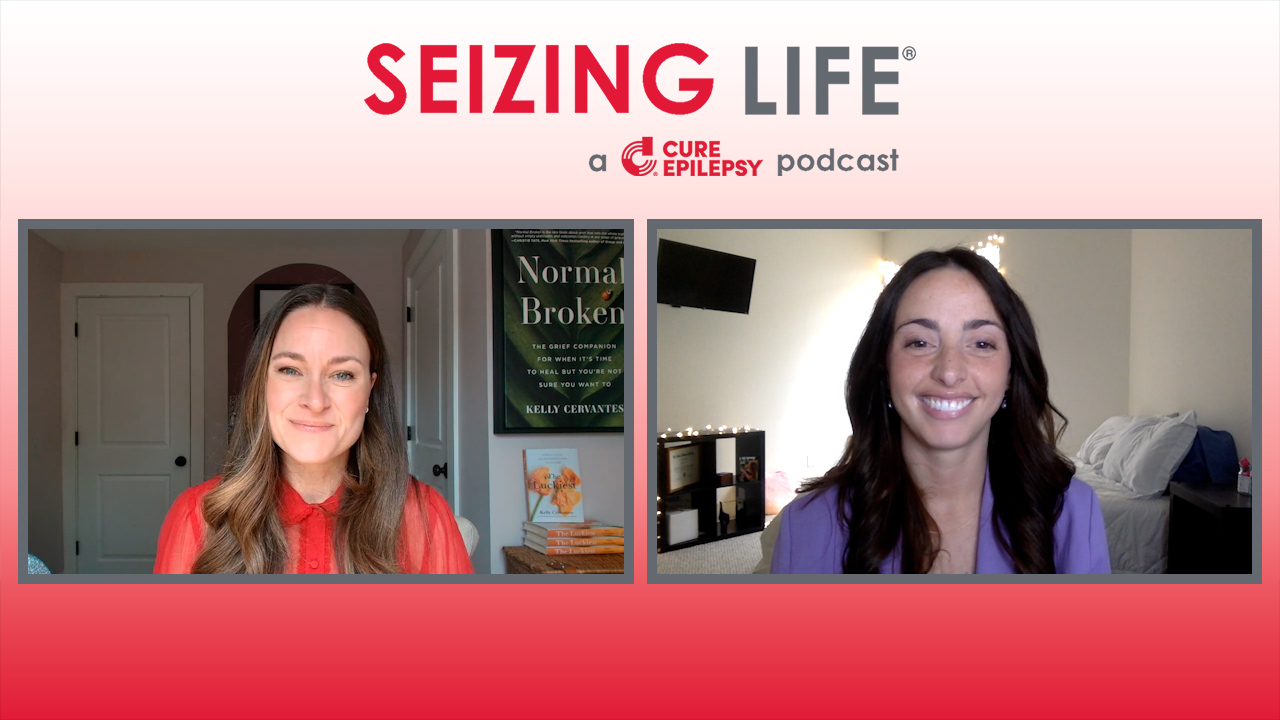
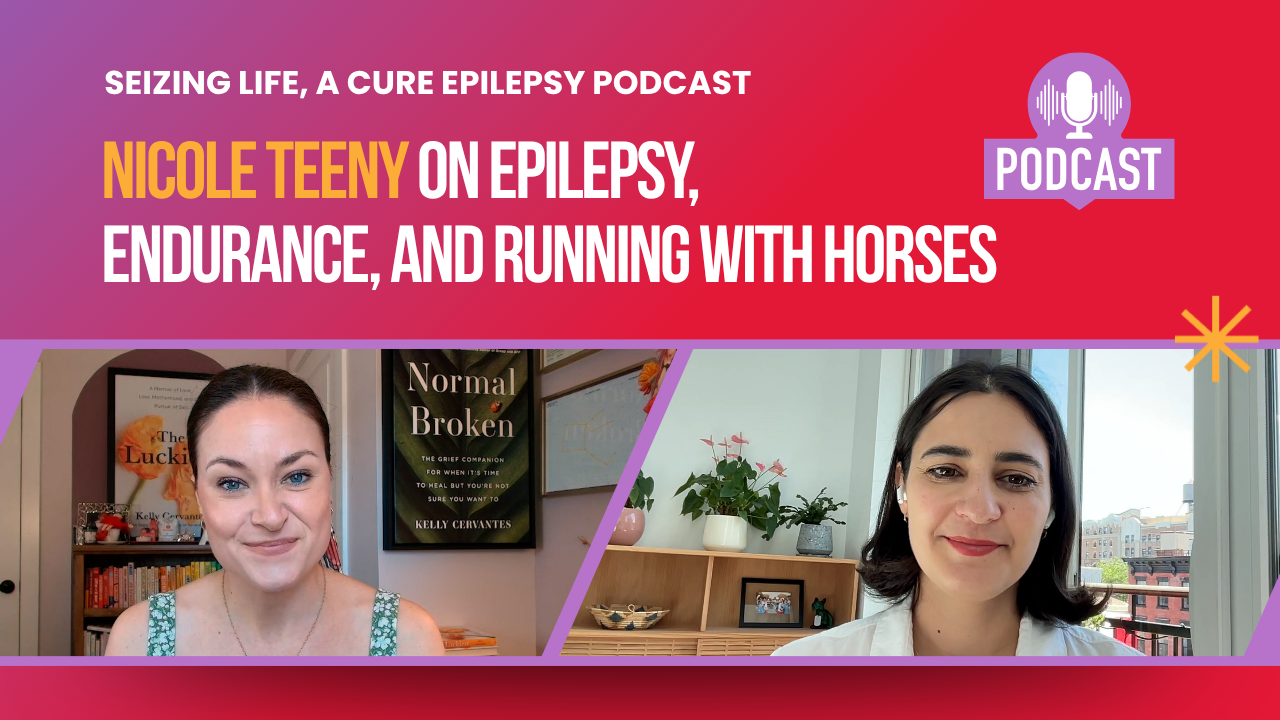
Writer, filmmaker, and podcast creator Nicole Teeny joins Kelly to share her journey with adult-onset epilepsy and the deeply personal story behind her ESPN 30 for 30 audio documentary, GIRL v. HORSE.
Epilepsy entered Nicole Teeny’s life in her early thirties, upending her life, work, creativity, and passion for running. Nicole discusses the shock of her first tonic-clonic seizure, the long process of diagnosis and finding a medication that helped control her seizures while allowing her to feel like herself, as well as the emotional impact of epilepsy on her identity and relationship to her own body.
When epilepsy interrupted Nicole’s professional life it also derailed her running routine, an activity that she had long depended on for both physical and mental well-being. As Nicole struggled to gain seizure control through a series of medications, she also set an audacious goal for herself: running a 50-mile endurance race against horses. With support from her wife, family, and doctors, Nicole found ways to train safely, confront uncertainty, and reclaim a sense of connection to her body. In this inspiring conversation, she details how preparing for the race helped her learn to live with epilepsy by focusing on “controlling the controllables,” and explains how the experience became a four-part ESPN documentary series.
Nicole’s story is a powerful reminder of the resilience of people living with epilepsy, the importance of community and support, and the urgent need for continued epilepsy research to improve treatments and ultimately lead us to a cure.
Listen to Nicole’s 30 for 30 Audio documentary: GIRL V. HORSE
Episode Transcript
Kelly Cervantes:
Hi. I’m Kelly Cervantes, and this is Seizing Life, a monthly podcast produced by CURE Epilepsy. This month, I’m joined by writer, filmmaker, and runner Nicole Teeny to talk about her extraordinary journey with epilepsy and the deeply personal story behind her ESPN 30 for 30 audio documentary GIRL v. HORSE. Today, Nicole shares how she navigated diagnosis, treatment, and the uncertainty that epilepsy brings and how creativity, endurance, and determination helped her find her way back to herself. Nicole, thank you so much for joining us today. To start things off, can you just give us a thumbnail sketch or, perhaps, since you’re a filmmaker, an elevator pitch about who you are?
Nicole Teeny:
Yeah. So I’m in Brooklyn, New York. I’m a writer, director, and I work in documentary and also in narrative podcast. I have films on Netflix and Paramount+, and I most recently have a podcast series called GIRL v. HORSE on ESPN 30 for 30 that is about my journey with epilepsy and running an ultramarathon against horses. Actually, I realized more recently than that, I completed a triathlon in Antarctica and was the second woman to do so.
Kelly Cervantes:
Oh my gosh. I cannot wait to dive into all of that. First and foremost, congratulations. That is wild, literally. You’re amazing. Of course, my interests lie in that you’ve been able to do all of this and accomplish all of this while navigating epilepsy. So how did epilepsy first enter your life? When did you have your first seizure?
Nicole Teeny:
I was in my early 30s when I had my first seizure. It was just sort of like a normal summer day. I’d actually been kind of burning the candle at both ends before that. I just finished up a big project. The night before, I had kind of celebrated with some of my friends and stayed out late. And so I was like, “Oh. Great. I’m done with my project.” That morning, or I guess it was more like late morning, early afternoon-ish time, I was hanging out with my mother. It was the weekend, and we just sat down on the couch to just chit-chat. I was like, “Oh. I’m so tired. It must be like all this, projects and work.”
I sat down and was like, “I think I’m going to take a nap,” and I never take naps. At least at that point, I hadn’t. I woke up instead in an ambulance covered in blood, kind of confused and delirious, and was like, “What am I doing here?” That’s when they’re like, “Nicole,” those voices that are hovering over you, they’re like, “You’ve had a seizure. Stay calm, man.” And so that was when I first had my first seizure, was with my mother. But she is a nurse, and she was trained as a nurse. So she knew right away, like, “Okay. I know what this is. I know what’s going on here.” And so I was very fortunate.
Kelly Cervantes:
What did the doctors tell you in the ER? Were any tests done? What information did you have after that first seizure?
Nicole Teeny:
They kind of were like, “Well, it could be a fluke. It’s just one seizure. Anybody can have a seizure. It’s got to be a pattern to be epilepsy.” In fact, epilepsy wasn’t even really on the table. That word wasn’t even really something that they discussed in the ER. It was more like it was a packed ER, “Let’s get her out. Let’s move on. Go follow up with a neurologist.” So I was like, “Oh my gosh. A neurologist.” For me, that was one of my biggest fears, was that something with my brain would be off, because I feel like a lot of us, we feel like our brains are part of who we are and part of what makes us us.
Kelly Cervantes:
And especially as a creative.
Nicole Teeny:
Yeah. You get it. You’re a creative person, as well. You’re like, “Oh my. That’s me.” So yeah. It was pretty nerve-racking, but I was like, “Okay. I’m going to go see who my PCP recommends.” Ended up being this woman, Dr. Amy Jongeling, who is still my neurologist today, and I got so lucky having her. She’s just a remarkable human being, incredibly smart, incredibly kind, funny, which is also pretty awesome to have when you’re struggling with something that you don’t know what is going on, and also just willing to listen to patients, which I think is, the more I hear other people’s stories, I think is not a common thing. So I felt very grateful to have her.
She had them work up an MRI, blood work, and I had to do a 48-hour EEG in the hospital. At that point, it’d been a couple months, and so I was like, “That was just a fluke. It was so nice to meet you. What a crazy thing that happened. Oh wow. Weird stuff happens to people. Right? Maybe this is my weird thing that happened to me, and I’ll use it in my art later,” whatever, very naive. By the time it came to the 48-hour EEG in the hospital, I was like, “Okay. Let me just get through this. I have places I need to be, things to do. Glad this weird event in my life has kind of passed.”
Then, the next morning, the doctor came into the room, and she was like, “Okay. We’re just going to go over your results. There was some epileptic discharge.” So I was just like, “Wait a minute. That’s not supposed to be the answer that I heard today. This was supposed to be just this contained moment.” But she said, “If you haven’t had a second one yet or another one, it’s very unlikely you’re going to have another, especially if you don’t have one in the next six months.” So I was like, “Okay. It’s been a couple months already. We’ll just let the timer go.”
Kelly Cervantes:
So you’re crossing fingers, and counting months, and hoping that that second seizure doesn’t happen, but unfortunately, it did. Otherwise, we wouldn’t be talking to you today. So when did that second seizure happen, and sort of walk us through what transpired from there.
Nicole Teeny:
So it was around like five and a half months, and I was like, “Great. It’s almost six. It’s probably not going to happen. We’re good to go.” I went on a girls trip with some of my friends. So I had a friend visiting LA, and so I got together some of my college friends. I flew down there, and we all met up and hung out. The first night, everyone arrived, and we went to bed. The next morning, once again woke up in an ambulance, and I was fortunate that we were all crammed into this apartment. I was sharing a bed with one of my friends, and I guess I had fallen off the bed. She was like, “Nicole? Nicole?” and I didn’t respond. So she came over and was trying to figure out what to do. The other friend came over, and they were like, “Okay. Let’s call 911.”
They’d known about the first seizure, so they were kind of like … It wasn’t like, “What the heck just happened?” That was the second seizure, and that was kind of like a … Because they were tonic-clonic seizures, it was like, “We have to do something about this now.” It was not something I could ignore, and lost my driver’s license, had to suddenly schedule a zillion appointments, try to figure out what this meant for my life. I was in the middle of a project, and I had to stop.
Kelly Cervantes:
So you have this second seizure, and at that point, are you diagnosed with epilepsy? Is that when you started medication?
Nicole Teeny:
Yeah. So then, the doctor’s like, “Okay. Epilepsy is a propensity to get seizures. You’ve now had two, completely unprovoked. There’s no evidence or reason why. So you do have epilepsy, because it is continued unprovoked seizures. So we got to make these stop.” So then, we began the extremely fun journey of trying to find a way to control the seizures or at least wrangle them in some sort of fashion and then finding … I mean, as you know, I’m sure the medications that you can get and the different treatments can sometimes be worse than the seizures, at least in terms of trying to function as a human being.
Not only had my brain turned on me and decided it wanted to revolt and have a seizure, but then, even with these medications, it was bringing out different lenses and ways of seeing the world that were not pleasant. And so you start to question your own understanding of the world and who you are. Because if I’m not my brain, and if I can never go back to that person who I was, then who am I?
Kelly Cervantes:
Yeah.
Nicole Teeny:
So I think there was like, there’s the physical issues of trying to find a way to be safe and find a way to literally continue and function in my life, like being on set. I like to run a lot. Can’t do that safely. But then, I think that the big thing is the, “Who am I?”s that are, and, “What does my future even look like if we can’t get this thing under control?”
Kelly Cervantes:
I think you expressed that so well and in a way that I haven’t heard it expressed before, but yes. Trying to figure out who you are, there is no going back to who you were before. But who is this new person, and how do these drugs impact that? I know that you are on a medication now that more or less works for you, and we’ll get to that a little later. How long did it take you to find a medication where it helped with the seizures and you could tolerate the side effects?
Nicole Teeny:
So the first seizure happened at the end of 2018, and it was kind of like an in and out of hospital sort of thing for a year and a half or so until the pandemic hit. I felt like, “Okay. I’ve got …” I ended up on a medicine where I wasn’t having tonic-clonics anymore, and since the pandemic was happening, I was like, “Okay. If I try to continue this trial and error of finding a new medication, I might, once again, end up back in a hospital.” Also, you don’t want to take beds from other people, but also, “I don’t want to get exposed.”
It just felt like it wasn’t the right time to continue. So I kind of held at something that was like good enough for a while until later, after things started to be a little bit safer, I was able to kind of pick that journey back up and try a new medication. I’m really glad I did wait, because it was drama, as it is trying new medicine.
Kelly Cervantes:
So it took you several years, I mean more than two, two, three, four to find a … get to where you are now with a medication that has allowed you to continue and pick up running again.
Nicole Teeny:
Yeah.
Kelly Cervantes:
I am not a runner. I just am not. I admire people so much that are. What is it about running? How did you pick it up, and how did your epilepsy affect it?
Nicole Teeny:
So I’ve been running since I was a kid. I was extremely clumsy as a child, and I was always running into things and tried different sports. But I had a lot of energy. My parents were like, “Okay. Let’s just try running,” And I could do that. It didn’t require much coordination, and I just turned out I wasn’t the worst at it. I loved it. I felt empowered. I was very scrawny as a kid, but when I ran, I felt really strong. I felt, I don’t know, I felt comfortable in my body.
I did my first half marathon when I was in middle school, and then, through high school and college, I just kind of casually ran on the side for fun and for health. Then, when I turned 30, like a year or two before that, maybe 28, I started picking up running again, and I ran another half marathon end of 29. Then, I think 30, that year, I ran my first full marathon, and I caught the bug. I was like, “Oh my gosh. I just got to do more of these.”
And so I was training for my second marathon when I had the first seizure, and I was really bummed. Because I had wanted to run New York City Marathon, and I’d gotten in. I was like ready to go. I was a couple months away, and the second seizure was in October, early October. The marathon is the first week of November, so it was one month before. So I was like, “Okay. This is not going to happen.”
Kelly Cervantes:
I can imagine the amount of training that goes into that, and then to be pulled away by a seizure is … It had to be devastating, but I wonder. So you go from half marathons to marathons, and you’re training. Then, at what point does your idea to race a horse … When I say that, I don’t mean you’re on top of the horse and racing with the horse. You are racing against a horse. Horse is running. You are running. Where did that idea and dream come from?
Hi. It’s me again. Can I ask you to do me a favor to help the podcast out? It would mean so much to me and my colleagues at CURE Epilepsy, if you could rate us five stars on Apple or Spotify and leave a review. Ratings and reviews help Seizing Life reach more people in the epilepsy community who are looking for answers, connection, and hope. Every rating, review, and download really does make a difference. Thank you so much for listening, and now back to Seizing Life.
Nicole Teeny:
When Epilepsy interrupted my running, it kind of felt like it was also interrupting the thing that connected me with my own body. Mentally, I didn’t feel connected. Physically, I didn’t feel connected. At the time, I had also been reading this book called Born to Run, which is like a seminal work in the running canon for books. Midway through the book, there’s a tiny little section in one of the chapters where, to support his thesis of humans being great runners, which humans, I should mention, humans are the world’s best long-distance runners when it comes to animals. We can outrun any animal, technically, if the distance is long enough.
He goes as far as to say a human could even outrun a horse. I just kind of had been stopped in my tracks when I initially read that, was like, “Wait a minute. Humans can outrun horses? That’s nuts.” That kind of had, when I’d read it, logged itself away, and I hadn’t finished the book when I had my second seizure. I picked the book back up, and I remembered, “Oh. There was that crazy idea.”
At that moment, when I was reading it, I was in bed going through a really terrible medication for me, and things were very bad. I read this thing, again, picked up my book about, and remembered, “Oh. There was that time that I had that dream where I could race a horse, where I thought, ‘Oh. Maybe that’s possible.’ Right now, it feels so far away from me.” It felt like the exact opposite of where I was sitting in that moment. I was stuck here, inside, couldn’t be alone, didn’t know when I was going to be able to get back to running again, let alone running safely.
Kelly Cervantes:
So, but you found ways to work around that.
Nicole Teeny:
I did.
Kelly Cervantes:
Talk to us about how you figured out how to train safely.
Nicole Teeny:
So for me, I think the first part of training was finding the right medication and treatment. I think people who’ve been through the journey of trying to find that realize it is a real effort-inducing endeavor. So once I got that done, I was like, “Okay. Phase one complete.” Then, I needed to work up to finding the confidence. Also, on route to that, I’m still a runner, and I still would love to run. I got really bummed about it, because running, for me, is, it’s not just a way to keep in shape. It’s part of who I am. It’s like a meditation. It’s like the way I process the world. It’s how I feel in sync with my body.
And so finding a way back to that became really important to me. I was kind of lamenting about it one day, and my then girlfriend, now wife, Mariel, was like, “Why don’t I just ride my bike next to you?” I was like, “Oh my gosh. I never even thought about that.” She knows exactly what to do when I have a seizure, and she’s been there for all of them, or not all of them, but for … She’s seen the range of which they can be, tonic-clonics, et cetera. So I was like, “Okay.” Because if I’m out there running in the streets of New York, and I fall down and what have you, it’ll be helpful to have somebody who knows, “Okay. Here’s what we do.”
So I was like, “Okay. This is amazing.” At that point, after having gone through just having so many seizures and feeling so disconnected, it just restored confidence in myself and made me feel like, “Oh. Maybe I’m still me.” You know? Then, as she started doing this biking next to me, she got a little curious, and she was like, “Oh. Maybe I want to try running, too.” She’d always said, “No. I’ll never run,” and I was never going to pressure her. I’m not that person. You know? But I was like, “Okay. If you’re interested, let’s go.”
So then, she started running with me. It not only was this way where I felt safe, but it became this fun thing that now is a thing we enjoy doing together. We do race. We plan trips with races around it, and it kind of became this … Yeah. It was crazy how it started to become such a big part of both of our lives. Eventually, I knew, “Okay. If I want to race the horses, I have to do this by myself,” not just because it’s a really long distance, 50 miles, and I’m not going to make Mariel run 50 miles. But also for me to feel that sense of control and independence again, I knew that this is a path I have to run alone.
So we started thinking about, “Okay. What are ways that can build confidence as well as be safety?” I ended up using Google Maps to track my location, and then I’d send that location to my mom, and to Mariel. They would be able to physically track me on a map. Then, at the beginning, especially, as well, I would call them. So I’d have these little Airbuds in, and I would have them on the phone with me so they would know if something was happening. Then, they’d be, “Okay. That’s where she is. We know what’s happening.”
I remember the first time I went out, I was so scared. I was like, “Oh. What’s going to happen?” But Mariel was like, “I’ve got you. I’m watching you. I know where you’re at.” I just did the little couple miles in the neighborhood, and it ended up being okay. I remember just being so overwhelmed with emotion after that, just like, “Okay. I got this. We can do this.”
Kelly Cervantes:
So you have the mix of the medication, Mariel running with you sometimes, or Google Maps, and you have now found a way that you can train safely, which is this huge step. But how in the world did you figure out how to run against a horse? Because that’s not typically something … You can sign up for a 5K, or a 10K, or a marathon, but this is not something that you’re like, “Race against a horse. Sign up for that.”
Nicole Teeny:
Yeah. It was a real challenge. How am I going to find a horse? Right? And how am I going to physically run against one? Is there any special training? I had all these questions that I wasn’t sure about, and I live in New York. I do not own a horse. I didn’t really know where exactly to start, and then my mom suggested, “Why don’t you ask your Aunt Cindy? She has horses.” Aunt Cindy was like, “There’s this thing called endurance rides, which are actually long-distance horse races with people on the horse that go for 50 to a hundred miles, and they take very good care of the horses. There’s vet checks along the way. The horses are trained,” which animal welfare is important to me. Then, as well, they’re on trails. So I was like, “Oh. This is a great opportunity for me to figure out if I can use my advantages as a human to excel.”
And so that’s how I found, eventually, this organization called AERC, which is American Endurance Ride Conference. They have a website where they’ve got all the upcoming races, and there’s hundreds of them around the country. I was like, “Great. I should be able to find one,” and it ended up being a lot more challenging than I thought. Because of course, you call these people up, and they’re like, “What do you want to do? What? Why? On feet? On your two feet?” They’re like, “That’s nuts,” or, “No,” or offended, or all the range of emotions, and confusion.
And so I must have called like a hundred-plus rides before one person was like, “You know what? Let me figure this out.” And so she went back to her governing organization and was like, “Do you think we can make this work?” And so she was like, “Yes. You can do it. It’s also public trails, if you can start on the same start of this. Then, we’ll see who wins.”
Kelly Cervantes:
So where was this race, and sort of set the stage for us on getting there.
Nicole Teeny:
So the race was called Ride Like the Wind, and it was in a place called Big Hill Lake, Kansas. And so we think of Kansas, it’s technically flatter than a pancake. Right? And this place is called-
Kelly Cervantes:
I grew up in Nebraska. I can attest to this.
Nicole Teeny:
Yeah.
Kelly Cervantes:
Yes.
Nicole Teeny:
So I’m like, “Okay. I got this.” But I was speaking with the person who manages the trails there, and she was saying, “Yeah. This place is called Big Hill Lake.” She ended up kind of giving me these GPS files, and the elevation seemed to be a lot more than what you would expect out of Kansas. The elevation gain during the course was higher than this one race I was looking at in Moab. It was in a forest. There was rattlesnakes. There were dead armadillos. It was ticks. It was not at all what you would kind of picture in your head as Kansas. So it was quite surprising to arrive there and be like, “All right. Let’s do it.”
But part of training for a race where you don’t really know where you are, and I think also part of epilepsy is accepting the unknown and sort of being like, “Okay. Well, how can I prepare for what I can’t predict?” I ended up having a running coach for the project, and she said, “You control the controllables, and then, when there’s things that … You train for them. You put yourself in situations where you are going to encounter those problems. Then, by the time that something happens that you didn’t expect and you didn’t train for it, that’s a contained thing, because you know how to deal with the other things.”
And so that’s something that I feel like really has meant something to me, also, as I go through life, as well, especially with someone with epilepsy, is, “Okay. With the training, how can I …” I got the tracker. I try to get sleep before a long run, stay hydrated, listen to my body when I’m having an aura. Those are things that I think I learned along the way of just having to be prepared.
Kelly Cervantes:
So how does the race work? So you arrive in Kansas. You are as prepared as you can possibly be. This is hillier and a higher altitude than you had anticipated, in the forest, rattlesnakes, armadillos, the whole shebang. How long does a race like this last, and what was that experience like? It’s one thing racing next to a person, but these horses, I’m sure … I mean, they’re beasts. Standing next to a horse can be an intimidating experience, let alone racing next to one.
Nicole Teeny:
Yeah. It was crazy. They are a lot bigger than I had pictured in my mind. I had visited my Aunt Cindy in preparation of like, “Okay. What is it?” That was a real startler, but out there on the trail, it was completely different. Because they’re motivated. These horses, they’ve been working out. You know what I mean? You look at them, and you’re like, “Okay. You’re ready to go. ” It’s like the muscle weightlifters of the animal, the horse kingdom. So I was like, “Okay. This is some real competition.”
The trail was actually single track, which means there’s really only enough room for one body, be it horse or human, on it. So I was like, “Okay.” That was one of the uncontrollables. “How am I going to navigate around it?” While I was there, the riders actually told me, “Okay. Well, you call out each time you see a horse, and we’ll call out when we see you.” Because one of the biggest worries for these horses is being spooked. So how do you keep them less afraid, aware of what’s going on?
When they came by or when I came by, I would kind of move to the side, and just lean in the bushes, and then let them pass me. The first few times, oh my gosh, I was very afraid. I think the more horses that I passed and the more horses that passed me, it started to become more … I sort of knew what to expect a little bit more and kind of became a little more confident and a little bit less scared. I mean, that’s sort of like anything unknown. Right? I started to study like, “Okay. Well, where are the horses? Where are they thriving? Where am I thriving?”
I noticed that when there was a really Big hill, let’s say like a scramble, one where you kind of have to use your hands, these horses would just power up them. They were monsters just attacking those hills. It was insane to watch. I was just like, “Okay. I’m not getting in the way of that,” but also, “How can I compete with that?” But then, I see a downhill up ahead, and I see the horse kind of slow down a little. I’m like, “Okay. Wait a minute. Those same four legs that are an asset going uphill are actually something that can be something that holds the back a little bit. Maybe that’s where my advantage is. But to be able to fully take advantage of that, I have to lean into the hill. I have to let the hill carry me and kind of go faster than maybe I would’ve been comfortable with otherwise.” There’s rocks. There’s tree branches, et cetera. I could trip, and then the horse right behind me could run right over me.
But if I really want to be able to do this, I have to just sort of swallow that fear and just kind of be like, trust the training, trust that I’ve been leaning into these sorts of terrain already so much. So just have that confidence. When I did that, it felt like I had wings. It’s so silly, but it was one of the best days of my life. I just felt so, I don’t know, proud of myself and just so finally like, “Okay. This is my body. It’s kind of been screwy before, but it can do some cool things, too.”
Kelly Cervantes:
All right. So we are on the edge of our seat now. Tell us about the end of the race. Did you outrun a horse?
Nicole Teeny:
So going in, I had one goal. I only needed to beat one horse, because then, I could prove that yes, indeed, a human can outrun a horse. Back in the day, a lot of this is based on a scientific theory that humans were able to persistence hunt by outrunning an animal, and that would be their way of hunting. So I only needed to outrun one animal to prove that we could indeed hunt that way. So my goal was one horse. I got to get one horse.
As I’m going through, even though I’m having these moments where I’m feeling good or feeling like it’s tough, there’s still these intersecting loops which make up the course. So I’m not exactly sure where I’m at. I am noticing horses are passing me. So I’m starting to lose track of where I’m at in the race, and Mariel and my parents are there cheering me on, being my support crew, as they are, have been in epilepsy and in my life. They’re here, as well, physically, not just symbolically for this race.
They’re letting me know, “Okay. You actually have this many horses behind you, this many.” As the race goes on, I’m still trying to power away, but that number of horses behind me is dwindling. And at some point, it gets down to there’s only two horses behind you. I’m like, “Okay. There’s five to eight miles left. Okay. If I just push through, maybe I can keep them on my tail.” At some point around mile five, I think it was, because it was eight when I got that information, I hear two horses coming behind me, and they pass me. I know, just at the pace that they’re going, that I can’t keep up with them.
I have this moment where I have to reckon with myself, “What has this all meant if I can’t beat a horse, a single horse? There’s years of my life of training, of figuring this thing out, that … Was is wasted?” when it’s so silly and stupid anyways, and yet it has meant so much to me. I’m thinking like, “Well, this journey started out because of the epilepsy, of trying to prove to myself that I’m still me,” that it’s something that got me out of bed, got me pushing and trying things that scared me. It served its purpose regardless. Silly as it is, it was a thing that motivated me, and that is what I needed.
Then, I’m flipping around at a corner, actually. As I mentioned, these trails are intersecting loops, and some of them are going back on each other. That’s why it’s been a little bit hard for me to keep track of it on my own, and I see this other horse kind of approaching me on this back and forth trail, out and back. I’m thinking like, “That’s kind of weird. Why is a horse out here? Maybe it just finished early, and they’re just walking it off. And they’ve come out here to hang.” I’m thinking, “But that’s also like … This is kind of far away from the finish. We’re still a couple miles away. After you ran, or trotted, or whatever 50 miles, why are you going to go out a couple extra?”
I try to … I’m also a little tired and delirious, because it’s just been so many miles. I’m like, “Okay. Whatever. It is what it is.” So I keep going, and then I see another horse. I’m like, “That’s odd,” and then another one. I asked them, and they’re like, “Yeah. There’s still more horses coming.” I was like, “Oh my gosh. I got to keep running. I still have a few miles. I still have a chance.” I buckle down, and I’m like, “Okay. I can do this.” Those last few miles, you kind of, you’ve been running. I was running for nine hours plus.
Kelly Cervantes:
Oh my God.
Nicole Teeny:
I’m Feeling like I’m going to vomit. I’m just hanging on by a thread. But Mariel comes run next to me for a little bit of encouragement at the very end, and she’s like, “You can do this. You’ve done harder things than this.” When I think about it, yeah, she’s right. You’re sitting there in the hospital bed, not sure if you’re ever going to get out. You’re like, “What’s going on?” It’s a lot harder than racing against horses.
So I’m like, “God. This is nothing. I can do this. I can do this.” I push through to the end, and I get to the parking lot, camping ground area, which is the final end. I see up ahead that there’s the riders who have finished and the volunteers and stuff have kind of made this makeshift finish line for me to cross out of caution tape and the tape that they were using for the horses. So it was just like …
I love running. I’ve never been first place. So being able to run through the tape was just like, I don’t know, it was so magical and so special for … I just, I was overwhelmed with emotion. I have to know, though, were those horses … Did I beat any horses? And so there were 18 horses, and I beat half of them. I beat nine horses. So I’d like to think that if we were really out there needing food, my tribe would’ve feasted.
Kelly Cervantes:
Yes. They would have. Oh my gosh. Congratulations. First of all, I mean, 50 miles, beating half the horses, nine hours. That is wild. It is absolutely wild, and you are incredible and a force. I want to be a part of your tribe so that I can eat, because I’m not running 50 miles. So you get through this whole experience. How does this journey … Now, you are a documentary filmmaker. This is your background. How does this then become an ESPN 30 for 30 podcast documentary?
Nicole Teeny:
So in addition to running, the way that I process life is through art and through creating. It’s also what I do by trade. I’m a filmmaker and a podcaster and such. And so I ended up pitching the project at … Tribeca Institute has this program at the time with IF/Then, which is a documentary organization. We pitched a short film. There’s five of us finalists at the Big Sky Film Festival in Montana. You’re hoping that you can get some funding to make a short 15-minute film, but ESPN was in the audience. They came up to me after, and they were like, “Have you considered making this actually a longer piece, like a series?” I was like, “Oh my gosh. A series?” They’re like, “Come back and pitch to us.”
And so I pitched to them, and it was during the pandemic. They were like, “Let’s do this as a podcast series.” We ended up making a piece that was not 15 minutes, but 120 minutes, a four-part series. They were just such great teammates all through the process, creatively. Then, also, for the race, they’re encouraging me. They know what I’m going through as not just the runner and artist, but also as a person with epilepsy. And so it just was amazing to have them on my team.
Kelly Cervantes:
What kind of feedback have you gotten from the epilepsy community?
Nicole Teeny:
Well, it’s been really neat to hear from, especially, other runners who were like, “Oh. I have epilepsy. I used to run. I didn’t know if I could do it again. Thank you for creating this.” That means a lot to me, because that’s how I felt. I felt kind of like, “Ooh. Can this be done?” So that’s been really encouraging.
Then, I also got one particular message recently where someone said, “I didn’t know what to do,” that was not somebody with epilepsy, was not someone in the epilepsy community, who had listened to it, and was like, “Oh. I had no idea what to do if someone had a seizure.” I had heard your podcast. I heard the podcast, and I was on the subway. Somebody had a seizure, and I actually knew what to do. So that was so rewarding, because in the project, I was like, “I have to have seizure first aid right up there up top.” And so it was cool to be able to be like, “Oh. Wow.” I hope it’s helping other people in that way, too. You know?
Kelly Cervantes:
I think it’s always sort of the dream for epilepsy advocates and awareness, is sometimes, I know I feel like I’m preaching to the choir, as they say. Right? I’m talking to the people who get it. What is so hard is to talk to the people who don’t get it and to educate people outside the epilepsy community. So I think that’s incredible and such a wonderful service that you have provided to this community. To close things out, what is the status of your epilepsy today? How are you doing?
Nicole Teeny:
So I’m on lamotrigine now, and that has been the best medication that I’ve found yet where I’ve been able to both have tonic-clonic seizure control as well as still feel like I’m hanging on to me. I’ve noticed that with my epilepsy, that it gets more, I don’t know what the term is, activated around different parts of my cycle. So I’ve talked with my doctors, and I’ve started some birth controls to kind of even out the hormones. So far, it’s been great, a lot of the … very little auras and focals. So I’m feeling very hopeful that this is the path, but just like with running, you’re always trying to tweak your form and your training. You’re always trying to get that, “How can I make this better?” but also still going out and trying to enjoy the run.
Kelly Cervantes:
Nicole, you are an inspiration to us all. Should the end of the world come, I’m finding my way to Brooklyn to be a part of your tribe, and I am completely in awe of you.
Nicole Teeny:
You’re invited. Welcome.
Kelly Cervantes:
You are wonderful. Thank you so much for sharing your experience with us today and for advocating in the way that you do. It means the world.
Nicole Teeny:
Thank you for having me, and I feel similarly about your podcast. It’s so much of an inspiration, and I’ve learned so much just listening to different episodes. So thank you for doing what you do and for making this podcast.
Kelly Cervantes:
Thank you, Nicole, for sharing your inspiring story with us. Nicole’s journey speaks to the resilience so many people living with epilepsy show every day and the reality that we still have so much more work to do. For the nearly one third of people with epilepsy who do not gain seizure control with current medications, stories like Nicole’s are a powerful reminder of why research matters so deeply. If you’d like to help us move that research forward and bring us closer to better treatments and, ultimately, a cure, please support CURE Epilepsy by visiting cureepilepsy.org/donate. Thank you.
Legal Disclaimer:
The opinions expressed in this podcast do not necessarily reflect the views of CURE Epilepsy. The information contained herein is provided for general information only and does not offer medical advice or recommendations. Individuals should not rely on this information as a substitute for consultations with qualified healthcare professionals who are familiar with individual medical conditions and needs. CURE Epilepsy strongly recommends that care and treatment decisions related to epilepsy and any other medical conditions be made in consultation with a patient’s physician or other qualified healthcare professionals who are familiar with the individual’s specific health situation.