

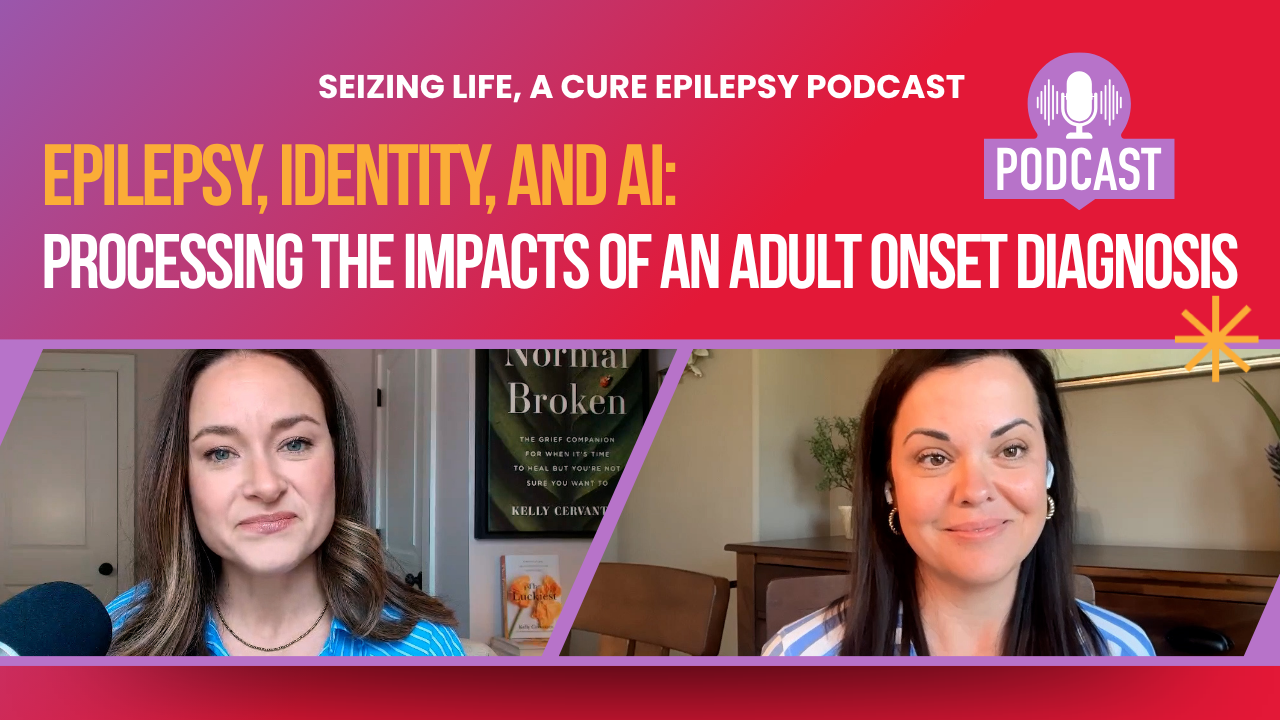
Epilepsy, Identity, and AI: Processing the Impacts of an Adult-Onset Diagnosis
Episode Overview
In this episode of Seizing Life, Katie Czyz talks about being diagnosed with adult-onset epilepsy at age 39 after more than a decade of symptoms initially mistaken for panic attacks. Katie describes the focal aware seizures she experienced for years without realizing they were seizures, the mix of relief and grief that came with finally receiving a diagnosis, and the challenges of finding a treatment plan while managing medication side effects, memory loss, brain fog, and the emotional impact of epilepsy.
Katie also shares how she turned to artificial intelligence (AI)—not as a replacement for medical care, therapy, or human connection, but as a form of “cognitive scaffolding” to help organize her thoughts, process emotions, and prepare for difficult conversations with loved ones and her therapist. She discusses the personal essay she wrote for the New York Times’ Modern Love column, the response she received from people living with epilepsy and their caregivers, and why sharing her story helped others recognize the often-hidden experience of focal seizures.
This conversation explores the symptoms and impacts of adult-onset epilepsy, the mental health effects of diagnosis and treatment, and both the promise and limitations of AI as a tool for those navigating chronic illness. CURE Epilepsy does not endorse using AI in place of professional mental health support or medical advice.
More on A.I. and Epilepsy: Seizing Life, episode 134 with Dr. Daniel Goldenholz discussing the promise and pitfalls of A.I. in epilepsy care
Episode Transcript
Kelly Cervantes:
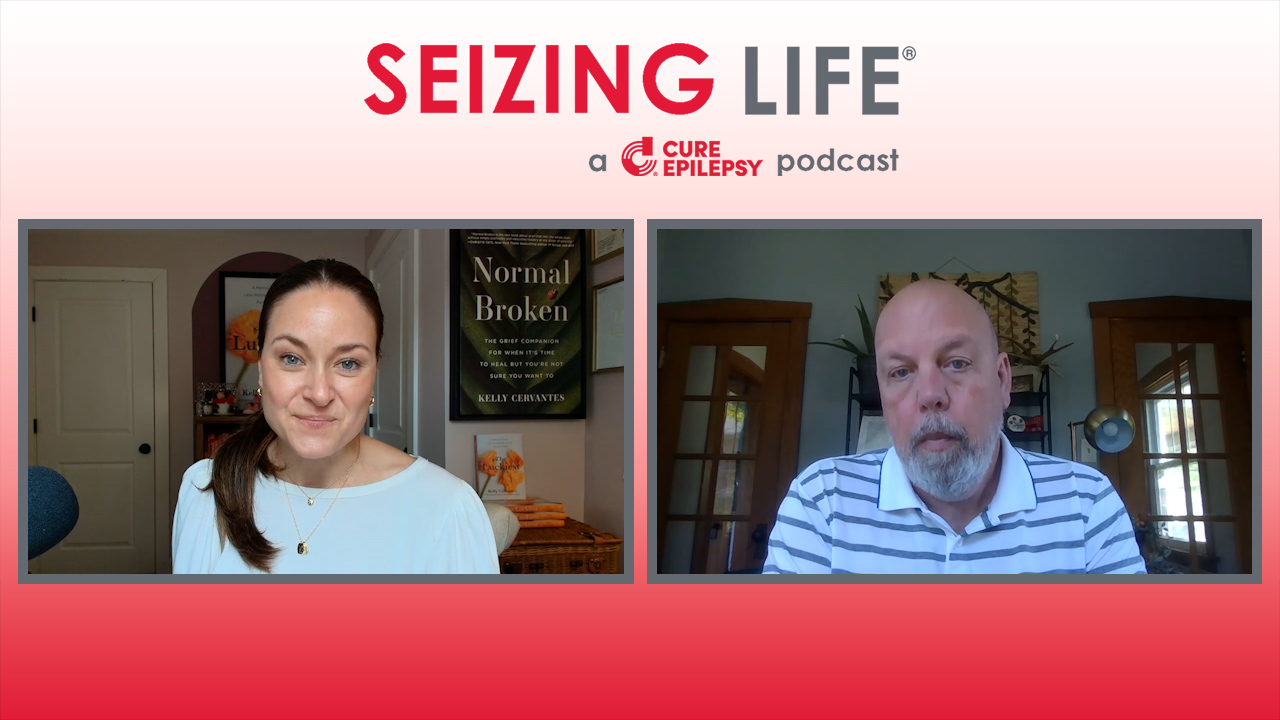
Hi, I’m Kelly Cervantes and this is Seizing Life, a monthly podcast produced by CURE Epilepsy.
Today, I’m happy to welcome Katie Czyz to the podcast. Katie was diagnosed with epilepsy in her late 30s after years of suffering from symptoms that were mistaken for panic attacks. She is here today to share her journey, which includes using AI as a resource for cognitive and emotional support as she adjusted to life after her epilepsy diagnosis, an experience that Katie wrote about in a Modern Love essay for the New York Times. Katie, thank you so much for joining us today. To start off, I want to get to know you a little bit. You were diagnosed with adult onset epilepsy at 39, which super fun to just throw a wrench into the middle of your life like that. But right now I’m curious about what your life looked like before that.
Katie Czyz:
Yeah. First of all, thank you so much for having me. I’ve been a long time listener of this podcast and it just feels kind of like a full circle moment to be on and talking to you and seeing you live talk with your voice that I only ever listened to. So yeah, before the diagnosis, my life looked relatively normal from the outside. I was married, I had two children, working in a pretty demanding leadership role in technology. I had really built a career around communication and problem solving and being the person who could hold a lot of complexity at once. I was capable, I was productive. So from the outside, everything was wonderful and great. But in the inside, internally, I was experiencing these episodes that at the time I didn’t know were seizures. And as you said, I got diagnosed later in life. I had been experiencing those symptoms though for about 12 years.
But for me, and I think a lot of the doctors I was seeing, because they weren’t outwardly presenting, my seizures are focal aware, so they don’t actually present on the outside, the word seizure never really crossed my mind. So when I would have these episodes, I would just sort of push through them and I would be exhausted afterwards, but I thought maybe I’m just tired because I’m a mom and working full-time and maybe it’s my brain failing. I don’t know, but I would just push through and keep up the very capable look on the outside.
Kelly Cervantes:
So you were diagnosed in 2022, 12 years of seizures before that, that you don’t know are seizures. What was the tipping point? How did you finally get an epilepsy diagnosis and recognize that this wasn’t just exhaustion or I guess what did you think they were before finding out they were seizures too?
Katie Czyz:
Yeah, so it was kind of a wild 12 years of just dealing with them, and then a wild way that I figured out what they were. My seizures, just to kind of walk through what they look like, they’re very difficult to explain. So I think that’s part of it. When I was explaining them to doctors, I just had a really hard time articulating what was going on. I have these very brief quick moments, maybe a handful of seconds, 10, 20 seconds, where I have this overwhelming sense of deja vu. And it’s not like a deja vu where you’re like, “I’ve been here before.” It’s like I’ve been dropped into an alternate reality sort of deja vu. And then I’d have a rising or sort of dropping in my stomach followed by nausea, followed by dread and confusion. And at the time when I went and saw my doctors and I really was seeing my primary care doctor, as I was explaining them, obviously now I can reflect back and be like, “He wasn’t as educated as maybe a neurologist is and would’ve caught.” But he said it’s either low blood sugar or anxiety.
And I have had anxiety for a large part of my life. So at the time I was like, “Okay, I guess that makes sense.” And I continued to just sort of push through them. And again, because I wasn’t convulsing or having what in my brain at the time I classified as a seizure, that though never entered my mind. And my grandfather was a doctor, and so I grew up with a lot of faith in the medical community and just sort of deferred to them. And I was like, “Okay, well, I guess they’re anxiety.” So I got on an SSRI and just continued to have them, continued to push through.
And then in 2022, I was on a medication for another condition related to thyroid stuff. And part of it was, a component of it was topiramate, which is a epilepsy anti-seizure medication. And at the time, my doctor had said, and I’ll never forget being in the office because then I reflected back and I was like, “Oh, I should have paid attention to that advice.” She said, “Don’t suddenly stop taking this because people who have maybe an undiagnosed seizure disorder, your body will get used to being on this. It’ll have the dependency, and then it’ll go through withdrawal and you might have seizures return.” But when your doctor’s giving you those sort of warnings and it doesn’t really apply to you, it’s sort of in one ear and out the other, you’re like, “Okay. Whatever.”
Kelly Cervantes:
Like, “I don’t have a seizure disorder.”
Katie Czyz:
No, no. “Yeah, I would know if I had a seizure disorder, lady.” But then about a couple months into it, we went on a spring break trip. And of course, I’m a wild mom. I think my kids were like, I don’t know, six and four at the time. So we’re just scrambling to get ready. I forgot to go get my medication at CVS and I thought, “I’ll get it when I get back.” That gave my body about a week to do exactly what my doctor had warned me it would do. And I had five of these episodes in one day when I got back. And I though, “Okay, wait, I remember her saying something about this. This seems a little too coincidental.” So I ended up, and to this day, I don’t know what spurred me to Google this, but I Googled epileptic auras because I was like, “It’s such a weird feeling that I wonder if this is some sort of an aura.”
And every symptom that came up, I was like, “Yep, yep, yep, yep, yep.” So I called her and I said, “Hey, remember when you told me not to stop the medication? Well, it turns out I did, and this is what’s happening.” And she said, “Oh yeah, that sounds like seizures, so I’m going to refer you to neurology.” And then I went to a neurologist and we went through a lot of testing and I got an answer. Yeah.
Kelly Cervantes:
How did that feel? I can imagine mixed emotions, but to have an answer is there’s relief in that, but the answer isn’t the one that you want.
Katie Czyz:
No, and that’s exactly it. I tend to say it was relief, but it was a lot of grief at the same time. I think I was relieved that I finally had an explanation because when you’re going through something and you don’t have a diagnosis and you’re being told it’s one thing, but maybe your gut is telling you it’s another, you start to question your own truth. So it’s like I felt this relief in that, okay, I have an answer and maybe there’s a path forward to treating this. But then I also had, I didn’t want a diagnosis of epilepsy, so the grief quickly followed. And I think the grief was a lot around my memory, losing the way that I understood my body. I started to realize all the sort of times or memories of trips and things that I didn’t even have. And as I started to learn about my epilepsy and the fact that I had been having these seizures for 12 years, I understood that those memories were probably lost because I just kind of grinned and beared it and just continued to seize and not knowing it at the time.
So I think there was a lot of grief for the way that my life was changing. And I didn’t know really at the time what the medications would look like. I didn’t know the side effects of medications. As I would tell people, everyone had their own words of wisdom, even though they hadn’t ever really had epilepsy or dealt with it. They were like, “Well, have you tried the keto diet? And have you…” So everyone has their advice. And it’s like-
Kelly Cervantes:
“My dog did X, Y, and Z.”
Katie Czyz:
Exactly.
Kelly Cervantes:
Yeah. It hurt them all.
Katie Czyz:
Yes, exactly. And it’s like you’re just trying to grapple with, okay, I need to figure out what I do and what my life looks like now. Because I guess I’ve had it now. I know now that I’ve been dealing with this for some time, but once you get a name to it, it becomes a whole nother thing. And then as I know you know, the medications, sometimes I often feel like the medications are worse than the seizures themselves. They are-
Kelly Cervantes:
Absolutely. Yeah, no, the side effects are terrible. And to that end, what was your experience? I mean, you get this diagnosis of epilepsy, you are grieving. Now you have something that you can research and you start to understand the memory loss and all of these other comorbidities that come along with the seizures. Do you find out what’s causing your seizures? Did you get a type of epilepsy diagnosis? And what did that treatment journey look like for you in the beginning?
Katie Czyz:
Yeah, so I didn’t realize it until a few years later, and this sounds strange to say, but my first EEG came back abnormal. And I did not realize that that was in a way sort of lucky because there are lots of people that have epilepsy that get normal EEGs all the time because it just captures what’s happening in your brain at that time, and it’s this archaic technology. And so of course, while it was devastating to hear, years later I reflected back and I was like, “At least I had an immediate answer.” Again, at that point I needed it. And I know that had it gone on where it was an unknown, I don’t know what that would’ve had in terms of effects on my mental health. So I got an abnormal EEG immediately. They put me back on topiramate, which was the part of the drug that I had been on. And because it was suppressing the seizures, they though, “Okay, let’s start there first.” And within a few months, I’m in these high stakes meetings quite a bit, fast-paced life, especially with work. And I was having a lot of trouble word finding more than normal. And I had a ton of brain fog. And it took me a while to relate that to the meds. Again, I think that in a way I was like, “Is this seizures or is it meds or is it both or what’s going on?” And I also had never really been in a position to advocate strongly for myself medically, and this has taught me how to do that. So I contacted my doctor and I said, “I don’t know that this medication’s working. I’m in meetings where it takes me a crazy amount of time. I know what I want to say, but I can’t get it out of my mouth and I just can’t have that.” And I remember at the time they said, “Okay, yeah, that makes sense.” Topiramate is actually one that we call Stupimax, I think, is the word that he used. It’s notorious for word-finding difficulties. And I’m like, “Why do we have a medication that all the doctors have a nickname for that’s known for causing these cognitive big time issues?” And so that was frustrating. But they put me on another medication, and that medication led to some serious emotional and mental issues. So at the time I was already battling depression given the diagnosis and I was grieving quite severely. But this medication, within a couple weeks of being on it, I was just started having suicidal thoughts and it was really heavy. And so again, I was like, “This isn’t working either.” And we did an EMU stay. I did advocate for myself for that. I was like, “I’m sorry, but at this point I want to know what’s going on in my brain. I know I had an abnormal EEG, but I need more information.”
Kelly Cervantes:
Good for you.
Katie Czyz:
And so at that point… Yeah. And it was the worst week of my life. My brain, of course, was like, “I’ll be on perfect behavior during this time. I’m not going to seize at all.” But it did give us some interesting findings in that I was having subclinical seizures. So they were detecting seizures that I didn’t even know were happening. Nurses and doctors would run into the room and be like, “How are you?” And I’m like, “I’m fine. What’s going on?” They’d be like, “Well, we saw seizure activity,” and that I have temporal lobe epilepsy likely coming from the left side of my brain. So it gave us answers, and then I was able to get on a medication. I’m on lamotrigine and I’ve been on that. We’ve gone back and forth on my dosage because I do sometimes still have breakthrough seizures. And as you know, it’s sort of a compromise of I don’t want to have seizures, but the higher my dose is, the more I struggle with these side effects. And are the side effects worse than the seizures? You kind of have to pick your demon. And so that’s where I am today. I’m still toggling a little bit on the dosage, but at least I’ve been on the same medication for some time.
Kelly Cervantes:
Yeah, it’s the constant battle. And I think it’s one of the pieces that is so misunderstood. I mean, I remember when our daughter was diagnosed, I was like, “Okay, great. They’re going to put her on a medication and then this’ll be gone.” It feels like it should be treated. We’ve known about epilepsy for so long. And then to realize that it’s not curable with medication and that the side effects of those medications are insane, can literally make you insane. It’s such a difficult pill to swallow, quite literally.
Katie Czyz:
It is. It is.
Kelly Cervantes:
Hi, it’s me again. Can I ask you to do me a favor to help the podcast out? It would mean so much to me and my colleagues at CURE Epilepsy if you could rate us five stars on Apple or Spotify and leave a review. Ratings and reviews help Seizing Life reach more people in the epilepsy community who are looking for answers, connection, and hope. Every rating, review, and download really does make a difference. Thank you so much for listening. And now back to Seizing Life.
Kelly Cervantes:
And Katie, you wrote a really beautiful piece for the New York Times Modern Love column about how as you were trying to wrap your head around all of this new diagnosis and the new reality of your life, that you turned to an AI chatbot to help you process these emotions. Talk to us about how the chatbot helped you in this really confusing time of your life.
Katie Czyz:
Yeah. So after the diagnosis and medication up and down changes, I was dealing with a lot of fear and cognitive issues and shame and grief and really a profound sort of disruption in my own identity. And I wanted to talk about it, but the thoughts were really, really messy. My brain, it just couldn’t piece through the fog. And I really didn’t know how to sit with another human and sort of lay this all out for them in a way that didn’t feel like a burden to that other person. I didn’t have enough understanding of my own thoughts to really even open up to others. And so I really started using AI just as not even like we think of AI, and I certainly do this for work in terms of the formal prompts and using prompting. I was not formally prompting this thing. I was just going in and almost using it like a journal. So just downloading all of the things that were in my head that were very unfinished. And with the way that AI is trained on all the ways that humans communicate and the way to validate someone, it would respond in a way that would help me piece through those thoughts and come back with a, “Okay, I kind of understand myself better and I understand what the issue is.” And that in a lot of ways would then help me go to the humans with the thing because it would help me understand what is the thing that I’m trying to communicate? What is the thought here? What’s bothering me? So it really gave me a place to put my unfinished thoughts. It didn’t diagnose me. In fact, I didn’t really use it as much for like… I would ask it some questions about epilepsy occasionally when I would, again, because mine doesn’t appear on the outside, sometimes I felt a blip during a meeting where I kind of spaced out, “Is that something that happens?” And so I was using it very minimally actually for my epilepsy treatment, medication management, that kind of thing. I was using it a lot for the cognitive processing and to get back my language that I feel like I had lost and felt really messy.
Kelly Cervantes:
So to reiterate or emphasize, you were not using AI to replace your human interaction, but to give yourself a starting place, to use it as a cognitive tool. You were diagnosed with epilepsy, you are on these medications, there’s a disability there that you are trying to overcome. So more using it as this communication tool to help you form those thoughts so that then you could go to a therapist or to a friend or to your husband. And I think that’s a really important distinction that I want to make. You weren’t using it for therapy or to replace therapy, that you weren’t using it as a medical tool, but to better help you piece your thoughts together as a tool to then go on to the next steps, not replacing human interaction, but adding to it. Can you share with us the types of questions that you were asking AI and the responses that you received?
Katie Czyz:
Yeah. Yeah. And just funny, just to back up quickly because you mentioned therapists and I just want to double down on that. Yes, I in fact had gone to my therapist and I will never forget the session where I kind of shared with her that I’ve been using AI in this way. And she was like, “Well, I never thought AI would replace me.” And I said, “No, no, no, no, no. For the record, AI will never replace therapists. It’s just helping me bring to you,” because it even helped with those sessions where I’m like, “Okay, I got to…” Sometimes you only get an hour of your therapist’s time. That’s the other thing about having AI is I could get up at 2:00 AM and just put a thought down from my brain that needed to be processed. With your therapist, you don’t have that. So I would prepare for my therapy sessions by being like, “What is in my brain? Let’s take all those messy things out and come up with a way to process them and know beforehand what I really need to lean on and focus on.” But a lot of the questions I asked were, again, not really formal or well put together. They were things like, “I am so tired all the time. I feel like a mother who is missing out on her children’s life because I work all day and again, this very demanding career, and I felt like I would use a lot of my brain power during the day, and then I’d get to the end of the day and just feel exhausted.” And so it was almost more of a way for me to process a lot of my guilt and feelings around ways that maybe I wasn’t showing up in my life and figure out why I was feeling that way, which was a lot of my own internal sort of stories that I told myself since I was a kid.
So things like how do I explain to my husband that my fatigue is not the same as not trying or that I really want to be a mom, but it’s hard to explain those things to other humans that aren’t necessarily living that same diagnosis. It’s nearly impossible for them to really empathize. So questions that would just help me explore myself a little bit more. Not that I was ever looking for an answer, but more a reflection partner. I like to call it cognitive scaffolding. So it just helps me piece myself together a little more. Helps me separate what is actually the signal here versus the noise? What’s actually the thing that is the issue versus something that maybe I’ve built up into an issue and it’s not an issue and that has more to do with my childhood. And again, these are all things that I would discuss with my therapist or a friend also. It’s just that AI was almost like the rehearsal space for those conversations.
Kelly Cervantes:
I like that delineation there. I do think it’s important that we have to… We are just learning AI. We are at the beginning of really understanding the scope of it and the benefits as well as some of the scarier aspects. We hear the stories about AI psychosis and you’re not a researcher in this, but from your experience using it, how could someone… Is there a line? How do you know the delineation between using it as that rehearsal space and using it as a tool versus relying too much on it? In your experience, is there a line? Did you ever feel like you came up to that line? How do you know when it’s too much, I guess is what I’m trying to ask?
Katie Czyz:
Yeah. And this is definitely, I think, what the world is grappling with right now because to your point, it’s so early. And while I benefited from it, that’s my personal experience, but I also know there are stories where people have been harmed by it. And I think that the way that I sort of square them is by refusing to flatten either. So it’s like it can help me, it can help people. It can also be genuinely harmful to others. And I think a really important thing is what we’ve been talking about here is that it should never be a replacement. It’s another tool in your tool belt, yes. It’s just like having a church community or a hobby that you’re interested in and you form friendships there. These are all pieces of someone’s life that contribute to their overall well-being. And I think that having AI, you need to think of it as another tool, not a replacement for, but a space where you can go in, at least for me, this was my experience, and download all the messiness in my head and help make sense of it and returning me to a human. I always felt like after the conversations I’d have with AI, a lot of times they were over voice mode while I was walking my dog. I always felt like when it was done, I was more human than less. So I felt like I was more prepared to have these difficult conversations than I was beforehand. So I think that if there’s ever a issue where you’re feeling like you are less human or you’re secluding yourself more, or you can’t go out and have these conversations or you don’t want to because AI has, in someone’s mind, replaced all of those necessary relationships, that’s at the point where I think it’s likely could be very dangerous. It has to be thought of as another tool and not a replacement for anything really. It’s just an extra thing. But I think that for sure there are people who are likely a little more predisposed to maybe being harmed by AI. And I think that in a way I have a little bit of a leg up only because I work with AI every day. And so I see its fallacies. I see that it hallucinates all the time. When people say AI is going to take over the world, there’s a part of me that’s like, “Not anytime soon because it’s not very smart.”
Kelly Cervantes:
That’s good to know.
Katie Czyz:
Yeah. So I think that it’s always sort of understanding it’s not the magic bullet. It’s not going to solve everything. It’s just there. If you’d like to explore it as another tool, it’s there. But we all need to keep in mind that we’re still human and we still need to lean on our human relationships and be able to also just decide that if AI wasn’t existing tomorrow, you could still move on because you’re not that dependent on it. So I think that it’s definitely something that needs to be grappled with.
And I think just like any other technology like social media, it’s going to take some time for us to figure out how to do it and what to do. But I would think just as a person keeping an eye on your other relationships and making sure that you’re not completely siloing yourself from them is a really good sense. And whether or not you’re feeling like you’ve been returned to your human self after the conversations I think is important too.
Kelly Cervantes:
I think those are all really great signposts and guideposts for people who want to explore AI in this way to help them navigate that. I wonder, as you talk about community, what was the response you received from your Modern Love article? I mean, that’s a huge platform. And I’m curious from the epilepsy community, outside the epilepsy community, what the response was.
Katie Czyz:
Yeah. The response was much larger and much more emotional than I could have ever prepared myself for. A lot of people wrote to me to say that they felt seen in the piece. I got a lot of responses from caregivers that said they didn’t really understand the internal nature of having epilepsy and how it can really affect you in that way. And it was important and helpful for them to see it from my perspective, especially just again, so internally. And that piece was very emotional and sort of opened a window to people for how it can affect you in terms of your mental health. But I also got responses from people that were like, “I have been using AI this way and I’ve been really embarrassed to share it with anyone, and it’s been helping me. And I’m really happy to have heard that somebody is opening that conversation up and it makes me feel less alone in my use of it.”
I think there were some people in the broader public that AI is such a sensitive topic right now, and I was fully expecting there to be the people that are very uncomfortable with it. And that is okay, by the way. I think that we should be uncomfortable with it. I think that if we get too comfortable with it, that’s when it gets dangerous. So there were people that said, “You’re ruining the planet and other things.” But there were, for the most part, the majority of responses were, “I had never thought about using it this way.” Or, “I have epilepsy and I just felt really seen by your piece and I was so happy to have read it and it gave me a lot of comfort.” So I was not expecting the volume of responses that I got and it was overwhelming. And I guess I should have anticipated something because you’re being published in the New York Times millions of people are going to-
Kelly Cervantes:
And epilepsy is not a rare disorder.
Katie Czyz:
No.
Kelly Cervantes:
Millions of people have epilepsy, but I don’t feel like this communication gets New York Times level representation. And so I think it’s a really remarkable thing to give that sort of presence to all of these, the 1 in 26. It’s a really, really incredible thing that you were able to accomplish with that piece. And so thank you for that.
Katie Czyz:
When I wrote the piece, I was honestly, it was more of a personal endeavor for me to just sort of write about my experience and share my story with the world and how, or not even with the world, with what I anticipated would be not the world. I though I would just be sending it to the editor at the New York Times and I would never get a response. And within a week I got a response that they wanted to publish it and I was terrified. I didn’t expect that that would be the end state, and I don’t even know that that was necessarily my goal. I’m glad that I just sort of continued on with it and pushed through and said, yes, okay, this is what it is. Because to your point, it brought language to, I think, a condition that affects so many people, but we don’t talk about. And that was another thing. I did get responses from people that said, “I’ve had those same kind of episodes for years. I’ve never thought that they were seizures.” And that to me was the most validating. Had you asked me beforehand, “What do you want from this?” That was it. Because it’s like if I can prevent anyone from going 12 years in between or just grin and bearing it through it, that’s enough of a, like I can sign off now and be like, “I’m done.” As long as there is even one other person out there who went to their doctor and said, “Hey, I have these episodes and I read this piece, and I think they might be seizures.” Because I can’t imagine the number of people walking around experiencing what I did and not knowing what they are.
Kelly Cervantes:
Yeah, that was one of the first things that came to my mind as I was reading it is how many people read this and then realized that they have epilepsy? I mean, that was one of the first things that I thought of, that just the visibility of this seizure type, which is there’s a lot more seizures out there than just the tonic clonics. I’m curious, you wrote this piece last year and you’re a little further into your journey now. How do you use AI in your personal and professional life today?
Katie Czyz:
Yeah, I still use it. I use it a lot still for reflection. I tend to ebb and flow. So there are some months that are harder and I need a little more processing and maybe support from my chatbot. And when I say support, I just mean that cognitive scaffolding. Maybe I’m going through something that I just need to process with that and my therapist and my family. But there are other months where everything’s great and I don’t feel like I need it. So it’s kind of, again, a tool I reach for when I feel like I need that extra boost. But otherwise at work, I am the director of AI integration at work, so I’m working a lot with bringing AI into a lot of our operational processes at our company. And I work with AI day in, day out for work. And that is more of the formal prompting and the things that probably people, when they think about working with AI, that’s what I’m doing a lot in my day-to-day. So I use it, again, both for reflection, writing, executive functioning, but also research and synthesizing and that kind of thing. Yeah.
Kelly Cervantes:
Katie, thank you so much for chatting with us today, for sharing your experience, for teaching us about another tool and giving us the signposts to use as guardrails. I’ve enjoyed this conversation so much and I appreciate you.
Katie Czyz:
Well, thank you, Kelly. Like I said at the beginning, I’ve been a long time listener and fan of yours, and it just feels like a very full circle moment because there are so many podcasts that you guys have done that I’ve listened to from my car and been sobbing or felt seen or I just so appreciate the work that you guys are doing. And yeah, I’m happy to have been here.
Kelly Cervantes:
Thank you, Katie, for sharing your epilepsy story with us and how artificial intelligence has played a helpful role in your journey. CURE Epilepsy does not endorse utilizing AI in place of professional mental health support or for answers to medical questions. However, AI is here and is also being used by doctors and researchers to improve healthcare and accelerate valuable epilepsy research. If you would like a deeper perspective on AI’s role in that area, please watch episode 134 of Seizing Life in which Dr. Daniel Goldenholz discusses the promises and pitfalls of AI in epilepsy care. Thank you.
Legal Disclaimer:
The opinions expressed in this podcast do not necessarily reflect the views of CURE Epilepsy. The information contained herein is provided for general information only and does not offer medical advice or recommendations. Individuals should not rely on this information as a substitute for consultations with qualified healthcare professionals who are familiar with individual medical conditions and needs. CURE Epilepsy strongly recommends that care and treatment decisions related to epilepsy and any other medical conditions be made in consultation with a patient’s physician or other qualified healthcare professionals who are familiar with the individual’s specific health situation.