
Former NINDS Director Dr. Walter Koroshetz on Current Challenges and Promise in Epilepsy Research
Episode Overview
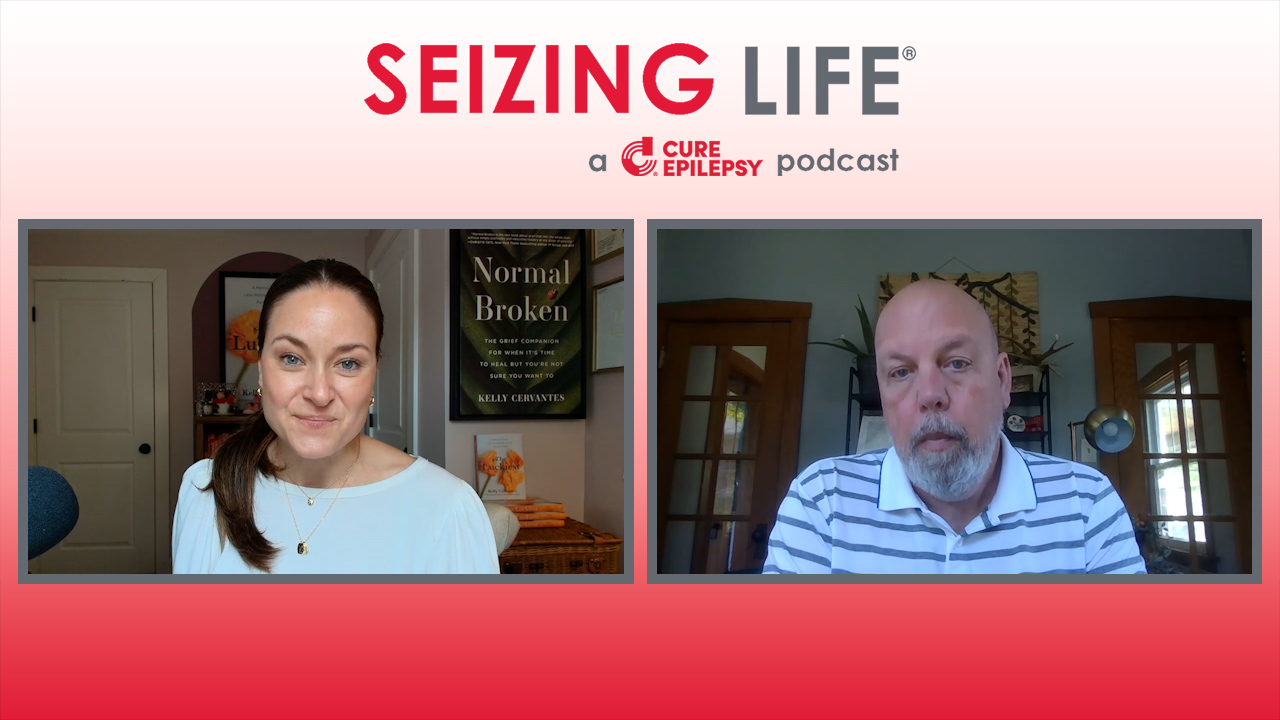
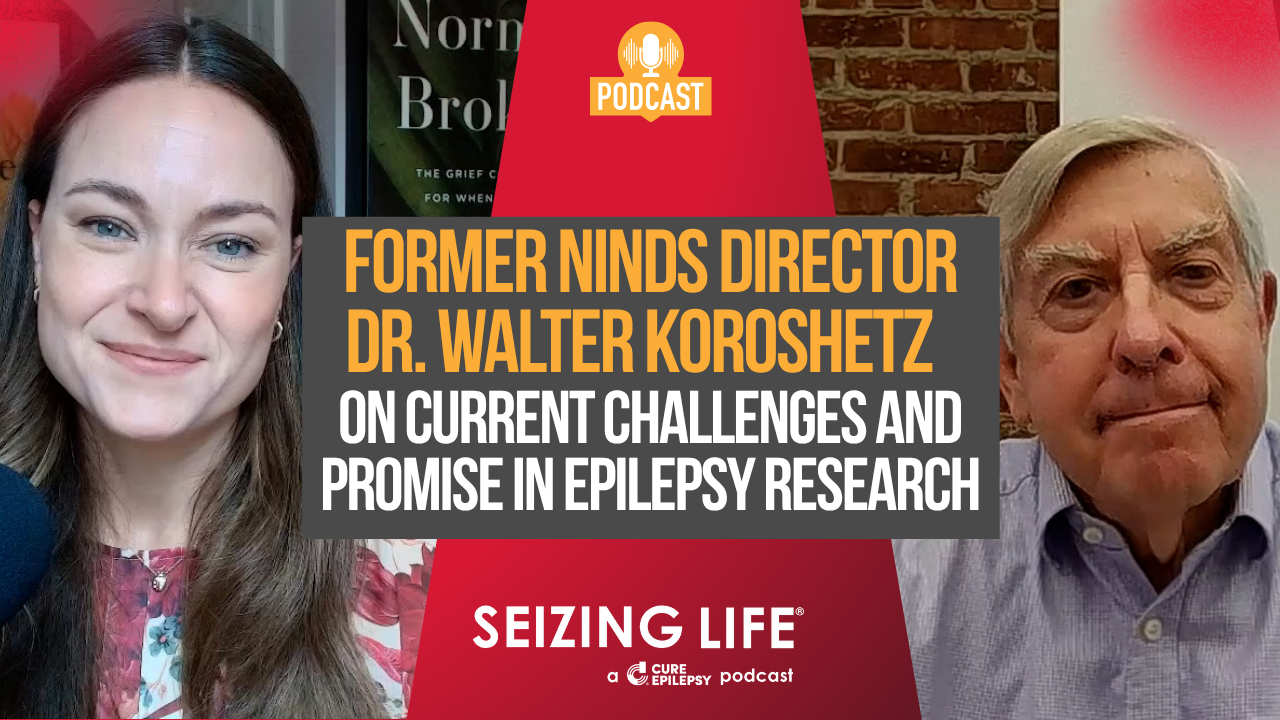
In this month’s episode of Seizing Life, Kelly speaks with neurologist, neuroscientist, and former National Institute of Neurological Disorders and Stroke (NINDS) Director Dr. Walter Koroshetz about the state of epilepsy research, the critical role of federal funding, especially for early-career scientists, and the advances bringing new hope to people and families impacted by epilepsy.
Dr. Koroshetz shares insights from his decades-long career in neurology and neuroscience, including his leadership at NINDS. He explains how epilepsy research has improved our understanding of seizures and led to the identification of hundreds of genetic causes of epilepsy, opening the door to more precise and potentially curative therapies. The conversation explores the promise of genomic therapies, gene editing, closed-loop brain stimulation, and technologies emerging from the BRAIN Initiative, a partnership between federal and non-federal partners with a common goal of accelerating the development of innovative neurotechnologies.
The second half of the episode focuses on the current research landscape with an eye towards the potential future impacts on epilepsy research. Dr. Koroshetz outlines the research roles of government, institutions, industry, and nonprofit organizations, and explains how they do and don’t collaborate with one another. He shares his view of the current federal funding situation, explains the history and effects of flat budgets in government funding, and reveals what he sees as the biggest threat to the scientific workforce and our country’s role as a leader in research. Finally, Dr. Koroshetz offers his advice for young scientists and what he sees as the most promising areas of epilepsy research that will improve the lives of patients and families living with epilepsy in the coming years.
Episode Transcript
Kelly Cervantes:
Hi. I’m Kelly Cervantes, and this is Seizing Life, a monthly podcast produced by CURE Epilepsy. Today, I’m honored to welcome Dr. Walter Koroshetz to the podcast. Dr. Koroshetz is a neurologist and neuroscientist who spent 27 years at Massachusetts General Hospital before joining the National Institutes of Health. He served as director of the National Institute of Neurological Disorders and Stroke, or NINDS, for 10 years. Dr. Koroshetz is here to discuss federal research funding, the complexity and advancements of epilepsy research, and the role of nonprofits like CURE Epilepsy in moving research forward.
Dr. Koroshetz, thank you so much for joining us today. It is an absolute honor to have you here.
Dr. Walter Koroshetz:
It’s a privilege.
Kelly Cervantes:
To start, for those in our audience who are unfamiliar with your career, can you give us a thumbnail of your professional life?
Dr. Walter Koroshetz:
Yeah, sure. I had two very fulfilling careers. I was initially a neurologist and a neuroscientist. I took care of patients, worked in clinical research, and that was at Mass General Hospital and the Brigham Hospitals in Boston. I was there 27 years, and then I left to go to the National Institutes of Health as the deputy director for the National Institute of Neurological Disorders and Stroke. And after about seven years as the deputy, I was named the director, and I was the director for about 10 years after that.
Kelly Cervantes:
So you just recently finished your tenure as the director of the NINDS. Can you give us a brief overview of what the NINDS is and what it does?
Dr. Walter Koroshetz:
Yeah, sure. So the National Institute of Neurological Diseases and Stroke is really the taxpayer’s investment in research that is aimed at getting better treatments, or to prevent or help people recover from neurologic disorders. It has various levels of funding, from research that is very basic on how the brain, the nervous system works. Then most of the research is on mechanisms of different neurological diseases, trying to get targets that could be used for industry to prosecute those targets to get new treatments. We have components that actually do clinical trials to test what type of treatments are beneficial in particular areas. And then, unusual for NIH, we had a very good program in what’s called translational research, which was funding biotech and academics to bring what could be a target and a drug that could be brought to the point where it could get an investigational new drug approval from the FDA to go into patients and test it in patients. So that was the full spectrum of what NINDS did when I was there.
Kelly Cervantes:
And what is the NINDS’ role in epilepsy research specifically?
Dr. Walter Koroshetz:
So epilepsy is a condition, of course, where the circuits in the brain go into a very abnormal pattern. Usually, the brain circuits are sending information in patterns that are very intricate and contain a lot of information. But in epilepsy, all the cells in an area start to fire simultaneously, and that blocks out the information processing and it leads to seizures. So that is a really basic science question on how that happens to the circuits in the brain. So a lot of research over the last 40 or 50 years has been on how that happens, and how you might slow it down or prevent it. And many of the drugs, pretty much all the drugs that have come out as anti-convulsants came out because they targeted a pathway or a molecule, an ion channel, a transmitter system that’s involved in epilepsy.
We also ran, in our translational program, a very interesting program for probably 45 years now, where we would have a system that was free to any company that could come in or investigator come in with their molecule, and we would test it in multiple different seizure models. And many of the drugs that are currently on the market went through that process. And that was a way of giving a standardized animal model program so that companies could be really secure if their drug was really working before they put a lot of money into its clinical development.
Kelly Cervantes:
Absolutely amazing. And I can only imagine that that helped hopefully speed up that process of getting that molecule into a clinical trial state. I wasn’t aware of the translational research piece either that the NINDS does. That’s incredible to hear. How does the NINDS decide what research they’re funding?
Dr. Walter Koroshetz:
Yeah. Really good question, and that’s really up to the institute director. The issue at NINDS is that we have, under our portfolio, up to 400 different neurological diseases. So that means that no disease gets the amount of money for research that they need, unfortunately. So what we have to do is think about funding research that has a chance of helping multiple different diseases. And what I learned at NIH over the years is that you can be absolutely positive that there are going to be breakthroughs coming that are going to be important for patients, but you can’t predict where those breakthroughs are going to come from.
So what we do is we fund, basically, on a very US-biased, competitive fashion. Applications come in from investigators about many different diseases, and then they are reviewed by peer review, experts, not government people, but people from the outside who are experts in an area, and they give those grants a score, and we would fund the best score of those grants until we ran out of money. And that’s how most of our money was sent out, so it wasn’t top-down, it was more bottom-up. The idea being that the best science, the most impactful science, independent of where it seems to be bucketed, is going to be what’s going to be best for the country as a whole. And that actually, I think, for epilepsy worked very well, because there were really good neuroscientists who got interested in epilepsy, interested in the biophysics of ion channels or neurotransmitter systems, and that really opened up a lot of new treatments for epilepsy.
Kelly Cervantes:
And I have to imagine, as you’re talking, 400 different diseases that are all competing for this money. However, epilepsy, it’s a spectrum disorder. It has many comorbidities, and at the end of the day, it is a symptom of other neurological conditions. So I would hope that some of the research being done, it may be for another disease state, but it overlaps with epilepsy, since seizures are such a prolific symptom of so many other neurological disorders.
Dr. Walter Koroshetz:
No, absolutely. Gee, lots of examples of that. We did have a couple of top-down programs. They were called Center Without Walls for epilepsy research. And so the genomic revolution came, and we funded groups to try and look at all the different mutations that cause infantile epilepsy, early child epilepsy. And everybody thought it was going to be good, that we’d find a couple, but we found hundreds. And so that really changed the landscape for what do you do for epilepsy, because as you said, seizures, and I mentioned seizures are this very abnormal firing state, but there’s a lot of things that cause that to happen in the brain that are not related to epilepsy, for instance. So with these infantile epilepsies, you now have a lot of genes that cause developmental delay in how the brain develops, and they cause epilepsy. And so it’s not epilepsy anymore, it’s called the epilepsies-
Kelly Cervantes:
Yes.
Dr. Walter Koroshetz:
… because there’s so many different drivers there. And that’s really the challenge now for infantile epilepsies, is now that we’ve identified the genes, how do you get in there and prevent epilepsy, and also the developmental problems that these children have, which are oftentimes so severe that epilepsy’s a comorbidity of something even more devastating.
So we have the ability now because… And that’s what we did in the last couple of years I was there, is to try to invest in what we call genomic therapies. So these conditions generally are very difficult to control with current drugs, but the gene abnormality is now knowable, and there are technologies now where, say, with gene editing, we could go in and normalize that mutation, and hopefully prevent the entire process, allow normal neurodevelopment to occur and not have epilepsy in those kids. So I think that’s really a challenge for the future that comes out of something we did in epilepsy, but then the gene editing technologies came in from outer space almost. It was people trying to understand how bacteria deal with viruses that led to the discovery of these gene-editing machineries that now we can bring to bear on the epilepsies. So I think that was a good example of research from many different areas coming together, creating a new challenge, but also new opportunities.
Kelly Cervantes:
Hi. It’s me again. Can I ask you to do me a favor to help the podcast out? It would mean so much to me and my colleagues at CURE Epilepsy if you could rate us five stars on Apple or Spotify and leave a review. Ratings and reviews help Seizing Life reach more people in the epilepsy community who are looking for answers, connection, and hope. Every rating, review, and download really does make a difference. Thank you so much for listening, and now back to Seizing Life.
Now, Dr. Koroshetz, you just mentioned it, and I can only imagine how much genetics, and the massive leaps and bounds that have been taken in the last decade in genetics, how that really played into some of the direction and the discoveries that were made during your tenure as the director of the NINDS. Is there anything else that really had a big impact or where you saw important advances being made?
Dr. Walter Koroshetz:
Yes. Oh, absolutely. What I see as the real promise for the future is the convergence of three areas of science that have come together. One we mentioned is the genomic sciences, which gives us the ability to manipulate genes, to monitor brain activity. When I started in neurology, we would learn about the brain by putting an electrode in a neuron and having the animal do a task, and then we would repeat it again and again. It’s like trying to figure out what a movie is all about, you can watch it as many times as you want, but only one pixel at a time. So really impossible, given the brain has 85 billion neurons. But now, with the new technologies for looking at circuits, which all came out of what we call the BRAIN Initiative, you can actually see millions of neurons simultaneously firing in an awake-behaving animal.
So the new area that came in was the ability to look at circuits, not only to monitor their activity at the cellular level, but also to be able to manipulate them with the genomic techniques. So today, the drugs we use for epilepsy are not smart. They’re dumb drugs. They go into your system, you’re trying to affect one channel in one area of the brain when it’s firing, and by the time you get the dose you need, the patient’s unconscious. So we’re limited by the imprecision, the lack of precision of the drugs. But gene therapy, the genomic therapies, the genomic tools that came out of the BRAIN Initiative mean that now we’re going to be able to go into just the neurons we want, just when we want that, to turn on whatever gene program we want to stop them from firing. So the genomic therapies that are coming out of the BRAIN Initiative, in combination with this ability to look at circuits, allows you to manipulate circuits, and that, I think, is going to be really precious for epilepsy going forward.
And the third one, which is what neuroscience has been doing for the last 50 years with success, is understanding different molecules. So all the drugs are made against molecules. And so we had the genomics, we had the molecules, but until the BRAIN Initiative came, we had no way to see the circuit that’s in action. We really were working with EEG, which was a technology from 1928, and it’s a great technology, but it’s not so great because of lots of issues. Doesn’t really tell you what’s going on, particularly in the deeper parts of the brain and through the skull. So now, we have these technologies, and even in epilepsy, they’ve led to real advantages. So we have programs that are coming out of the BRAIN Initiative where electrodes are put into the brain to stimulate the brain, but the stimulation occurs only when other electrodes detect an abnormality that indicates a seizure’s going to start, and then the stimulator comes on. It’s called closed-loop brain stimulation, and that is something that came out of the BRAIN Initiative. It’s being tested in certain epilepsy conditions.
And then, in the genomic space at NINDS, we actually started to invest in genomic therapies, gene editing out of the Common Fund project at NIH to actually be able to edit the genes in the brain. There’s a prize now, a million-dollar prize for people to develop the best way of getting gene-editing tools into the brain so that mutations that are active in the brain can be normalized. And then, there are a lot of other genomic therapies to replace genes in conditions where there’s what’s called a loss-of-function mutation that causes epilepsy, so you give the gene back that’s not there or is there in insufficient quantities. And then, there’s techniques called interference RNA or antisense oligonucleotides that can negate the actions of a bad gene, a mutation that’s causing a bad effect. So all these genomic therapies are now really coming, we’re in very early stages here, but I think they’re going to be very powerful for epilepsy.
Kelly Cervantes:
The speed at which science is moving currently, I mean, I was alive when we did the first gene mapping, and here we are talking about gene editing, and it is so exciting to see just that real possible cures are coming for people with epilepsy, for people with all sorts of disorders. It’s really exciting, and it provides so, so much hope, I know, to me and to patients and caregivers and families all over the world. I’m bubbling with excitement here listening to you talk about this. And I know that you get that, because I also understand that you have a personal connection to epilepsy, and if you’re comfortable, I’d love to have you share that with us.
Dr. Walter Koroshetz:
Yeah. No, I think epilepsy is so common. A lot of us have experiences with epilepsy in our families or friends. In my case, it’s a little unusual. My dad developed epilepsy when he was in his 60s. And then, unfortunately, he died during a seizure at home. He was in Brooklyn, I was in Boston. I never got to say goodbye. And unusually in his case, his brother, his older brother had also developed epilepsy and also died during a seizure. And then, his next brother, I actually admitted to the hospital in Boston because he had a spell, and it turned out that he also had epileptiform activity on his EEG, and so got treated for epilepsy. He lived to be 94. But you have three brothers who developed seizures in later age, and two of them died, one of them being my dad, so it is sad.
As you know, death during seizures is something that people didn’t talk about when I trained. But now, through the work of groups like PAME, CURE, it’s really come to the forefront. And also, NIH, NINDS funded one of the Center Without Walls on SUDEP, sudden unexplained death in epilepsy, which I think has made a lot of progress in trying to understand how that happens and potentially what we can do about it.
Kelly Cervantes:
First of all, I am so sorry for your losses, and epilepsy just really freaking sucks, and it’s brutal and it’s unfair and it doesn’t care who you are or who your son or nephew is. But I think it’s absolutely incredible that you were able to give your uncle a long life and get him treated, and it just goes to show, I think, how important catching and getting that epilepsy diagnosis as soon as possible, how important that is to prevent cases of SUDEP. And you talk about the Center Without Walls, and you brought it up earlier, and I know it’s a big source of pride for all of us at CURE Epilepsy, as our founder, Susan Axelrod, worked with you on those. It’s such an incredible thing to see. Research makes a difference, diagnosing makes a difference, and your career and your personal experiences are proof of that.
I’m curious how you see the roles of various branches of scientific research in our country, specifically government-funded scientific research, biotech companies, pharmaceutical companies, nonprofit organizations, how do you see their roles playing out in this research sphere?
Dr. Walter Koroshetz:
Right. So everybody that you mentioned has a role and they’re really important, and the trick is stitching them together. That’s been the problem in the US. But before I go there, I would say that you talk about the scientists and the public people, but people like Susan Axelrod had a huge impact on getting epilepsy, particularly the SUDEP space moving. So never underestimate the power especially of a mother. That’s the first thing you learn in government, never underestimate the power of a mother, and I think it’s very important to understand that now.
So the government is really the foundational funder for everything that anything else is going to stand up on. So if you want to get to the goal line, which is treatments for patients or prevention for patients, the thing that is holding us back is ignorance. We don’t know how to do it. And so science at the very basic level has to give us the information, but also the tools to go after these things. So the example, I mentioned that gene editing came out of just discovery science about how bacteria deal with viruses, and that’s going to revolutionize epilepsy care. So that foundational science, no one else is really going to fund that. I don’t see… Philanthropy can’t do that to any big extent. There are a couple of philanthropic organizations that give money, but they usually give the money to people that NIH has already funded, either in the training space or their early-stage careers. And then, the philanthropists come in oftentimes to fund really good scientists so that they don’t have to get into this competitive system that we have in the government.
The nonprofits have a tremendous role to play, particularly in the disease organizations, disease areas, because what you really need to solve a disease problem is really smart people. The government is not going to attract smart people into a disease. That’s what nonprofits can do. They can really energize people. Scientists can feel that their careers are going to be much more fulfilling if they’re part of an organization like that. And also, the government is terrible at funding people to get going so that they can get grants. So we have training programs and then we have research grants, but if you’re in a training program, and then you become a neurologist and you want to do epilepsy research and get a career development grant from the government, the average time you need to spend to get preliminary data is four years. So you need somebody who’s going to support you for four years so you can get your NIH career development grant, and that’s five years, and then you have to compete for your independent funding.
So in that gap, particularly after clinical training, it’s only the nonprofit organizations that help people get through that period so they can get the NIH funding, so that’s really important. And then also, as we mentioned earlier, for a treatment to get to patients, it’s got to be commercialized. So the biotech companies are really what are now driving innovation. And now, the big pharma companies are looking to the biotech companies to decide what things that they want to take into their space. And then, they’re the ones that have the deeper pockets to do the big clinical trials to get the FDA approvals. So there’s all these pieces that have to be stitched together, and the problem with our system is that there is no stitching. It’s unfortunately very serendipitous what happens as you get to each of these transitions.
Kelly Cervantes:
Well, I mean, it’s like a food chain, really. You need each piece of the pyramid. Otherwise, the whole system collapses. Is there something that could be done to improve collaboration between these branches or to accelerate the research that’s being done?
Dr. Walter Koroshetz:
Yes, I think so. I think, well, the system is what it is. It’s pretty tough to change the system, and if you change it, I’m not sure if it’d be any better, but we’ll see. So China’s another example where it’s completely different, everything’s top-down, and we’ll see how that works, where we’re more these multiple different roles that people come into play. But I think the one thing that we can do with the current system is for groups to be conveners, so a nonprofit, for instance, that convenes the basic science people, the trainees, the biotech companies, so that people can see the transitions and maybe facilitate the transitions when they make sense. Everyone has a little different agenda, and you have to be able to see the overlaps and make the most of those. But I think that is something that I’ve seen to be very productive.
Kelly Cervantes:
So speaking of that food chain or pyramid-
Dr. Walter Koroshetz:
Yes.
Kelly Cervantes:
… when every step depends on the one before it, and I would love to hear from you about the federal funding cuts that we’ve seen specifically within the last year, and how that has played out both from a legislative perspective and its impacts on scientific research.
Dr. Walter Koroshetz:
Yeah. Well, Kelly, it’s a very different scenario now than it has been in the past. But I think there’s a couple of points to make, and that is that although the Executive Branch planned very deep cuts, 40% cuts in the NIH budget, big cuts to the institutions that are doing the research, the Congress looked and said, “No, we don’t want to do that. We don’t want you to do that.” So Congress did not cut the NIH budget. The budget is the same as it was basically for the last four years. And Congress has always been very bipartisan and seen the value of NIH, because what we’re doing at NIH has nothing to do with politics. Diseases do not know politics. They treat everybody unequally, unfairly. So the funds have not really decreased.
What happened though, which has happened before for NIH, is that there’s initially a desire to increase the budget and the budget goes up, and then the Congress says, “Well, we already did that, so now it’s going to be flat.” And then, a couple of years later, they say, “Well, we need more money,” and they raise it again. So we were flat pretty much between 2004, where the doubling of the budget happened, and 2016, so 12 years of almost flat budget. And what happens in that time is that inflation comes in, and so the cost of doing the research goes up, but you don’t have any more money. And then, in 2016, we got more funding, and that ended in 2023, and now it’s been flat. But inflation, as you know, inflation is pretty significant.
So the cost of a grant at NINDS went from about $450,000 to $550,000 a year, and it’s all due to inflation. So if you normalize the dollars to 2023 money, there’s no increase, it’s all inflationary. It’s just the cost of doing research went up, the cost per grant went up. If you have a flat budget, that means you can fund fewer grants. So that’s what’s happened to the budget and the funding. And so it’s really just a matter of we haven’t gotten the inflationary increases, but we did not get any cuts. So that, I think, is important to recognize, because this has happened before and we’ve gotten through it, so I think it’ll happen again. Congress has stood by the NIH, which they’ve done before, and I think that’s great news.
But the consequences, unfortunately, given all the other things that have happened, are that people are really nervous. Universities are nervous that they’re not going to get the funds from the government, so they’re cutting back on students that they take. People who think about a career in science say, “Oh boy, this doesn’t look good. The government doesn’t like science anymore. Maybe I shouldn’t go into science. Can’t rely on the federal government’s support for science.” So they go into some other field, and that, you can’t get back. So there’s the reality of the situation, and then there’s a negativism that’s grown up around this new reality, and the latter is probably more destructive than the former, in my mind.
Kelly Cervantes:
Interesting. There’s an immigration issue here as well. I believe that there is a significant number of postdocs who are also from other countries. How does that play out?
Dr. Walter Koroshetz:
Right. People may not know this, but what happened over time is that as science became more sophisticated, the principal investigators do their work by hiring postdocs, postdoctoral fellows who are the ones who are doing the hands-on experiments all the time. The principal investigators are overlooking that work, they’re analyzing the data that comes in from it. But half the postdocs in the US came from other countries. And that was because people from other countries who were interested in science saw the US as a very welcoming environment and an environment with opportunity, because anyone in the US can write a grant to the National Institutes of Health for funding, which is not what happens in other countries, where things are much more top-down. It’s more dependent on what your position is and what institution you’re in. But here, it’s a very democratic system, and people from all over the world came here, and we benefited tremendously from that influx of talent from other countries. And unfortunately, that is at real risk now, because we’re not seen as a welcoming community anymore, and that’s going to hurt us long-term. Yes.
Kelly Cervantes:
I think that is one of my big takeaways from all of this, is that even should funding get increased in the near future, we are looking at these generational concerns where people aren’t going into research. We are not getting that influx of brilliant minds from other countries, and so we end up having this brain drought, as it’s been called, which is, I think that’s alarming. We’re on the cusp of all of these amazing discoveries, but if we don’t have the scientists to play them out, then we’re delaying life-changing medicine. I also wonder if you can speak to the difference between indirect and direct costs when it comes to labs and institutions, and how that battle plays out.
Dr. Walter Koroshetz:
Yeah. Well, let me just talk to your first point, which I totally agree with, and it’s probably the thing that should be on the top of everyone’s list. So I think one thing we should do is to look at what happened when the last administration came in. Things happened very quickly, bang, bang, bang, bang, bang, right down the line, and it was all predetermined, there was a plan. So I think that what we need in science is we need a plan to rebuild our science as soon as we get that opportunity.
So what we can’t do is just sit and say, “Well, things will settle down. They’ll improve slowly by slowly.” We need an initiative that gets out there and says, “These are the opportunities for you to come to the US. These are the opportunities in the US if you’re interested in science and you’re in college in the US, these are the opportunities you can follow to get into science, and you’re going to have a fulfilling career.” And we can’t just sit back and let things happen as they will. We really need to take the initiative now when we get that opportunity to reverse the hole that we’re in. So that’s the first point.
I think in terms of the second question, in terms of the money, yes. So when the NIH gives a grant, so we give a grant, say $3 to an investigator to look into a promising area in epilepsy. We also then give half of that, $1.50 to the university, which is supposed to be used to take care of the buildings and the infrastructure and the IRBs and the IT and all that other stuff that we call the infrastructure that the investigators need to do their work, and that’s what’s called the indirect costs. So there has been discussion about what those indirect costs should be. As I understand it, there’s a process that’s been going on for years where there’s a group in the government that goes out and they do an assessment and audit in determining the cost of doing research in a particular city or area. They develop an indirect cost rate, and that’s what the government uses for all their research, not just NIH research.
So that process, people could look at it and maybe determine if it’s optimal or not. But that’s indirect costs or not… If you shut off the indirect costs, then the universities are just going to go bankrupt. They’re going to have to fire many of the scientists. They’ll have to take the costs for running the building and the heating out of the grant somehow. So yeah, it’s not going to save anybody any money.
Kelly Cervantes:
So how should the epilepsy community specifically be responding to all of this uncertainty around research funding?
Dr. Walter Koroshetz:
Yeah. The epilepsy community and other disease communities, they know really well what the value of the research is. Because when I came out of medical school, I think we had three epilepsy drugs, phenobarbital, Dilantin, and I guess Tegretol. And now, because of research, there’s so many more drugs that are effective for epilepsy, and that all came out of research. So you don’t want that to stop. And so the epilepsy community, I think, understands that better than anyone.
And then, I think what is a little harder for disease communities to understand is what I said before, which is that the real breakthroughs come out of left field. You can’t predict them. So you need this foundational funding to enable the epilepsy field to advance, as well as you need money in epilepsy. And then also, to really stay true to the fact that diseases, epilepsy knows no politics. This is not partisan. It’s not a Democratic issue. It’s not a Republican issue. This is a people issue. It’s for people who are suffering that really deserve the research that can take their suffering away, or their kids’ suffering away, or the next generation’s suffering away. And that message, I think, is gold, it’s true. We’re not a hedge fund here. We’re not trying to make money. We’re just trying to help people who have bad problems.
Kelly Cervantes:
Yeah. I know one of the ways that CURE Epilepsy has really focused on these young researchers, and doing what we can to try and support their work to keep them in epilepsy research. To that end, what would you say to young researchers who are looking at this uncertain landscape, seeing the devaluing of science and research coming from the administration?
Dr. Walter Koroshetz:
I can say this now because I’m not in the government. I mean, my life and when I talk to people, I say, “You want to do what you want to do in life, and don’t let anybody stop you.” The government is not an employer, it’s a granting agency. And so your job is to find out what you want to do in life, and find out who can help you get there, and in this instance, who’s going to pay for your research, and you don’t let anything stop you. You don’t want to be on your deathbed and say, “Gee, I wish I didn’t give up doing X, Y, and Z when this guy was the president.” I mean, that doesn’t make any sense.
Kelly Cervantes:
No. No.
Dr. Walter Koroshetz:
So you can’t let these things get in the way of what’s really important for you and your life.
Kelly Cervantes:
Yeah.
Dr. Walter Koroshetz:
And as I said before, there’s been ups and downs, and people who are motivated really need to stick to their guns, do what they think is important. And you have to scrounge around. You have to diversify. You may have to downsize. I went for five years without a grant and had to work a different string of research, and then was able to get an NIH grant back again. So I think you have to keep your eye on the prize, and not necessarily on the stuff that’s going on around that.
Kelly Cervantes:
That’s great advice for all of us. Now, Dr. Koroshetz, this may be the question that I am most excited to ask you, and it is our final question. In your opinion, what should the national goals for epilepsy research be over the next decade?
Dr. Walter Koroshetz:
I think that, I hate to use the word cure, but I think what we really want to do is cure epilepsy.
Kelly Cervantes:
Yeah, we do.
Dr. Walter Koroshetz:
So I think you have to look at what the opportunities are, and you can’t predict the future that well, but I would say that with the genomic therapies, we should be able to cure epilepsy.
Kelly Cervantes:
Wow.
Dr. Walter Koroshetz:
We were really shocked by the success that was seen in spinal muscular atrophy, which is a genetic disorder where babies would die within a year, a progressive muscular weakness, much like ALS affects adults. There was a promise that there was a way of potentially fixing this issue. NIH funded a big study to try and determine how this would actually happen. And then, the companies came in and tested a drug, and kids who would be dead at a year are now playing in the park, they’re not on respirators breathing for them.
And so the promise of genomic therapy, as I said before, is very high effect size, very little in the way of side effects. It’s much more precise. And now, if you have a child with a neurodevelopmental condition due to a genetic mutation with epilepsy, you can say, “Well, you did that for spinal muscular atrophy. Why can’t you do that for my child?” And there is no answer to that. There is no reason. It’s just a matter of getting the resources and the time and the people together to do it. Some of these are going to be harder problems than others, but spinal muscular atrophy was not an easy problem. That was pretty amazing.
And another take-home message is involved in the Common Fund project for gene editing. To get a drug from discovery in the lab to a drug that’s out in the market takes 20 years on average. But in the gene-editing program, they found a child with a mutation, they found the mutation, they developed a gene-editing treatment for that mutation, tested it in a mouse model, and treated the child within six months of birth. So genomic therapy does not have to be a 20-year saga. The trouble with genomic therapy is has to be individualized, so we need ways of scaling that up across more individuals. But the timeframes are just very different than they are for small molecules. So I think that’s one area where epilepsy, I’m really excited to see what will happen in that space.
And the other areas, I mentioned the BRAIN Initiative and the ability to look at circuits and modulate circuits. So a couple of years ago, I was taken a talk by a group in Britain where they developed a circuit modulation therapy which only turned on when the cells started to seize, and it would stop the seizure and then it would turn off. And so those kind of circuit therapies, I think, could be very powerful in epilepsy, because as I said when we first started, epilepsy, the brain is firing in synchrony. It shouldn’t do that. We should be able to develop a therapy that turns on when those cells go into that synchronous all-at-one firing, and that would be through some kind of precision therapy targeted at this very abnormal circuit activity. So I think those two areas in my mind are where I’ve got my fingers crossed that really big, big changes could occur.
Kelly Cervantes:
Wow. That gives us all so much hope and so much to look forward to. Thank you so much, Dr. Koroshetz, for chatting with us today, for giving us hope, and for your decades in this field working for, treating, and helping people with neurological disorders, especially epilepsy.
Dr. Walter Koroshetz:
Well, it was a privilege and a pleasure, Kelly. Thanks for all you’ve been doing over the years in getting this information out. Very important.
Kelly Cervantes:
Thank you.
Thank you, Dr. Koroshetz, for sharing your expertise, your perspective, and your personal connection to epilepsy. As we heard today, progress in epilepsy research depends on sustained investment, collaboration, and a continued commitment to supporting the scientists whose discoveries can lead to new treatments, and ultimately, cures. If you would like to support CURE Epilepsy’s mission to fund breakthrough epilepsy research with the goal of finding cures, please visit cureepilepsy.org/donate. Thank you.
Legal Disclaimer:
The opinions expressed in this podcast do not necessarily reflect the views of CURE Epilepsy. The information contained herein is provided for general information only, and does not offer medical advice or recommendations. Individuals should not rely on this information as a substitute for consultations with qualified healthcare professionals who are familiar with individual medical conditions and needs. CURE Epilepsy strongly recommends that care and treatment decisions related to epilepsy and any other medical conditions be made in consultation with a patient’s physician or other qualified healthcare professionals who are familiar with the individual’s specific health situation.