
Author’s Personal Epilepsy Journey Inspires Young Adult Novel
Episode Overview
Author Kara Storti shares her decades-long journey with epilepsy and explains how her experiences inspired her recent novel, The Electric Life of Lavender Lewis.
Kara details her journey with epilepsy – from hiding unexplained episodes as a teenager to the realization years later that these were focal seizures– and ultimately finding a diagnosis and treatment that brought greater control. Kara discusses how epilepsy shapes her independence, work, and creative life. She shares how her own experiences with seizures inspired her recent novel, The Electric Life of Lavender Lewis, which centers on a teenage girl living with epilepsy. Kara also discusses the importance of authentic epilepsy representation in media and literature, the value of combating stigma, and providing support and hope to those living with epilepsy.
Episode Transcript
Kelly Cervantes:
Hi, I’m Kelly Cervantes, and this is Seizing Life, a monthly podcast produced by CURE Epilepsy.
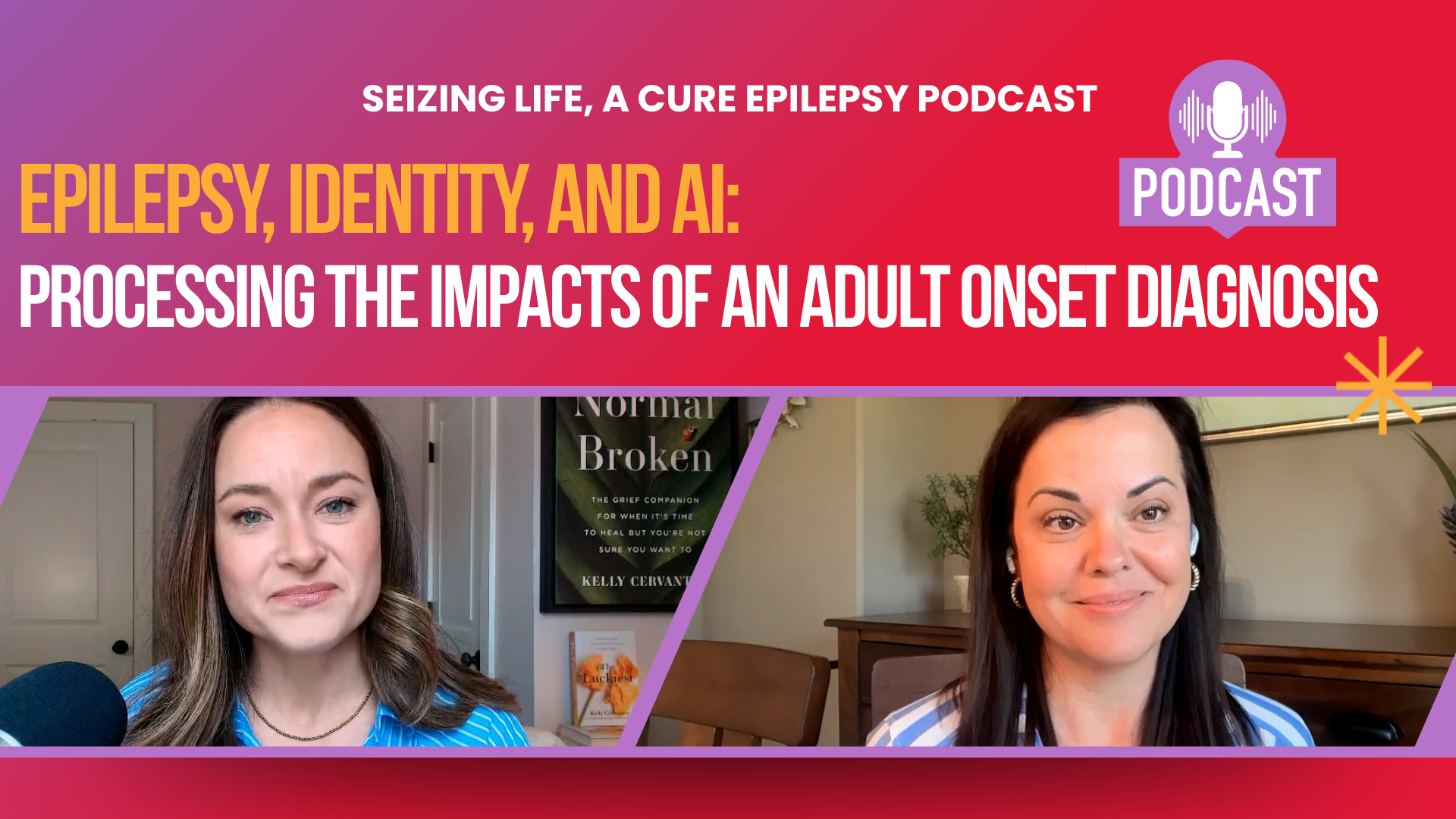
Today, I’m joined by author Kara Storti, who has lived with epilepsy since her teenage years, though she didn’t know it until her late 20s. Kara shares what it was like to hide years of unexplained episodes, the process of finding an effective treatment, and how epilepsy continues to shape her independence, work, and creative life. Last spring, Kara published The Electric Life of Lavender Lewis, a novel that draws deeply from Kara’s own experiences. I enjoyed the book so much, I had to invite Kara to come onto the podcast to talk about her epilepsy and creative journeys and how the two came together in the creation of this novel.
Kara, thank you so much for joining us today. I’m so excited to be able to talk to you. So our listeners can know a little bit more about you, can you give us a bit of your background?
Kara Storti:
Yeah, sure. So when I think about myself, I think, well, first I’m a writer for young adults. Second, I’m a boring scientific editor for a pharmaceutical company. And then I consider myself an artist and a good friend and a good wife and dog owner. But for the most part, it’s like my day job is working at a pharmaceutical company and my night job is writing. And in a way, it exercises both part of my brain, so the left side and the right side, and it’s kind of balancing me out a little bit. I live in Salem, so it’s October. It’s insane right now. The It clown is just walking down the street randomly. And now that I’ve lived in Salem for six years, I’m used to it. It doesn’t startle me anymore, and it doesn’t startle my dog anymore either, but that’s me.
Kelly Cervantes:
My daughter is Halloween-obsessed, loves everything spooky and scary. We’re going to have to come visit you in Salem. She would absolutely love it.
Kara Storti:
Yes, you’ll absolutely love it.
Kelly Cervantes:
So you also have epilepsy. Talk to us about how epilepsy first came into your life. I know it’s been a journey.
Kara Storti:
It has been a journey. When I was 13 years old, that’s when I had my first seizure. I sometimes think because it was adolescence, the hormonal shift maybe caused it, but we’ll probably never know. But I remember that I was in my kitchen talking to my mother and then this crazy sensation hit and I went into a fog and I had no idea what was going on. My mom really didn’t notice because we were just talking at the time. I think I paused and I felt like I was having an out-of-body experience and I felt like I was hallucinating. I didn’t know what was happening. When it kept on happening throughout that year when I was 13, I really thought I was going crazy or having schizophrenic episodes. And at that point, there wasn’t a WebMD to go online and look up my symptoms. I hid it for a very long time. My brother at that point was going through some problems and I though, “Okay, I’m going crazy too. It runs in our family. We’re all crazy and it’s just a matter of time before I’m locked in a padded room.” I did not know what was going on. I just knew that it was different, funky, not great. And that’s how I started. That was the entry point into my epilepsy.
Kelly Cervantes:
My heart breaks for little 13-year-old Kara who’s just trying to hide this and not sure what to do. How long did you hide it for?
Kara Storti:
A really long time because I was embarrassed about it and I did not know what was happening. I hid it for probably almost 10 years.
Kelly Cervantes:
Oh, my gosh.
Kara Storti:
Yeah. And it would come off and on. So it went throughout middle school and high school, then it stopped in college, which college is one of the most stressful times, right?
Kelly Cervantes:
Yeah.
Kara Storti:
And my triggers are stress, lack of sleep, and surprise, which college induced all of those things, but for a period of time I didn’t get seizures. And then when I moved on to my first real job, when I moved to Boston, then they started up again and they started up so frequently that I thought, “Okay, I have to do something about it.” But the way that I was diagnosed was really weird. So we can talk about that later or talk about it now.
Kelly Cervantes:
Yeah. How were you diagnosed?
Kara Storti:
Yeah. So when I would go into these seizures, I would have different manifestations. Sometimes I would hallucinate, sometimes I would talk a little funny. Sometimes I would just blank out or laugh randomly for no reason. And I thought to myself like, “This has to be more than schizophrenia or whatever.” So I was in graduate school for my MFA for writing, and I met this man there and we got kind of close. He told me about his wife who was having the same symptoms that I was having, but he’s like, “Yeah, she’s talking funny. She laughs randomly. She feels like she’s going into a fog.” And I was like, “What? You are describing my exact symptoms. What is this?” And he’s like, “Yeah, she has epilepsy.” It just blew my mind. And that was the first time someone had pegged me and I felt, “Wow.” It was crazy.
And then I went to the doctors and I said, “I’m wondering what this means.” And someone described their symptoms and it sounds like my symptoms. And my neurologist asked me, “If you could explain what’s happening, how would you describe it?” So I went on and I described it how I just described you. But then I said, “It feels like there’s an electrical current going through my brain, even just a literal zip.” And she looked at me and she’s like, “Oh, honey, I think you have epilepsy.” And I was like, “Oh, my God.” Yeah.
Kelly Cervantes:
What did that feel like to have a name for it after all of these years?
Kara Storti:
It felt like relief. A lot of people say that when they get diagnosed with different illnesses that are mysterious, I felt relieved, but I also felt really scared. See, now I’m getting emotional. I don’t know why, but I felt so scared. Yeah.
Kelly Cervantes:
Yeah. So you’re having these blanking out episodes, which are actually seizures. How did that affect you as a teen and young adult? Because people had to have noticed.
Kara Storti:
Yeah, they would notice if I would blank out or they would ask me a question and I wouldn’t answer. So I always felt this anticipatory fear of, “Oh my gosh, is this going to happen?” Or if I was in class and a teacher asked me a question, “Oh my God, am I going to blank out?” And so I remember every time a teacher would ask me a question, I’d get all flushed and red in the face because I just didn’t know what would happen. It’s so unpredictable. You just don’t know. So I don’t know if this is one of your questions, but once I was diagnosed, I did tell everyone so they knew and so that it wasn’t… I remember I had talked to a friend before I got diagnosed and I told her, “Yeah, do you ever get these blanking out episodes?” And she was like, “Oh yeah, I blank out all the time. I just kind of go into these modes that a lot of people do.” But the way that she described it, I wanted to be like, “Oh, no, no, no, that’s not it at all.” So it was just hard to describe to people because I wasn’t having tonic-clonic seizures and it didn’t seem as serious.
Kelly Cervantes:
Right.
Kara Storti:
Yeah.
Kelly Cervantes:
I think that’s the hard thing for people to understand and even for you to understand pre-diagnosis is that there are all of these different types of seizures and different way that they manifest and the auras and the feelings. I think every person I’ve ever spoken to who has epilepsy, which is a whole freaking lot of people, they give different explanations and different descriptions, which is what makes it so hard for people to understand and so hard to treat. Once you knew what was going, that you had epilepsy, what was your medication journey like?
Kara Storti:
It was bad, and I know that’s very common for people who just learn that they have epilepsy, but they first put me on a very high dose of Keppra. They titrated it, but eventually it was a high dose. And I remember my doctor, when they finally got the results back from my 48-hour EEG, he called me on a Wednesday night, which you know when a doctor calls you on a Wednesday night, it’s never good news. I was all alone. I was single at the time and he was like, “Kara, you’ve had 22 seizures within 48 hours. We need to get you on medicine right away.”
Kelly Cervantes:
Oh, my gosh.
Kara Storti:
So he wrote me up…. I know. I was like, “What are you talking about?”
Kelly Cervantes:
Oh, my God. Well, but it sort of makes sense with a lot of what science says is that a seizing brain will just continue to seize and seize more. I mean, in certain ways, it’s kind of amazing that you didn’t develop into a tonic-clonic or something more dangerous, like physically dangerous. Not that the seizures that you are having aren’t dangerous to your brain, but physically dangerous.
Kara Storti:
Yeah, totally.
Kelly Cervantes:
22. My goodness.
Kara Storti:
I know. And some of them occurred in my sleep. They would cluster in my sleep, and of course I had no idea that it was happening then. So he put me on Keppra. Then that wasn’t working because I went insane, and I call it my dark era. I try to joke about this because what am I going to do? It’s either laugh or cry.
Kelly Cervantes:
Yep.
Kara Storti:
I hated it. There was some suicidal ideation, which that’s not usual for me. I’m usually an upbeat person. So, stupidly, I weaned myself off, of course, started having more seizures. Then he kind of scolded me, which I get that. And he said, “Well, why don’t we put you on Lamictal?” And I started that. That wasn’t helping. And then he kind of gave up on me and was like, “Okay, we’re going to send you to a woman-specific neurologist who just specializes in women’s epilepsy.” She changed my life. She totally understood me. She understood how my seizures work, how it affected me as a female, and put me on Lamictal extended release, which changes… That small little adjustment, extended release. And then that wasn’t controlling them a lot, so they layered it with Vimpat.
And now that I’ve been on Lamictal and Vimpat, I don’t have as many seizures. I consider it under control. I still have seizures, but not nearly as bad. At one point, I was having 15 seizures a day, and it felt as though I was toeing the line between having a seizure and reality, and it was blurring together, and that’s never good.
Kelly Cervantes:
No, no. Oh, my goodness.
Audio: Tasia:
Hi, this is Tasia from CURE Epilepsy. Since 1998, CURE Epilepsy has raised over $100 million and funded more than 300 epilepsy research grants in 19 countries. Learn what you can do to support epilepsy research by going to cureepilepsy.org. Now back to Seizing Life.
Kelly Cervantes:
Kara, I am so happy to hear that you have gained a modicum of control over the seizures. I mean, 15 seizures a day and just waiting for the next one to happen in that in-between state. You’re right, it blurs reality.
Kara Storti:
It does.
Kelly Cervantes:
It actually makes a whole lot more sense now for the description for the character of your book, which we’ll get to in just a minute. I’m so excited to talk about it. But first, you mentioned that when you first got your diagnosis that you were not shy about telling people. Talk to us about that decision to tell people and any sort of social, professional, emotional impacts that came along with that.
Kara Storti:
Yeah, sure. I think one of the things that made me feel comfortable about telling everyone is I’m not really a private person. I’m just not. I want to share with people for their information so they know, and then if something happens and I act unresponsive, or even if I have a tonic-clonic seizure, they’re not blindsided by it. So just practical, a practical thing for them to know. My sister, when I told her about my diagnosis, she was really clinical about it and very matter of fact and less emotional. She was just like, “There’s treatment for this, you’ll be fine. If you’re not, we’ll figure it out.” And that kind of calmed my nerves and sort of, “Yes, I can tell people this is an issue. It doesn’t make me a leper. It doesn’t make me contagious, and people should know,” especially I wasn’t able to drive and I’m still not able to drive, and I never want to be that person who mooches off another person, “Can you drive me here? Can you drive me there?” And I’m not saying that’s bad, but for me, I never wanted to be a burden on people. So just to give them a heads-up, I will be taking Ubers or maybe sometimes I will ask you for a ride, but that’s an explanation for my transportation issues.
In terms of work, I had to get a doctor’s note. One of the things that I wanted to do was take the medication and then see how it affected me, and I didn’t want to be at work and out of it or loopy. So I got a doctor’s note and that went okay. But there are times even now where I feel like I can’t work straight through. I have to take breaks. I have to take naps. At one point, I felt guilty for taking naps, but since my main trigger is sleep, and my colleagues know that I have epilepsy, so they understand, but they sometimes forget. A lot of people forget because they’re not seeing it on a day-to-day basis, and it’s not happening anymore on a day-to-day basis.
Kelly Cervantes:
So I want to get to your book, The Electric Life of Lavender Lewis. I absolutely loved it. Young adult book, the main character Lavender, or Ven, has epilepsy. I mentioned earlier that her epilepsy seems to mirror yours a lot. Tell our readers, give us a short synopsis of the book without giving too much away, of course.
Kara Storti:
Yeah, sure. So it’s about a 17-year-old girl, like you said, named Lavender, or Ven for short. After her mom dies, which is an inciting incident, she begins to have seizures that are very out of the realm of logic, I guess. She before had severe seizures, but then she goes into one where she meets a mysterious boy within a seizure space. He has epilepsy, she has epilepsy, but he doesn’t know who he is, where he is, and she tries to find out his identity in the real world. So she goes, she embarks on this journey throughout New England. She goes to Salem, which I had to give a shout-out to my city, Salem, with her woo-woo aunt who is into crystals and witches and spells to try to find him. So I’ll leave it there. It’s kind of a blend of sci-fi, and romance, and magical realism.
Kelly Cervantes:
It is such a fun read. How much of the character of Ven did you base on your own personal experiences as a teenager?
Kara Storti:
Oh, my gosh, so much. So much. It almost feels a little memoir-ish, which that is fine, but I didn’t want to write a memoir. I don’t know. That’s not my thing. But when I was a teenager, as I said before, I would have these hallucinations that were unexplainable to me, and I wanted to give examples in the book showing how the invisible disease can have these intense manifestations. So for example, this one is really weird. I was in the shower and I had a seizure. Thankfully, I didn’t fall or lose consciousness or anything, but I immediately felt a man standing over me in the fricking shower. And I was like, “This is a dark presence. I’m terrified right now. Oh, my gosh.” Then I come out of my seizure and I’m holding myself like this, as if I don’t want him to see me naked, that it actually felt like it was happening. And I come out thinking, “What am I doing?” And then I go back and I thought, “Oh, okay, that happened in my brain. Funny.” Jerky movements like this, strange things. One time I woke up, and I was with a partner at the time, I woke up and I had a seizure. I jerked up like this, and he said, “Did you just have a seizure?” And I lied and I said, “No, no, I didn’t. No.” And then finally afterwards, I said, “I don’t know why I was denying it in my seizure state, but I can’t control the things that are happening when I have a seizure.” I tried to take all of those or most of them that had really impacted me and put them in the book to show, “Wow, people have tonic-clonics, people have focal seizures, all of these different experiences can happen,” and I want people to know about it, even if they’re embarrassing.
Kelly Cervantes:
Well, and I think you do a really wonderful job of sharing the reality of what it feels like to have a seizure, but also to educate the reader on epilepsy without making them feel like they’re reading a textbook. I cannot imagine that that is an easy thing to do. How did you navigate that by being informative, but still keeping this as very much this fictional narrative story?
Kara Storti:
Yeah, I think, and I was thinking about this the other day, and I’m going to use a Venn diagram, which, Ven, whatever. So the circles and then where they meet, so one circle is the medical reality that took a lot of research. I didn’t want to just talk about my experience as I wanted a legit, sincere, authoritative… I mean, I’m not an expert, but I wanted to show that I have some authority over the experience and the illness. So I did research on tonic-clonics and all the billion different types of seizures people can have. As I said before, I work for a pharmaceutical company and I’ve seen actual study protocols on drugs they’re testing for epilepsy, and I see the process of how the drug is developed and how the study is designed for that particular drug. And I felt, “Ooh, that’s kind of a cool individual thing that I have access to and that I can learn from.” So those are some examples of where I put the cold, hard facts, medical reality into the book, but you can’t just write a fiction novel with that or it gets preachy.
Then on the other circle is the emotional reality of it, which definitely important. And she went up and down with her emotions, the fear, the depression that can happen, the side effects of drugs that can happen. There was a period of time where I thought I was losing my hair because of the drug, and it became this obsessive-compulsive issue for me that lasted for years, but I got hair extension, so it’s not a problem. It’s not a problem now. So that’s the emotional component. And then where they meet, I was like, “What can happen where they meet?” And that’s where the magical realism comes in. That gives you a full picture of the experience of how I dealt with epilepsy, how it can be fictionalized in a responsible, almost ethical way while bringing in entertainment. I never want to romanticize the disease or play it up as this fun, magical thing, but there’s a slice of magic or a slice of supernatural that can be explored and has been explored in years past.
Kelly Cervantes:
Yeah, you walk a fine line there.
Kara Storti:
Yes.
Kelly Cervantes:
And I have to admit that I was a little bit nervous when I first picked it up. I was like, “I mean, through centuries, people with epilepsy have been looked at as magical or mystical, and that has propagated a lot of stigma.” And so I was a little nervous about how you were going to walk that line, and I do believe that you did, you balance it out, and it sounds like something that you were conscious and aware of as well as you were writing it.
Kara Storti:
Oh, totally. I had to be, and I had to put that information within the book to confront it and to expose it and to show the contrast of why those things are not true. Like I said before, it’s not contagious. We’re not lepers. We’re not insane. Whereas a hundred years ago, people were considered insane and were locked up. I did some research and I was looking in the 1960s, there were some states that did not allow marriage between people who had epilepsy or if one of them had epilepsy, to the 1960s. I could not believe that. And then there were some instances where they couldn’t procreate because they didn’t want to pass down whatever gene that had epilepsy. And it’s just so sad that it’s taken so long to get rid of the stigma. And even now, the stigma, it has not disappeared. It’s still there. I talk to people and they say, “Okay, so what do you do with someone with epilepsy? I know you have to put something in their mouth to bite down on so they don’t swallow their tongue.” And it’s like, “No, dude. No, we don’t do that anymore.” Yeah, so it is still there, and this is not a rare disease.
Kelly Cervantes:
No.
Kara Storti:
So yeah, it’s not. Millions and millions of people have this, so it’s important to educate people as well. So I hope that I was able to educate some people a little bit on the reality of the disease.
Kelly Cervantes:
While also entertaining them.
Kara Storti:
Exactly.
Kelly Cervantes:
Speaking about being an artist who is living with epilepsy and you’re writing about this and the importance of breaking these stigmas or this misinformation, tell us about how you feel the importance of epilepsy being represented in mainstream media.
Kara Storti:
I think it’s very important. The one thing that I was really surprised about is I was trying to find fiction books, specifically YA fiction books that are about epilepsy. It was really hard to find, and I read some of them. There were a couple that I could find, and it did feel very preachy and just solely the medical side of epilepsy, and it felt really repetitive like, “Okay, she had a seizure. Okay, this is what she did about the seizure. Okay, she had another seizure. Oh, too bad that she has that.” I don’t want that, and not to knock these authors, but I don’t even know if they had epilepsy, and that was the thing. And I thought that it was important for me to write about an experience that I have, because it would come through the writing if I didn’t have it. And because we were talking about millions and millions of people having epilepsy, and then you have the other side of people don’t, they still need to be educated about it equally.
Kelly Cervantes:
Yeah, absolutely. I’m curious about as you are figuring out the story that you want to tell. As a writer myself, what does your creative process look like? I’ve spoken to so many young people who want to be writers, who have an idea for a book, many of whom have epilepsy. What does your writing process look like to help guide the next young writer?
Kara Storti:
Sure. I’ve always been told to write where the heat is. I’ve always been told that’s where you should start because why would you start off with something boring to get to the next thing that you’re excited about? Just go in, dive into the moment that you’re like, “Yes, this is what I want to communicate.” The things that I really wanted to put on the page was things that I had experienced, specific moments that had really imprinted on my mind. So for example, when I got set up for a 48-hour EEG, you know how they put the metal electrodes and they’re digging into your scalp and you’re getting scabs because of it, I wanted to write about it because who thinks about that? No one knows that unless they have epilepsy themselves. And I was like, “Oh, man, I really want to write about this. I want to write about the nurse who I thought was really mean and stern. She didn’t care.” That was interesting for me. And then the different hallucinations. So I just vomited on the page. Then I try to write towards what I think is the climax of the book. So I have that in the back of my mind that I am working towards that, then I just start. I don’t have an outline. And that’s how I did my last book too. I knew where it was going. I don’t necessarily know the end, but I know where it’s going. So that is one of the general things that I do, right where the heat is.
Kelly Cervantes:
Yes. Which is great, great advice.
Kara Storti:
Is that what you do too? Yeah?
Kelly Cervantes:
Yes. 100%. Yeah. No, especially with my first book, I bounced around. It was absolutely not written in order. It was whatever I was feeling in that moment or could relate to. Absolutely. I wonder what you hope, separately, what people living with epilepsy might take away from the book as well as people who are less familiar with epilepsy.
Kara Storti:
Sure. I would like people who have epilepsy, especially teenagers, to know that there’s hope. I did not want to write this tragedy, in the end it’s depressing and there’s no way out of this, even though it is a lifelong disease. However, I tried to end it on a bright note. The disease can be managed even if you have to have surgery, even if you have to go through different meds. It is a matter of being persistent, having an advocate, which is really unfortunate because sometimes your doctor is not going to be your best advocate. Some people don’t have a community, a parent, a partner who can advocate for them, and that’s important. Sometimes you can find it in a neighbor, in a teacher. So if they could find someone to support them, that’s important to give them hope.
And also, I thought medical literacy, health literacy is really important for people who have epilepsy. Read about your condition, know it, know what other people experience. And then that way you won’t feel as alone, but you’ll also go into your appointments educated and informed. And I don’t know, and I don’t blame teenagers for not knowing, but if they could get a leg up on their experience, do some reading, know what questions to ask, that’s like owning your disease and there’s something very empowering about that. That answers your first question.
And then in terms of people who don’t have epilepsy, I’ve gotten a lot of feedback of people saying, “Oh, my gosh, I did not know about these partial complex seizures. I didn’t know focal seizures. I just imagined them on what happens on TV where you fall to the ground and you convulse.” That’s one thing that I think is important to know as a person who doesn’t have epilepsy, how to deal with someone who is having a tonic-clonic seizure, because who knows? It could happen when you’re in the classroom with a neighbor. That actually happened to me with a neighbor where she was convulsing. And the first thing you do is get everything out of the way to make sure they don’t hurt themselves. You don’t try to give them water. You don’t put anything in their mouths. You turn them on their side so they’re not choking on any of their saliva. I tried to put that or some knowledge of that in my book. I think those are all things that are important to know. And as a side note, I’ve been doing TikToks about epilepsy.
Kelly Cervantes:
Oh, my gosh, I love it.
Kara Storti:
Yeah. And one of them that got the most traction, not that I got a ton of views or whatever, but that got some traction is I mimicked what it’s like to have a seizure that I have. And so it could be just me talking and then I blank out. And I showed that on the video. There were comments that I got from people that said, “Oh, I didn’t know that that could happen, that that could possibly be epilepsy. I’m going to go talk to my doctor.” My job is done. I’ve done-
Kelly Cervantes:
Wow.
Kara Storti:
Yes, I’ve helped society in some… And that’s the whole point of writing the book. Let me contribute to society in some way. Then that video did it.
Kelly Cervantes:
Oh, my gosh. Kara, you’re amazing. Thank you so much. The Electric Life of Lavender Lewis. Will we see? Will there be more of lavender in the future? Do you have more stories for her or is she sort of one?
Kara Storti:
Maybe.
Kelly Cervantes:
Maybe. Yeah.
Kara Storti:
Maybe. If people are interested, there’s always more to talk about, more experiences. So who knows? Stay tuned.
Kelly Cervantes:
Yes. Amazing. Thank you again. Thank you for writing this book, especially for young adults. It’s a space that they’re craving to look out and see someone who looks like them. And I think you do such a beautiful job of representing that part of our epilepsy population. So thank you so, so much.
Kara Storti:
Thank you, Kelly.
Kelly Cervantes:
Thank you, Kara, for sharing your experience and using your writing to tell an interesting and entertaining story that raises epilepsy awareness. Your journey is a powerful reminder that even when seizures are less visible, their impact can shape nearly every part of a person’s life. Kara is just one example of the 30% of people living with epilepsy who aren’t able to control their seizures with available medications. That’s why CURE Epilepsy was founded nearly 30 years ago. Our mission is to fund cutting-edge research in pursuit of more effective treatments with fewer side effects. If you would like to help us in pursuit of our mission, please visit cureepilepsy.org/donate. Thank you.
Legal Disclaimer:
The opinions expressed in this podcast do not necessarily reflect the views of CURE Epilepsy. The information contained herein is provided for general information only and does not offer medical advice or recommendations. Individuals should not rely on this information as a substitute for consultations with qualified healthcare professionals who are familiar with individual medical conditions and needs. CURE Epilepsy strongly recommends that care and treatment decisions related to epilepsy and any other medical conditions be made in consultation with a patient’s physician or other qualified healthcare professionals who are familiar with the individual’s specific health situation.