CURE Epilepsy Award
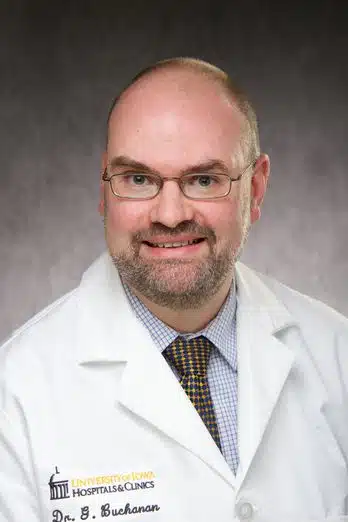
Gordon Buchanan, MD, PhD / University of Iowa Medicine
Dr. Buchanan’s group will examine whether a signaling molecule called serotonin drives this time-of-day vulnerability to SUDEP.
Taking Flight Award
William Tobin, PhD / The University of Vermont and State Agriculture
Dr. Tobin will test strategies to optimize cutting-edge gene and drug therapies by selectively targeting the most severely affected cells and brain networks in a mouse model of KCNT1-related epilepsy.
Catalyst Award
James Pauly, PhD / University of Kentucky
Having obtained promising initial results in mouse models, this project will now test the safety and brain distribution of this novel therapy in a canine model.
Catalyst Award
John Gledhill, PhD / Cognizance Biomarkers, LLC
The team will build upon their preliminary research showing that people with treatment-resistant epilepsy have differences in inflammation-associated proteins in the blood compared with those who do respond to treatment.
CURE Epilepsy Award
David Auerbach, PhD / SUNY Upstate Medical University
Dr. Auerbach’s team will use analytical tools that are well accepted in the cardiac field, but new to the field of epilepsy and SUDEP, to identify epilepsy patient populations at risk of cardiac arrhythmias.
Taking Flight Award
Rina Zelmann, PhD / Massachusetts General Hospital
Dr. Zelmann proposes to generate HFOs by repeated mild stimulation of the brain through the scalp, which may enhance the ability to detect HFOs.
Catalyst Award
Rodrigo Gutierrez-Quintana, MVZ, MVM, DipECVN, MRCVS / University of Glasgow
Dr. Gutierrez-Quintana’s team will now test the effects of Ant-134 in a population of dogs with naturally occurring drug-resistant epilepsy, an important step towards translating their findings into treatments for humans.
Taking Flight Award
Joanna Mattis, MD, PhD / University of Pennsylvania
Dr. Joanna Mattis will study neuromodulatory neurons which are “master regulators” that control many functions in the brain.
CURE Epilepsy Award
Nigel Pedersen, MD / Emory University
Dr. Pedersen’s team is studying whether brain regions that control sleep-wake also control seizures. For this project, the team will directly study electrical activity in parts of the brain that control sleep and wakefulness, and brain regions involved in seizures.